
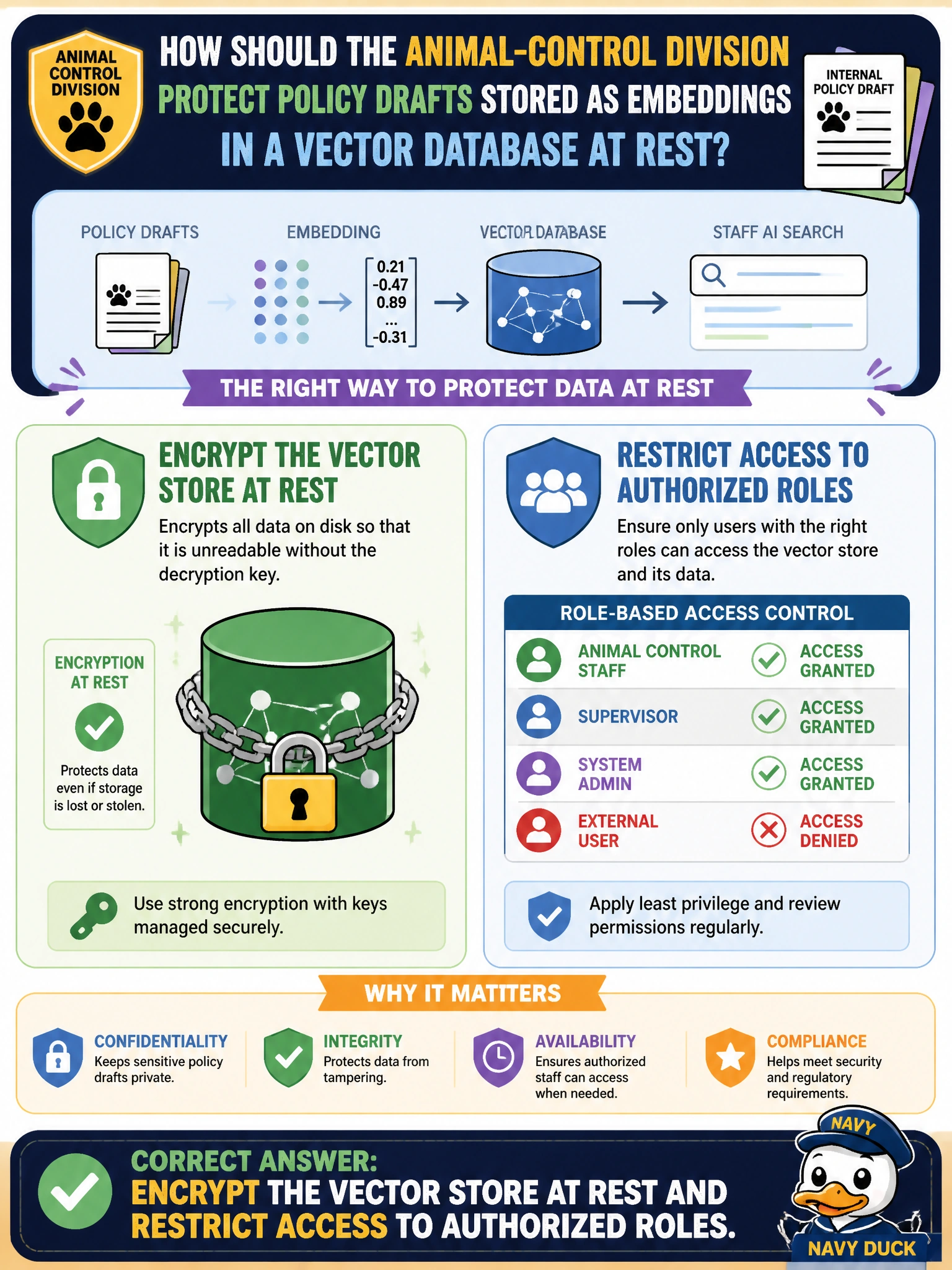
An animal-control division stores internal policy drafts as embeddings in a vector database used by staff AI search. How should it protect that data at rest?
Select an answer to reveal the explanation.
Short Explanation
Embeddings of internal policies aren’t scrap paper—they’re still agency data. Encrypt the vector store and lock who can open it, same hygiene you’d give any sensitive file cabinet.
Full Explanation
Embeddings of internal animal-control policy drafts in a vector database remain agency data—often confidential drafts not ready for public release or discovery without process. Protecting that AI-related store at rest means encrypting the vector database and restricting access to authorized roles, applying the same hygiene used for other sensitive repositories. Semantic search convenience does not make the contents non-sensitive or publicly releasable.
Leaving the vector store unencrypted on a shared public share exposes drafts to anyone with share access or a compromised peer. Publishing raw vector files to an open-data portal can leak internal policy content via reconstruction risks and ignores classification. Disabling access controls so any volunteer laptop can mount the store destroys least privilege and auditability.
Exam caveat: encryption at rest without key management, authentication, authorization, and audit logging is incomplete; authorized query access can still exfiltrate chunk text. Treat embeddings and source chunks as the same classification family unless proven otherwise.
Operational check: verify encryption is enabled with agency-controlled keys, enforce role-based access, run a denied-user test that cannot read embeddings, and confirm logging captures administrative access to the vector store used by staff AI search.