
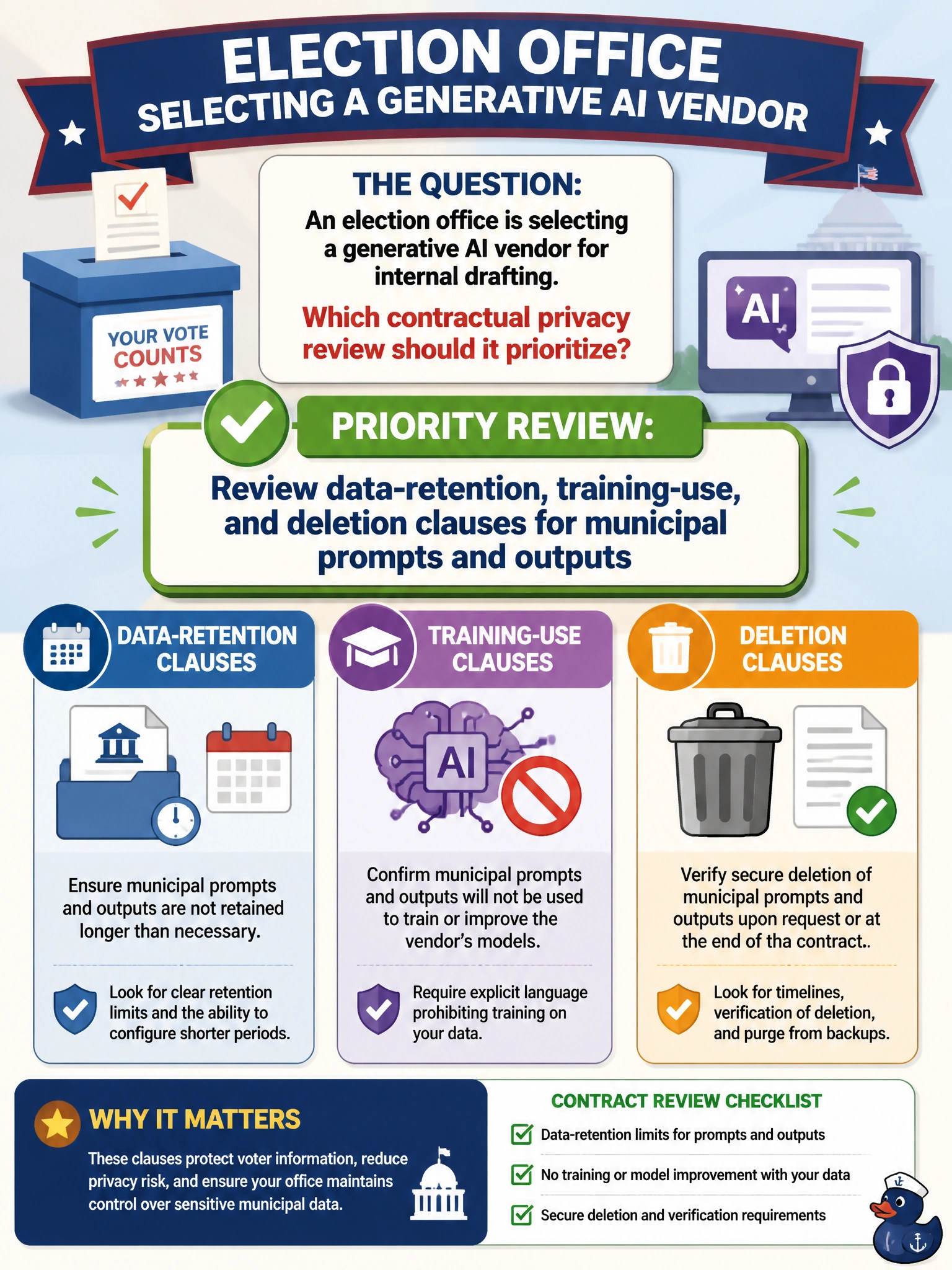
An election office is selecting a generative AI vendor for internal drafting. Which contractual privacy review should it prioritize?
Select an answer to reveal the explanation.
Short Explanation
The contract is where privacy either grows teeth or disappears. Check how long prompts stick around, whether they train the vendor’s models, and how deletion works—election offices can’t shrug that off.
Full Explanation
Selecting a generative AI vendor for an election office’s internal drafting requires contractual privacy review of data-retention, training-use, and deletion clauses for municipal prompts and outputs. Election-related operational text can be sensitive or politically consequential; contracts must state how long data is kept, whether it may train vendor models, who can access logs, cross-border transfers, and how deletion or export works on request or contract end. Procurement is where privacy becomes enforceable rather than aspirational.
Skipping retention clauses because election data is "never sensitive" is false and reckless. Accepting perpetual vendor reuse of all municipal prompts for advertising is unauthorized secondary use of government text. Allowing the vendor to sell prompt logs to third-party brokers unchecked monetizes agency data and expands breach, targeting, and integrity risk.
Exam caveat: strong clauses still need operational verification—DPAs, subprocessor lists, encryption commitments, and real deletion workflows tested before ballots or sensitive schedules are near the tool.
Operational check: redline the vendor agreement against city privacy standards, require written non-training or documented opt-out, map data flows, and run a deletion test on sample prompts before production use in the election office.