
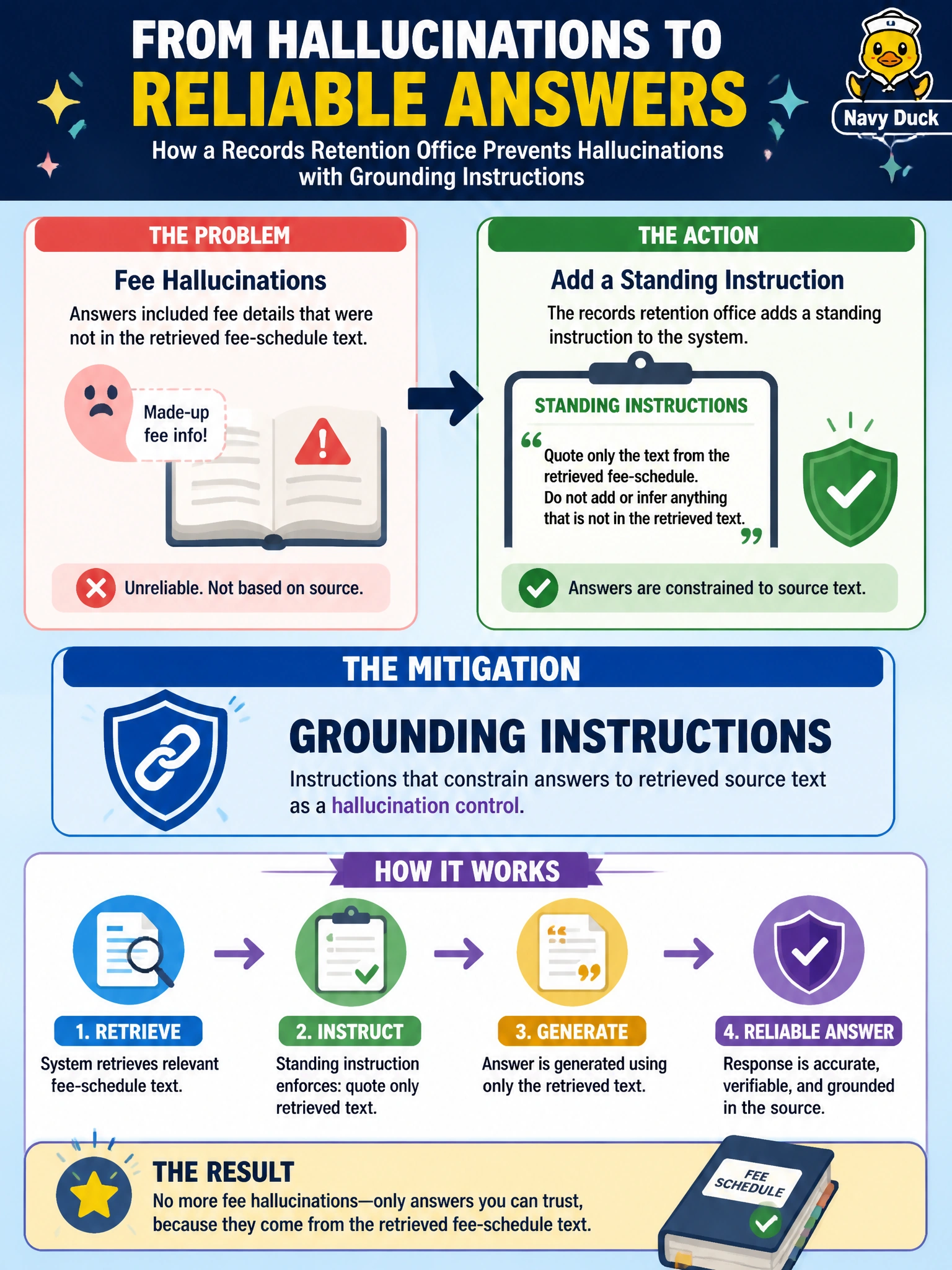
After fee hallucinations, a records retention office adds a standing instruction to quote only retrieved fee-schedule text. What mitigation is this?
Select an answer to reveal the explanation.
Short Explanation
If the fee is not on the page you retrieved, do not make one up—quote the schedule or stop. That grounding instruction is a classic hallucination brake. Turning up creativity or deleting the schedule makes things worse.
Full Explanation
Grounding instructions constrain the model to quote or limit answers to retrieved source text, which is a primary prompt-level control against factual invention. After fee hallucinations, a records retention office that requires quoting only retrieved fee-schedule text is applying that mitigation: dollar amounts and fee codes must come from the schedule in context, not from model memory. Grounding complements RAG by telling the generator how to use retrieved evidence.
Unsupervised pretraining on every city email fails by concept: broad pretraining is not a targeted hallucination brake for fee answers and raises privacy issues. Raising temperature to encourage more varied dollar amounts increases randomness and worsens fee invention. Deleting the fee schedule so the model must guess removes the authoritative source and forces hallucination.
Exam caveat: Grounding directives fail open if retrieval returns the wrong schedule version—so document freshness, collection routing, and citation display still matter. Models may still paraphrase incorrectly; requiring verbatim quotes or structured fields for fees is stronger than vague “use the context” wording. On the exam, map “answer only from retrieved text” to grounding as hallucination control.
Operational check: Ask for a fee known to be in the retrieved schedule and one known to be absent; accept only sourced quotes for the first and abstention for the second; reject any numeric fee that cannot be traced to the retrieved snippet.