
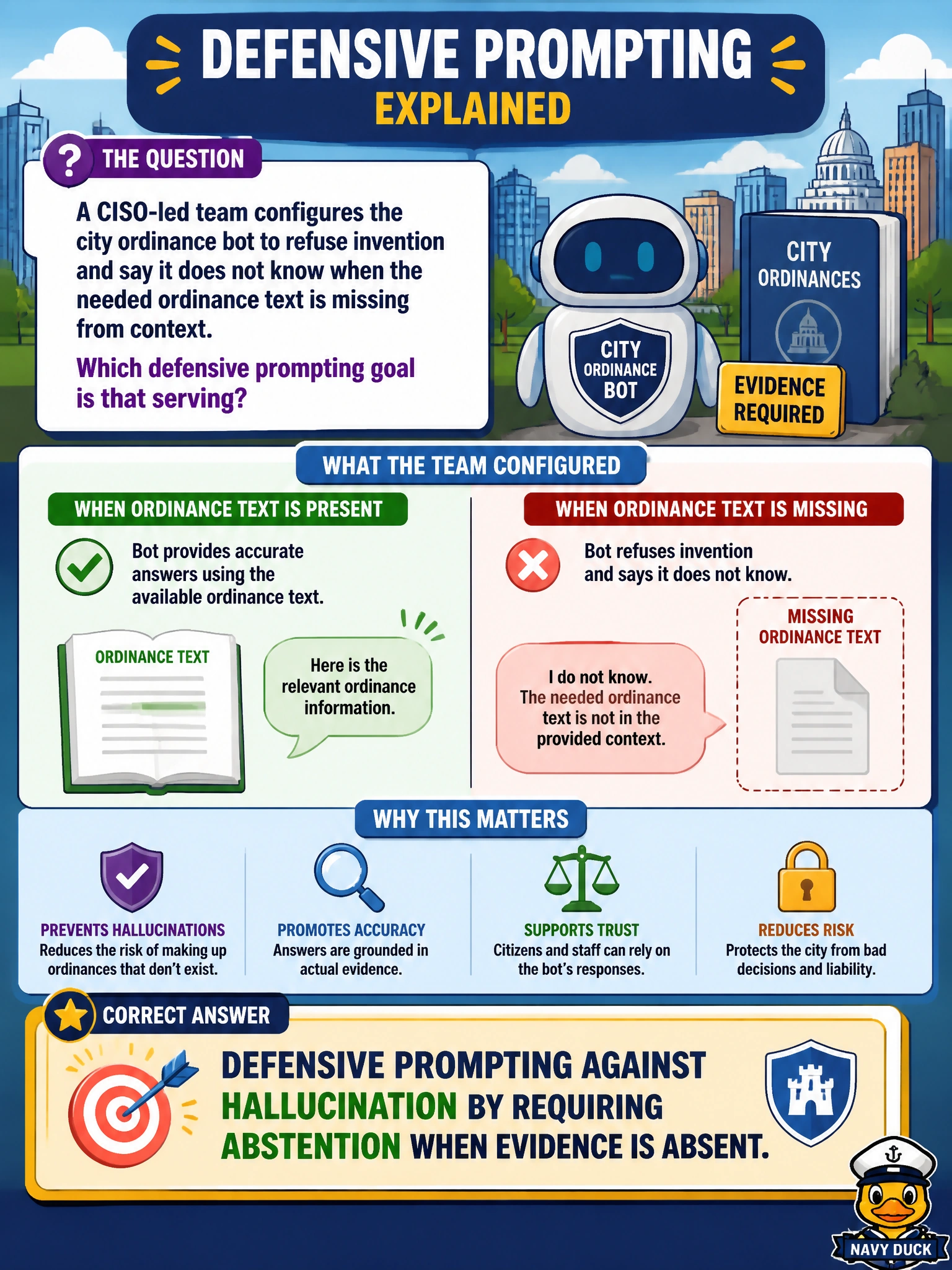
A CISO-led team configures the city ordinance bot to refuse invention and say it does not know when the needed ordinance text is missing from context. Which defensive prompting goal is that serving?
Select an answer to reveal the explanation.
Short Explanation
No ordinance in the backpack? Then say “I don’t know”—do not freestyle municipal law. That abstention rule is defensive prompting against hallucinations. Inventing fee fiction for clicks is the failure mode you are blocking.
Full Explanation
Defensive prompting against hallucination includes explicit abstention rules: when required ordinance text is missing from context, the bot must say it does not know rather than invent law. Configuring a city ordinance assistant this way serves that goal—refusing fiction about municipal codes protects residents and staff who might otherwise act on fabricated section numbers or penalties. Abstention is a prompt-level safety pattern for high-stakes civic facts.
Maximizing creative fiction about fee schedules for engagement metrics fails by concept: engagement is not a lawful substitute for accuracy in ordinance answers. Forcing the model to always invent a plausible ordinance number institutionalizes hallucination. Disabling all logging so wrong answers cannot be reviewed destroys accountability and blocks detection of invented citations.
Exam caveat: Abstention instructions reduce invention but can over-refuse if retrieval is brittle; pair them with better RAG coverage and clear escalation paths to human clerks. “I don’t know” answers should still be logged for knowledge-gap remediation. Distinguish defensive abstention from grounding-to-retrieved-text and from human review gates—related controls that appear in neighboring items.
Operational check: Query the ordinance bot for a deliberately missing section ID, confirm it abstains without inventing text, then query a known retrieved section and confirm it answers with the cited source; tune prompts until both behaviors hold.