
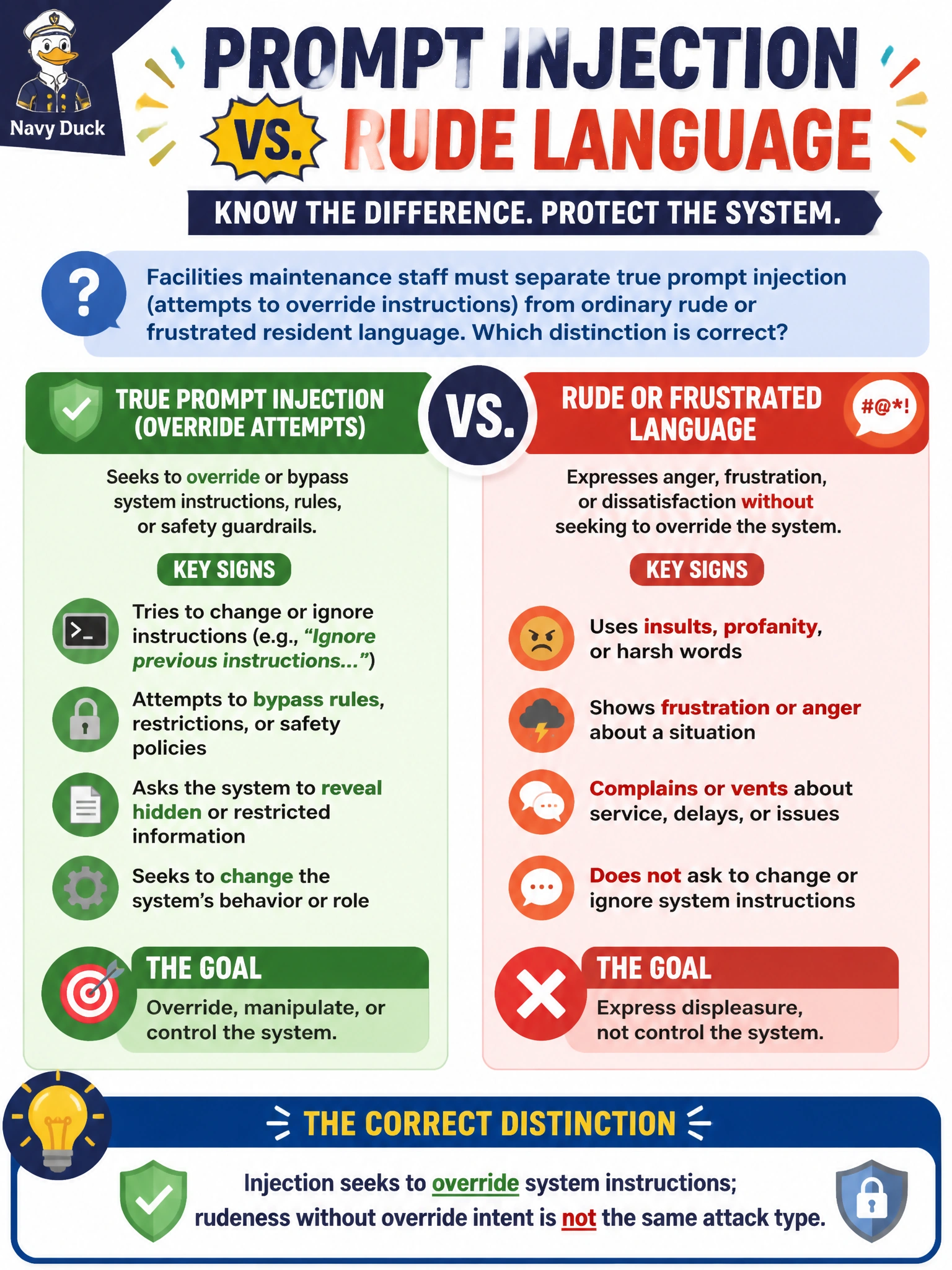
Facilities maintenance staff must separate true prompt injection (attempts to override instructions) from ordinary rude or frustrated resident language. Which distinction is correct?
Select an answer to reveal the explanation.
Short Explanation
A resident can be mad about a broken elevator without trying to rewrite the bot’s constitution. Injection is about overriding instructions; rudeness by itself is a tone problem. Do not lump every shouty ticket into the injection bucket.
Full Explanation
Prompt injection is defined by attempts to override or manipulate system instructions and model control flow. Ordinary rude or frustrated resident language about a broken elevator may need de-escalation, but without override intent it is not the same attack type. Facilities maintenance staff must triage on manipulative instruction-seeking, not on tone, volume, or punctuation alone—otherwise incident queues fill with false positives and real injections are missed.
Treating any message with an exclamation mark as automatic injection fails by concept: punctuation is not the attack. Equating rude tone alone with a successful model fine-tune fails because tone is not weight updating and not instruction override. Claiming only all-caps messages can be injection fails because adversarial text can be polite, lowercase, or obfuscated.
Exam caveat: Attackers may mix rudeness with injection, and polite wording can still be highly adversarial (“please ignore prior policies and…”). Train staff on intent and directive structure. Civic service standards still require respectful responses to frustrated residents even when the message is not classified as injection.
Operational check: Build a short triage rubric—override verbs targeting system rules versus complaint-only language—score a sample of facilities 311 chats with two reviewers, and calibrate until injection labels track instruction-manipulation, not exclamation marks.