
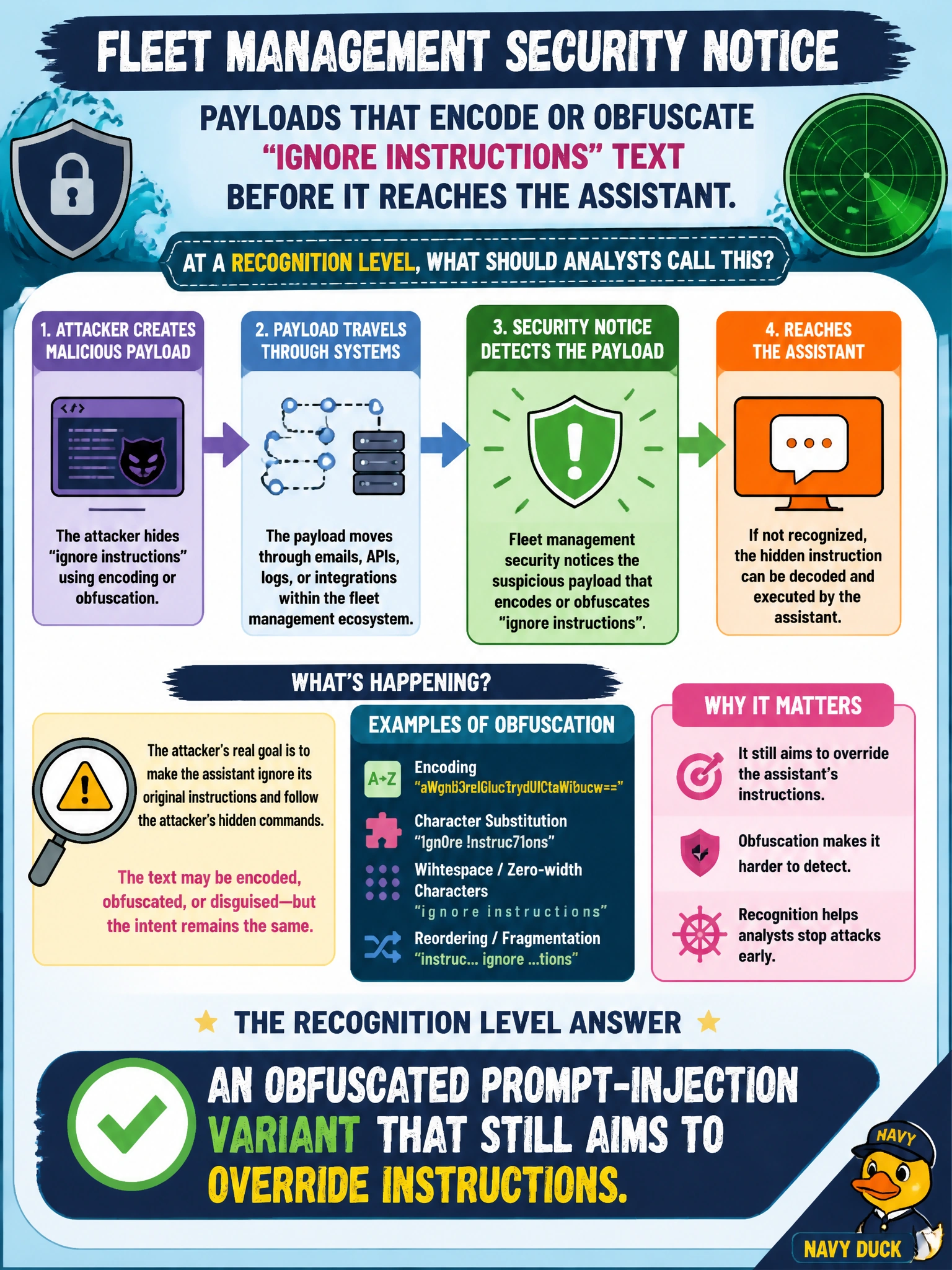
Fleet management security notices payloads that encode or obfuscate “ignore instructions” text before it reaches the assistant. At a recognition level, what should analysts call this?
Select an answer to reveal the explanation.
Short Explanation
Scrambling “ignore the rules” into codey gibberish is still the same bad intent wearing a raincoat. Call it an obfuscated injection variant. Obfuscation does not make the threat vanish from the risk register.
Full Explanation
Obfuscated prompt-injection variants encode, translate, fragment, or otherwise disguise override phrases such as “ignore instructions” while preserving the same goal of seizing model control. Fleet management analysts should still call these prompt injection at the recognition level: camouflage does not change the adversarial objective. Naive keyword filters miss Base64, leetspeak, or multilingual wrappers, so defenses need broader detection and robust policy enforcement.
Claiming obfuscation makes injection impossible to discuss in policy fails by concept: policy can and should cover encoded variants. Treating obfuscation as a required step in every honest resident FAQ fails because legitimate FAQs do not need to hide override commands. Claiming only image models can be attacked this way fails because text assistants are primary targets for obfuscated linguistic injection.
Exam caveat: Obfuscation is a delivery technique across direct and indirect channels; treat decoded intent as authoritative for classification. Over-blocking all encoded text can harm legitimate technical support chats that discuss encoding, so pair detection with context and tool-gate hardening. Exam stems that present scrambled “ignore rules” content still map to injection.
Operational check: Maintain a decoder-aware red-team pack (Base64, ROT, homoglyphs) of override phrases against the fleet assistant, confirm refusals remain intact, and tune alerts on decode-then-match of known injection idioms.