
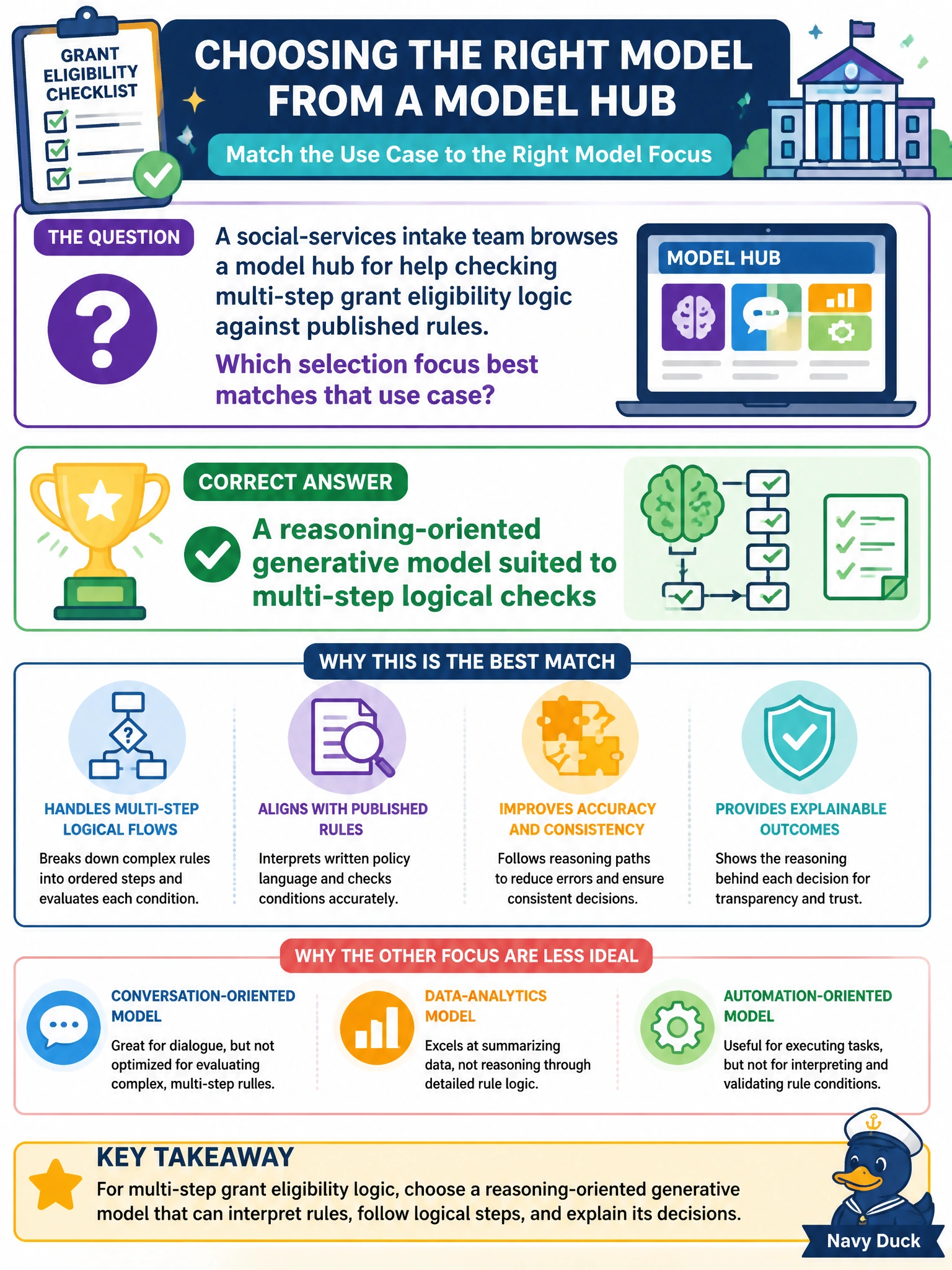
A social-services intake team browses a model hub for help checking multi-step grant eligibility logic against published rules. Which selection focus best matches that use case?
Select an answer to reveal the explanation.
Short Explanation
Grant eligibility is a puzzle with several locks. You want a reasoning-friendly model that can work the steps—not a poster painter or a voicebox that only reads the rules out loud.
Full Explanation
Social-services intake checking multi-step grant eligibility against published rules is a reasoning workload: chained conditions, exceptions, and comparisons across rule text. Hub selection should therefore favor a reasoning-oriented generative model suited to multi-step logical checks, evaluated on representative eligibility scenarios. Matching model class to that cognitive demand is more important than grabbing an unrelated modality card.
A diffusion model optimized for poster color palettes generates images; it does not perform eligibility logic against grant rules. The smallest embedding-only model encodes text for retrieval or similarity but lacks a generative reasoning loop to apply multi-step conditions and explain outcomes. A speech-synthesis card that only reads rules aloud provides accessibility audio, not eligibility determination.
Exam caveat: even a strong reasoning model should be grounded on the published rule text (retrieval or controlled paste) rather than relying solely on memorized training cutoffs that may be outdated. Operational check: build a short suite of grant-eligibility fixtures with known outcomes, score candidate reasoning models on accuracy and explanation quality, and reject cards that cannot follow the rule chain.