
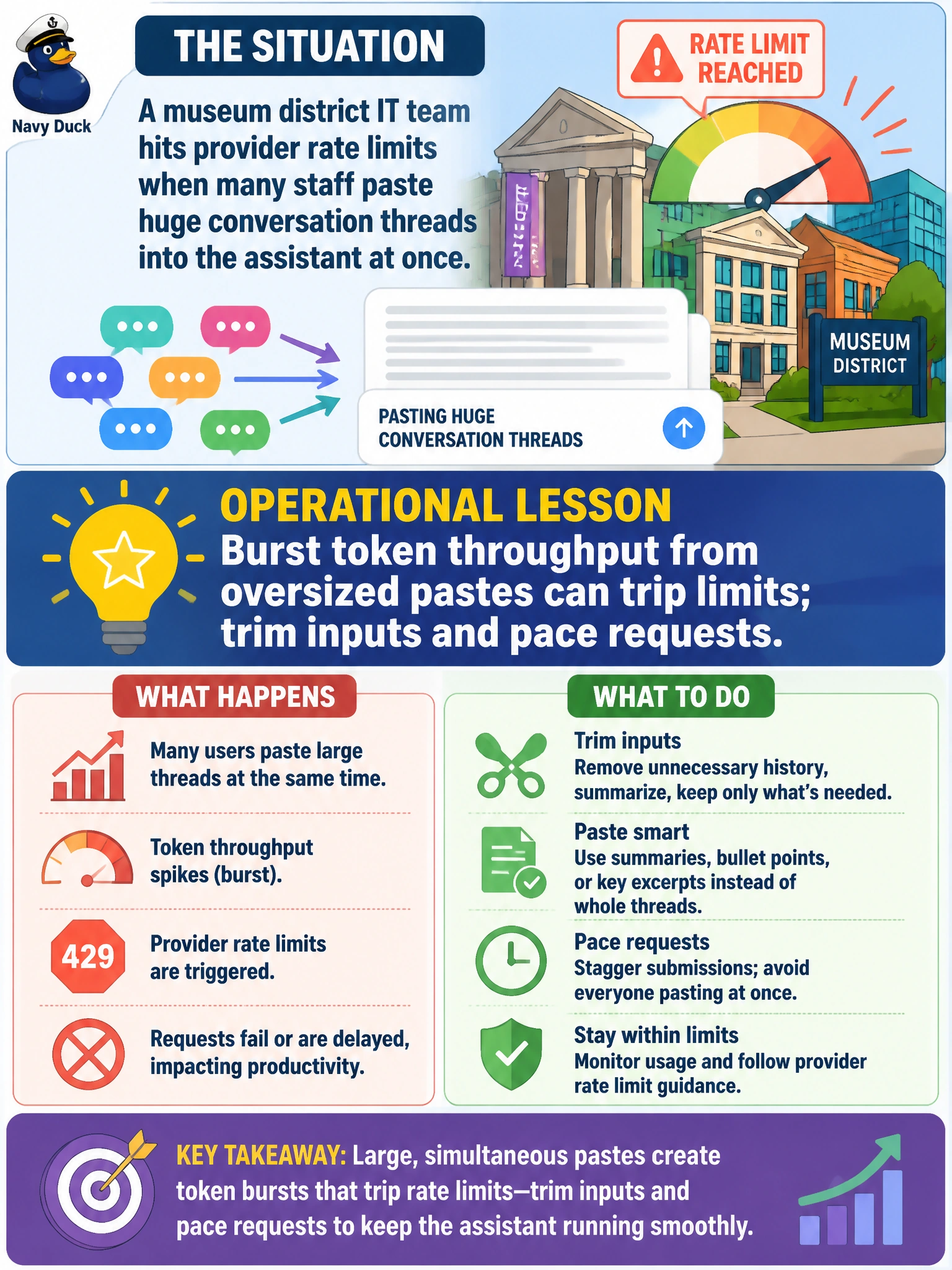
A museum district IT team hits provider rate limits when many staff paste huge conversation threads into the assistant at once. What operational lesson should they take?
Select an answer to reveal the explanation.
Short Explanation
It's like everyone in the gallery shoving through one turnstile at once—the gate locks. Smaller pastes and steadier request pacing keep the district under the throughput cap.
Full Explanation
Museum-district staff who paste huge conversation threads into an assistant in concurrent bursts send large token volumes that can exhaust provider rate and token-throughput limits. The operational lesson is that oversized pastes plus concurrent load trip caps; teams should trim inputs, summarize history before send, and pace or queue requests. Valid individual questions still fail at scale when aggregate throughput exceeds the plan.
Rate limits do not apply only to diffusion models, so switching the whole district to text does not create an exemption—text generative APIs enforce throughput controls too. Museum networks are not exempt from token throughput caps on public hubs; institutional identity does not waive provider quotas. Disabling logging so rate limits cannot "detect" large pastes misunderstands metering: limits are enforced on request volume and tokens, not by reading audit logs, and disabling logging harms security accountability.
Exam caveat: client-side trimming helps, but shared API keys across museum apps can still collide on the same quota—coordinate budgets across teams. Operational check: chart 429/rate-limit errors against paste sizes and concurrency, introduce a summarization step for long threads, and set per-user request pacing so district-wide bursts stay under the provider ceiling.