
Users complain about logging in separately to a dozen SaaS applications, while security also wants identity threats such as dormant privileged accounts surfaced across identity providers. Which Cisco Duo combination addresses both needs?
Select an answer to reveal the explanation.
Short Explanation
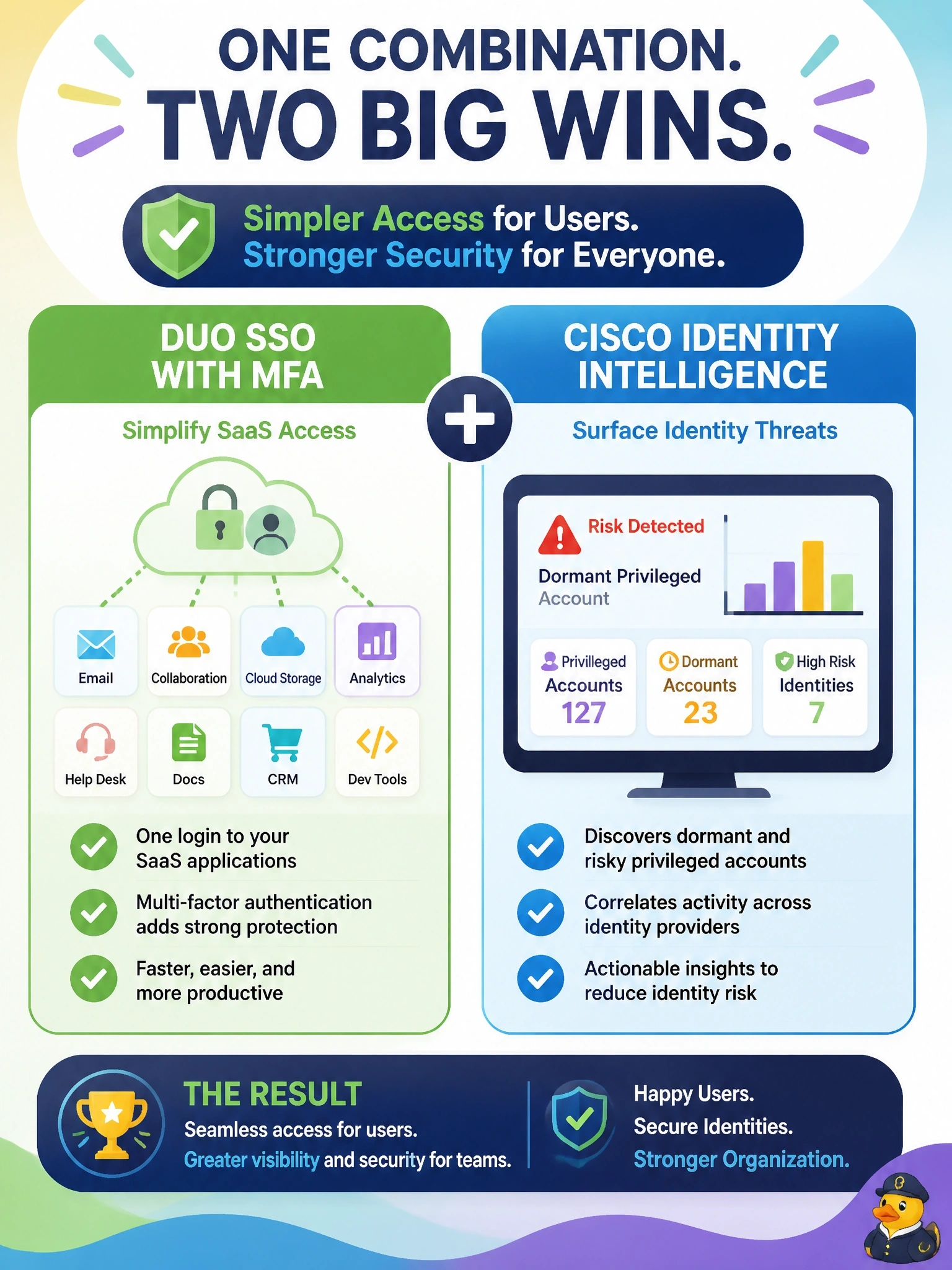
One door with a good lock beats twelve doors with sticky handles. Duo SSO gives users that single, MFA-protected door, and Cisco Identity Intelligence looks across your identity sources for the risky stuff like dormant admin accounts. Remembered devices only make the twelve doors open a bit faster.
Full Explanation
Duo SSO acts as an identity provider, using standards such as SAML, so users authenticate once with Duo MFA and gain access to many SaaS applications without separate logins. This reduces password fatigue and puts consistent MFA and policy in front of every federated application. Cisco Identity Intelligence aggregates identity data from sources such as directories and identity providers to give visibility into identity posture and threats, including dormant or overprivileged accounts, risky behavior and misconfigurations, and contributes to risk-based decisions. Together they meet both the usability and the identity threat visibility goals. Self-service and remembered devices reduce prompts but leave users with separate logins for each application and provide no identity threat analysis. Trust Monitor surfaces anomalous authentications within Duo and Device Health checks endpoint posture; neither provides single sign-on, and neither inventories dormant privileged accounts across identity providers. Bypass codes weaken authentication and Adaptive Access enforces context policy at login; it does not provide cross-source identity posture analytics. Exam caveat: SSO centralizes risk, so the SSO identity provider itself must be protected with strong MFA. Operational check: sign in once through Duo SSO and confirm access to multiple SaaS applications without additional prompts.