
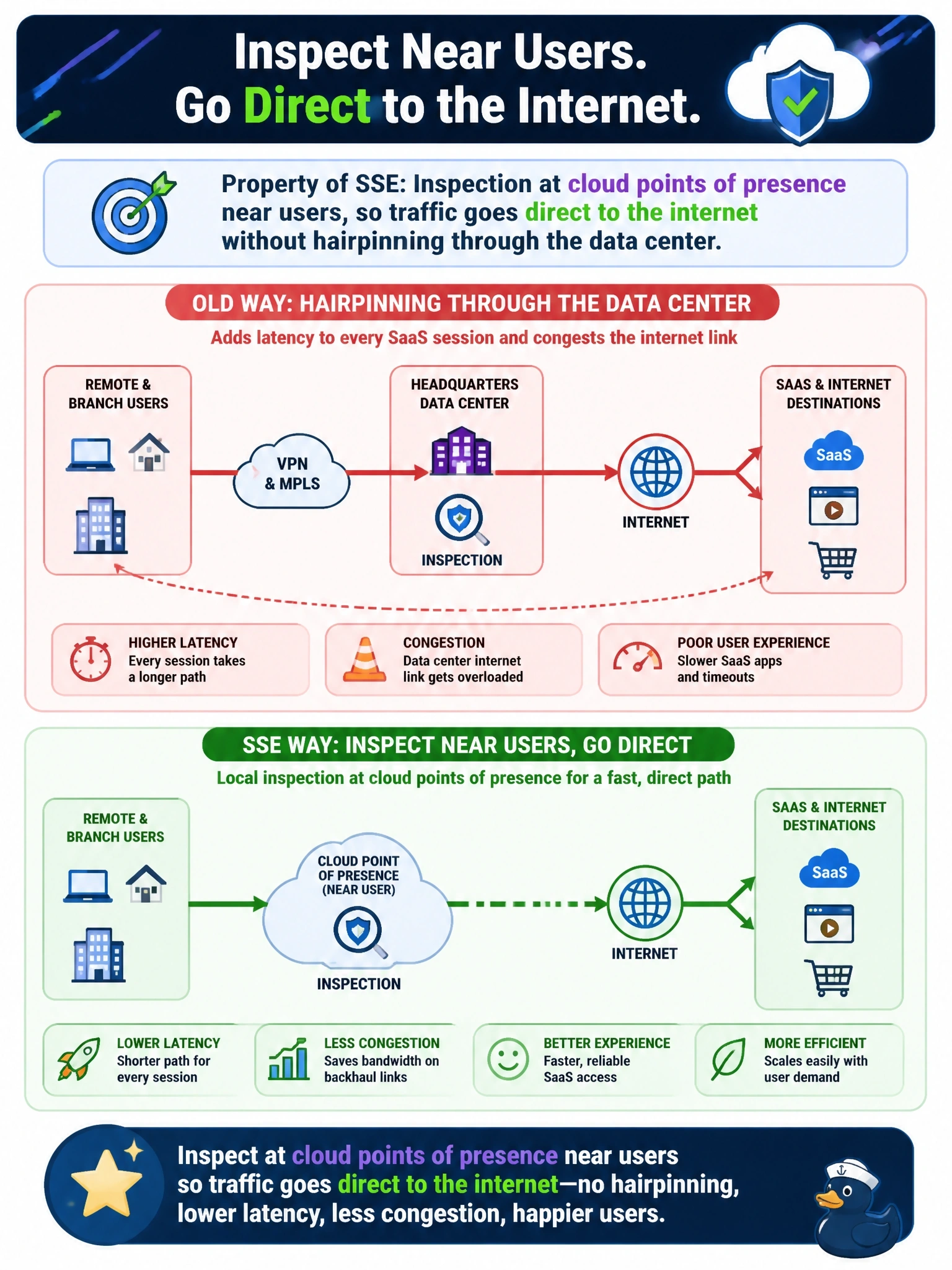
Remote and branch users' internet traffic is backhauled over VPN and MPLS to headquarters for inspection, which adds latency to every SaaS session and congests the data center's internet link. Which property of SSE addresses this problem?
Select an answer to reveal the explanation.
Short Explanation
Backhauling is like driving every package to headquarters before it goes next door. SSE puts the inspection station at a cloud point of presence near you, so traffic is checked close to the user and goes straight out. The trap is split tunneling without inspection — it fixes speed by throwing security away.
Full Explanation
Security Service Edge delivers inspection services from a distributed network of cloud points of presence. Users and branches connect to a nearby point of presence through an endpoint client or a site tunnel, the traffic is inspected there by the secure web gateway, firewall, CASB and DLP services, and it then proceeds directly to the internet or SaaS destination. Removing the detour through the data center reduces latency for SaaS sessions and frees the data center's internet link, while keeping consistent security policy for every user. A larger appliance at headquarters can increase inspection capacity, but the traffic still travels to the data center and back, so the latency and link congestion remain. A second MPLS circuit adds bandwidth to the backhaul path but keeps the hairpin and raises cost; it treats the symptom, not the architecture. A split-tunnel exclusion that sends SaaS traffic directly to the internet without inspection solves the latency problem by removing security for that traffic, which leaves users and data unprotected. Exam caveat: direct-to-internet with cloud inspection is a core SSE value statement; expect it to be contrasted with backhaul designs. Operational check: compare SaaS round-trip latency before and after steering traffic to Secure Access, and confirm in the activity logs that sessions are inspected at the expected point of presence.