
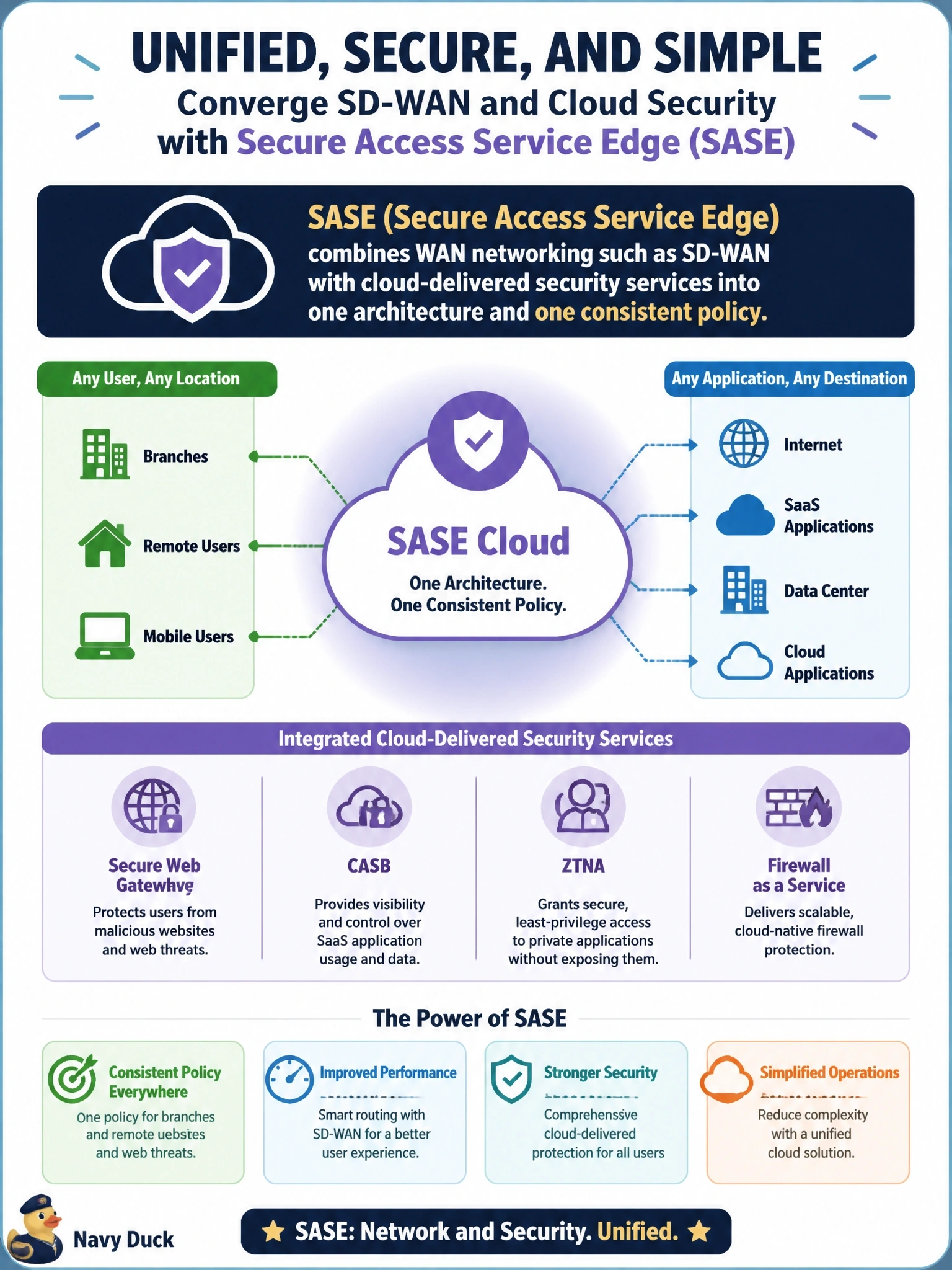
A retailer wants to converge its branch SD-WAN and its cloud-delivered security services (secure web gateway, CASB, ZTNA and firewall as a service) into one architecture with consistent policy for both branches and remote users. Which term describes this target?
Select an answer to reveal the explanation.
Short Explanation
If SSE is the security toolbox, SASE is the toolbox bolted onto the delivery truck — networking and security in one package. The moment the stem says SD-WAN and security converged, you're in SASE territory. Don't pick SSE; it's the right services but leaves the WAN half out.
Full Explanation
Secure Access Service Edge, a term introduced by Gartner, describes the convergence of wide area networking capabilities, most often SD-WAN, with cloud-delivered network security services such as a secure web gateway, CASB, ZTNA and firewall as a service. The goal is one architecture with unified policy and management, so branch and remote user traffic is routed efficiently and secured consistently regardless of location. The retailer's requirement to converge its SD-WAN with those security services is the definition of SASE. Security Service Edge is the security subset of SASE; it provides the listed services but explicitly excludes the WAN component, so it describes only half of the target. Zero trust network access is one of the services inside SSE and SASE, focused on per-application access to private resources; it is not the overall architecture. SD-WAN alone covers path selection and transport optimization for branches but does not provide the cloud security services. Exam caveat: SASE can be delivered by one vendor or by integrating an SD-WAN vendor with an SSE vendor; the term describes the architecture, not a single product. Operational check: verify that branch SD-WAN edges forward traffic to the security service and that a single policy applies identically to a branch user and a remote user reaching the same destination.