
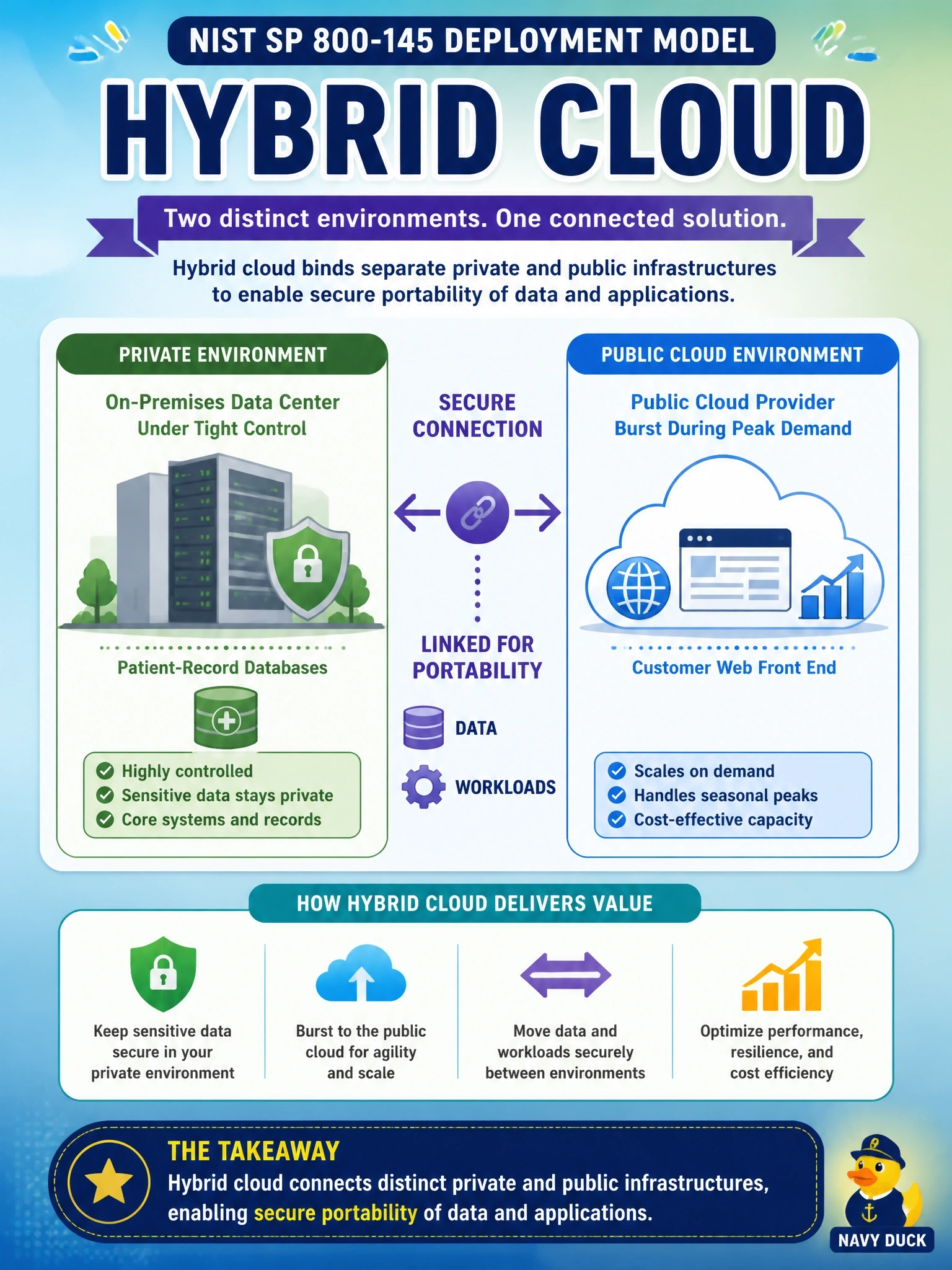
A healthcare company keeps its patient-record databases in its own data center under tight control, but bursts its customer web front end into a public cloud provider during seasonal peaks. The two environments stay separate yet are linked so data and workloads can move between them. Which NIST SP 800-145 deployment model describes this arrangement?
Select an answer to reveal the explanation.
Short Explanation
Think of it like owning a house and renting a party tent for the busy season: two places, one event. That's hybrid cloud — private and public infrastructure stay distinct but are joined so work can move between them. Don't let the public piece or the private piece alone grab you; the stem describes both, tied together.
Full Explanation
NIST SP 800-145 defines a hybrid cloud as a composition of two or more distinct cloud infrastructures, such as private and public, that remain unique entities but are bound together by technology that enables data and application portability. Cloud bursting, where demand overflows from private capacity into a public provider, is the classic example NIST itself cites. The company's sensitive databases stay on infrastructure it controls while the elastic web tier runs in the public cloud, and the link between them is what makes the whole a single hybrid deployment. Community cloud is wrong because it describes infrastructure shared by a specific group of organizations with common concerns; nothing indicates other healthcare firms share the environment. Public cloud alone is wrong because it describes only the burst half and ignores the private data center that holds the records. Private cloud alone is wrong for the opposite reason: it describes the controlled half but not the public burst capacity. Exam caveat: the model is about who uses the infrastructure and how environments are joined, not about where a server physically sits. Operational check: document which workloads and data classes may run in each environment, and verify the interconnect, identity and encryption controls apply consistently across both.