
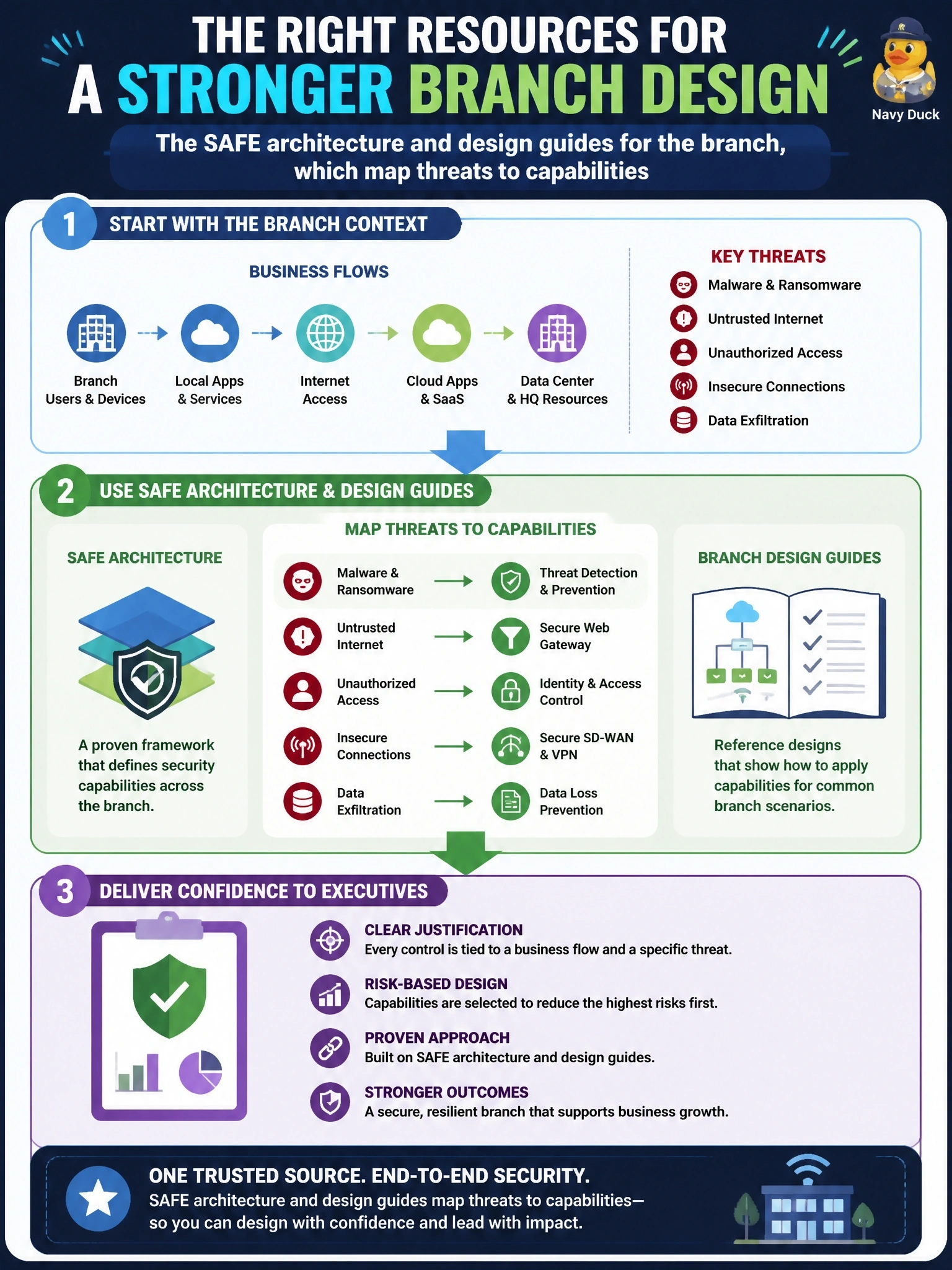
A security team must present a new branch design to executives and explain why each control was chosen, tracing from the branch's business flows and threats to the selected capabilities. Which Cisco SAFE resources best support that explanation?
Select an answer to reveal the explanation.
Short Explanation
Executives want the story, not the parts list: what you're protecting, from what, and why this control. SAFE's branch guides are written in exactly that order, flows to threats to capabilities. The trap is reaching for a hardening checklist or threat feed; those are useful, but they don't explain the design.
Full Explanation
Cisco SAFE is published as a set of guides organized by place in the network. Architecture guides describe the business flows, threats and capabilities for a place such as the branch, and design guides show how those capabilities are implemented. Because the guides already trace the reasoning from business use cases to threats to capabilities, they give a team a ready framework for justifying each control to a non-technical audience and for showing that every threat has a corresponding capability. Talos publications are threat intelligence; they describe current campaigns and vulnerabilities, which can inform the threat list, but they do not provide a capability model or design rationale for a branch. A CIS benchmark for IOS XE is a configuration-hardening baseline for one device type; it explains how to secure a router, not why the branch needs segmentation or threat defense. A CVSS report scores the severity of known vulnerabilities and supports patch prioritization, not architectural justification. Exam caveat: SAFE answers emphasize capability mapping per place in the network; product-level or device-level documents are rarely the right answer to a design-justification question. Operational check: build the executive slide from the branch architecture guide's flow and threat list, and show each selected control against the capability it delivers.