
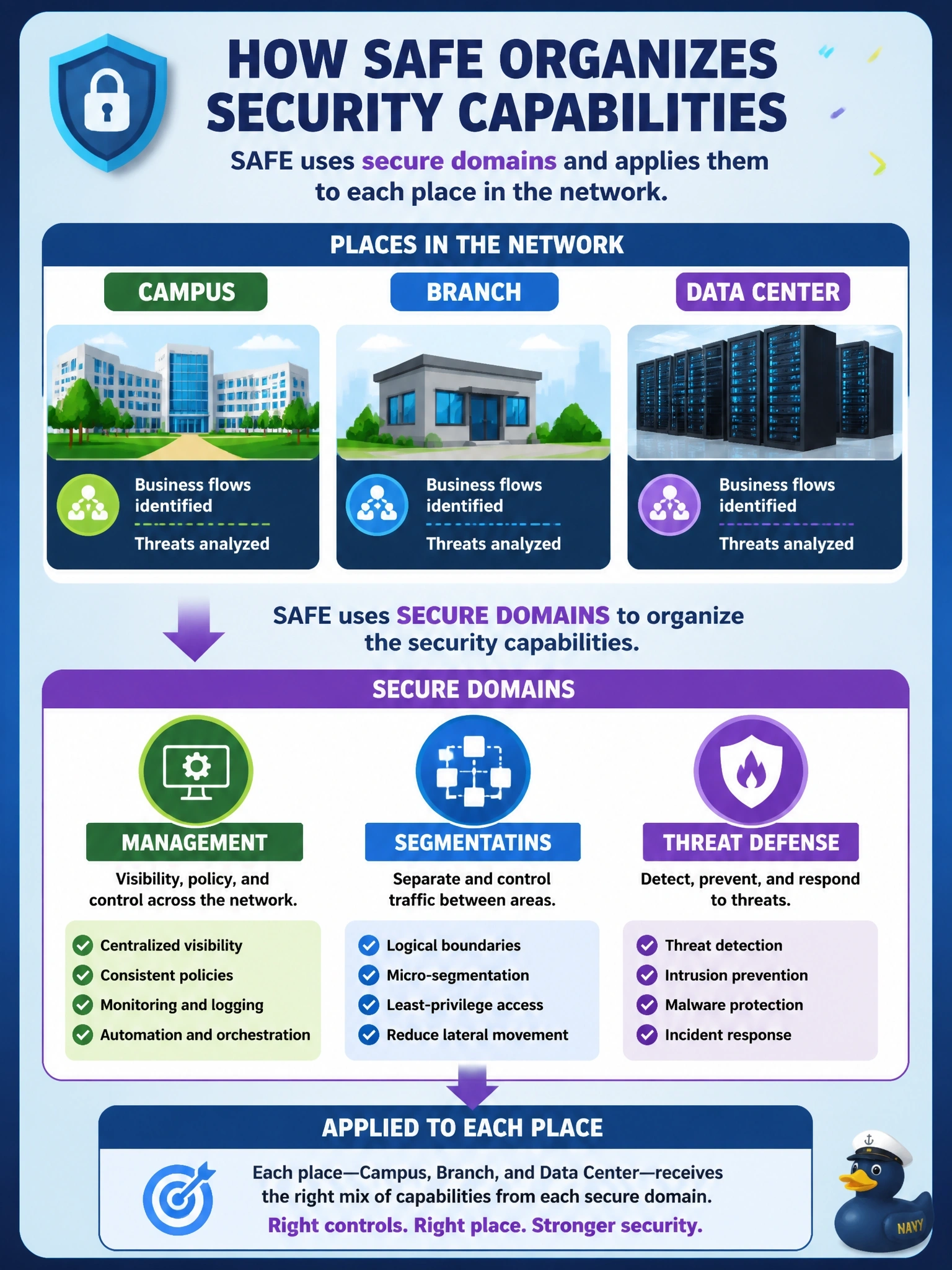
A security architect is using Cisco SAFE to plan controls for a campus, a branch and a data center. The team has already identified the business flows in each area and the threats against them. What does SAFE use next to organize the security capabilities each of those places needs?
Select an answer to reveal the explanation.
Short Explanation
Think of SAFE like a city planner's map: you mark the neighborhoods (places in the network), note what moves there and what threatens it, then check which capability groups each one needs. The trap is treating SAFE as a patch queue or a product list. It's a way to organize your reasoning, and the products come last.
Full Explanation
Cisco SAFE (Secure Architecture for Everyone) is a model for building defense in depth from business requirements rather than from a product catalog. It divides the network into places in the network, such as branch, campus, data center, edge, cloud and WAN, and describes security through secure domains: management, security intelligence, compliance, segmentation, threat defense and secure services. The method runs from business flows, to the threats against those flows, to the capabilities that counter them, grouped by secure domain for each place. Only then are products chosen to deliver the capabilities. A CVE list ranked by CVSS is vulnerability management; it schedules remediation but does not describe which capabilities a place requires. Mapping one firewall product to each OSI layer confuses a protocol reference model with a security architecture and puts products before capabilities. Licence tiers are a purchasing question that SAFE deliberately leaves until after the capability design. Exam caveat: SAFE answers point to places, secure domains and capabilities, not to specific SKUs or to a single control. Operational check: for each place, confirm every identified threat maps to at least one capability in a secure domain, and that each capability is then assigned to a concrete control.