
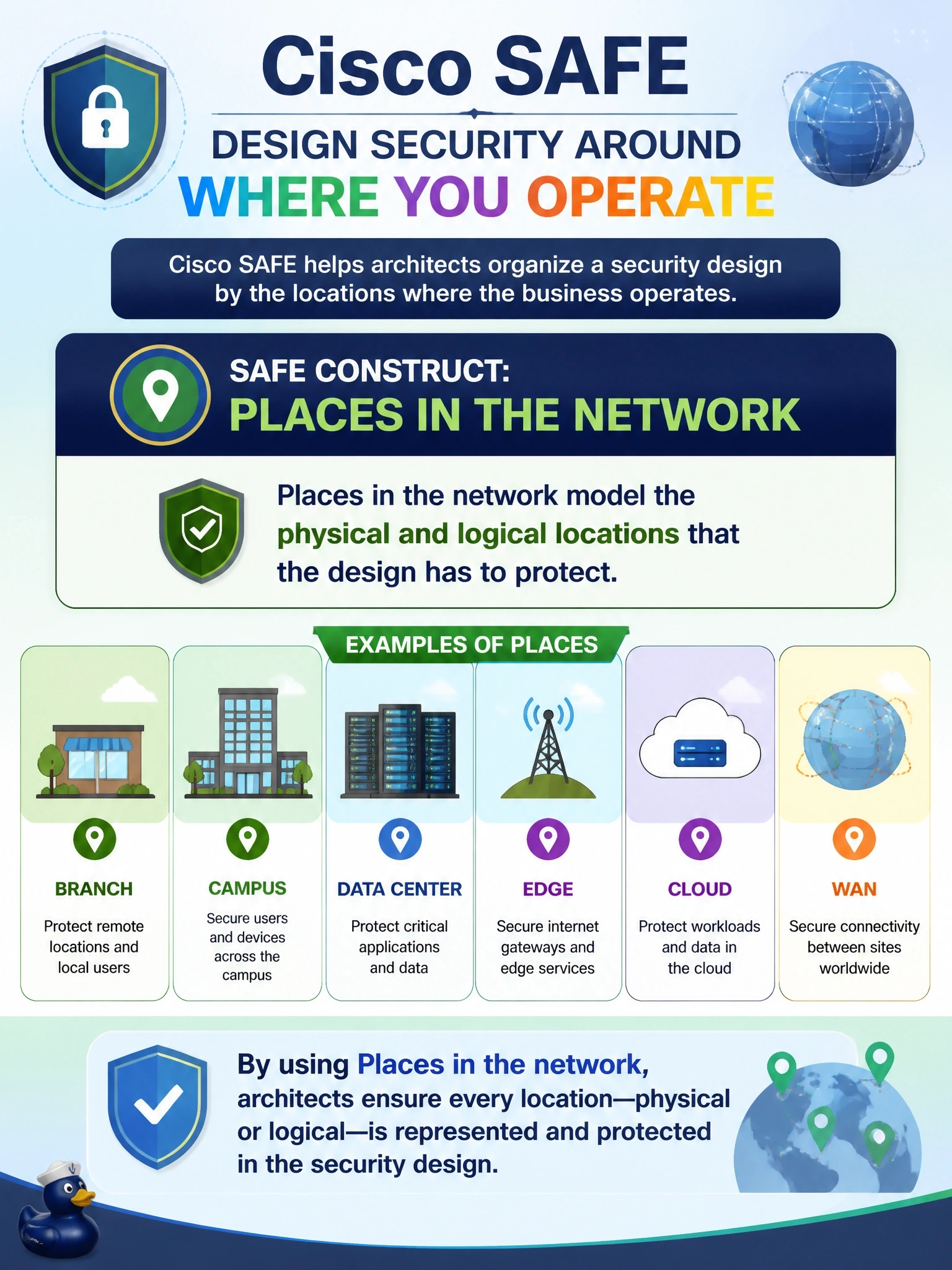
An architect uses Cisco SAFE to organize a security design around the locations where the business operates, such as branch, campus, data center, edge, cloud, and WAN. Which SAFE construct is the architect using?
Select an answer to reveal the explanation.
Short Explanation
SAFE gives you a map with two views: where things live and what you do to secure them. The "where" is the places in the network — branch, campus, data center, edge, cloud, and WAN. The trap is secure domains; those are the "what", like management and threat defense.
Full Explanation
Cisco SAFE, Secure Architecture for Everyone, is a security reference architecture that structures designs using a model of the network. Places in the network represent the locations an organization must protect: secure branch, secure campus, secure data center, secure edge, secure cloud, and secure WAN. Each place has typical business flows, threats, and recommended capabilities, which makes it easy to reason about controls location by location. SAFE complements places with secure domains, which are operational areas that span every place: management, security intelligence, compliance, segmentation, threat defense, and secure services. Secure domains therefore describe functions rather than locations, so they do not match a design organized by branch, campus, and data center. The attack continuum of before, during, and after an attack is a Cisco framing for mapping controls to attack phases, not the SAFE construct for locations. Business flows in SAFE describe how internal users, third parties, and customers use the network; they drive which capabilities are needed within a place but are not the locations themselves. Exam caveat: SAFE is a design and communication framework, not a product or configuration standard. Operational check: for each place in the network, list its business flows, map the relevant threats, and confirm every secure domain has a capability deployed there.