
A peer company shares an indicator report labeled TLP:AMBER under Traffic Light Protocol version 2.0. An analyst wants to forward it. Under the label's rules, with whom may the report be shared?
Select an answer to reveal the explanation.
Short Explanation
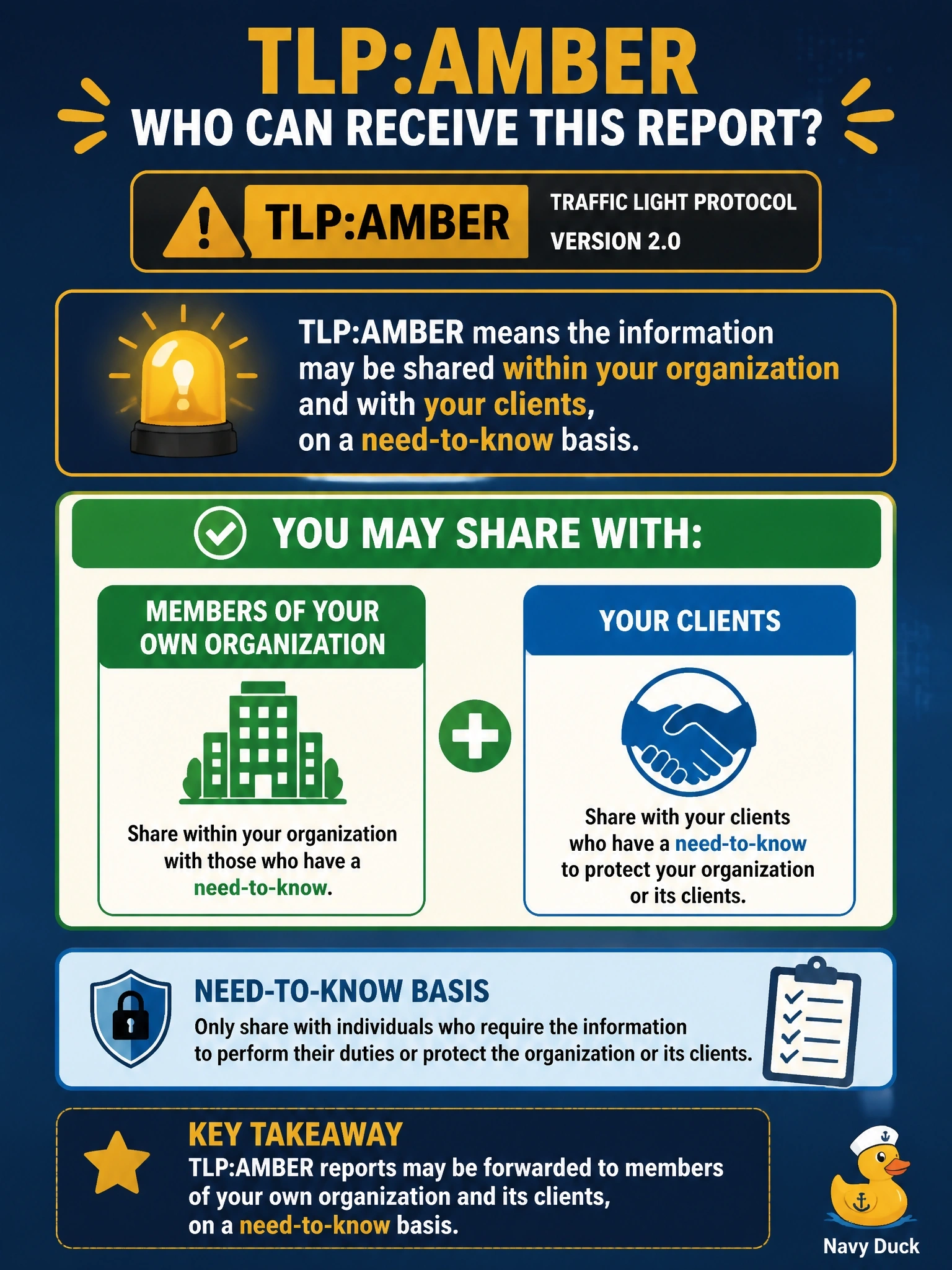
Think of TLP as a traffic light for gossip: red means it stops with you, green means your community can hear it, and clear means tell the world. TLP:AMBER sits in between — your own organization and its clients, need-to-know only. The trap is GREEN; AMBER doesn't reach the whole community.
Full Explanation
The Traffic Light Protocol, maintained by FIRST, uses labels that tell recipients how far they may share information. Under version 2.0, TLP:AMBER means limited disclosure: recipients may share it on a need-to-know basis within their own organization and with its clients. A stricter variant, TLP:AMBER+STRICT, limits sharing to the recipient's organization only, excluding clients. The source applies the label, and recipients who need to share more widely must ask the source first. Sharing with anyone, including public channels, describes TLP:CLEAR, which carries no limit on disclosure. Restricting information to the individual recipients only, with no further disclosure even to colleagues, describes TLP:RED, typically used for information shared in a meeting or with named people. Sharing across the wider community but not publicly describes TLP:GREEN. Exam caveat: version 2.0 renamed TLP:WHITE to TLP:CLEAR and introduced AMBER+STRICT, so older material may use different labels. TLP is an agreement among trusted parties, not a technical control, and it does not encrypt or restrict files. Operational check: before forwarding, confirm the exact label and version on the report, limit distribution to people in the organization or its clients who need the information, and ask the source for permission to share more broadly.