
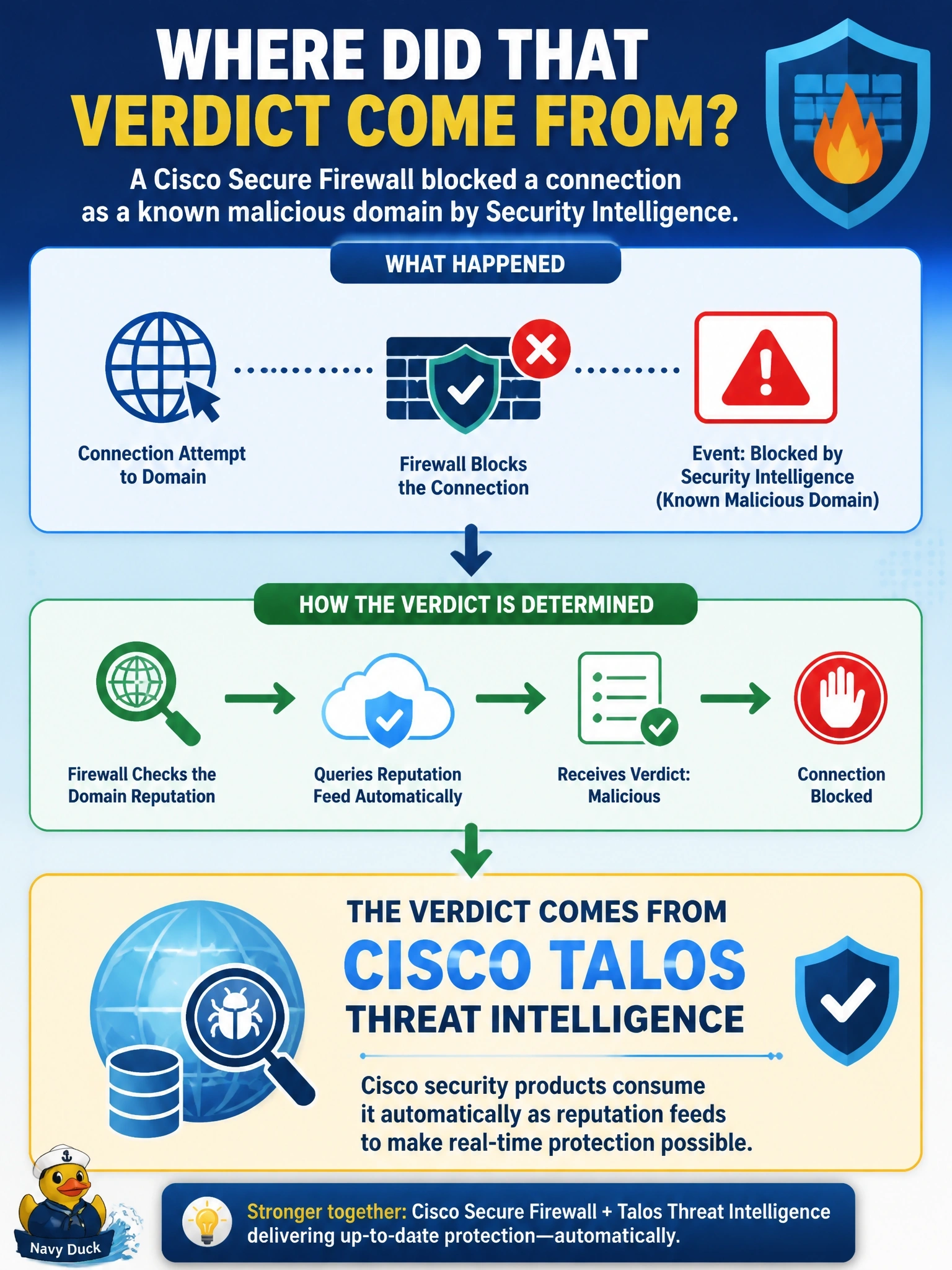
A Cisco Secure Firewall blocks a connection to a domain that the security team never added to any list. The connection event shows the destination was blocked by Security Intelligence as a known malicious domain. Where did that verdict most likely come from?
Select an answer to reveal the explanation.
Short Explanation
You didn't write that rule, so someone else did the homework for you. That someone is Cisco Talos, whose intelligence flows into Security Intelligence feeds automatically. Don't be fooled by ATT&CK or CVE; one maps behaviors and the other names vulnerabilities, and neither ships domain blocklists.
Full Explanation
Cisco Talos is Cisco's threat intelligence and research organization. Its research and telemetry feed reputation and category data into Cisco security products, which consume it automatically without the customer authoring entries. On Cisco Secure Firewall, Security Intelligence uses Cisco-provided feeds for IP addresses, URLs, and domains, updated regularly, and administrators decide which categories to block or monitor in the policy; matching traffic is blocked early, before deeper inspection, which is why the event names Security Intelligence. Custom lists and feeds also exist, but they contain only what administrators add or subscribe to, and nothing builds them automatically from incident tickets. MITRE ATT&CK is a knowledge base of adversary tactics and techniques; it describes behavior and does not publish operational domain blocklists. The CVE program catalogs vulnerabilities in software and hardware products and does not assign identifiers to malicious domains. Exam caveat: Security Intelligence can be set to monitor only, so a match is logged without blocking, which is useful when evaluating a new category. Operational check: open the connection event to identify the Security Intelligence category that matched, confirm that category is set to block in the policy, and, if the verdict is disputed, submit the domain to Talos for reputation review.