
Two data centers must exchange large volumes of data quickly over the internet, and the encryption keys must be agreed without ever being sent in the clear. Which design meets both requirements?
Select an answer to reveal the explanation.
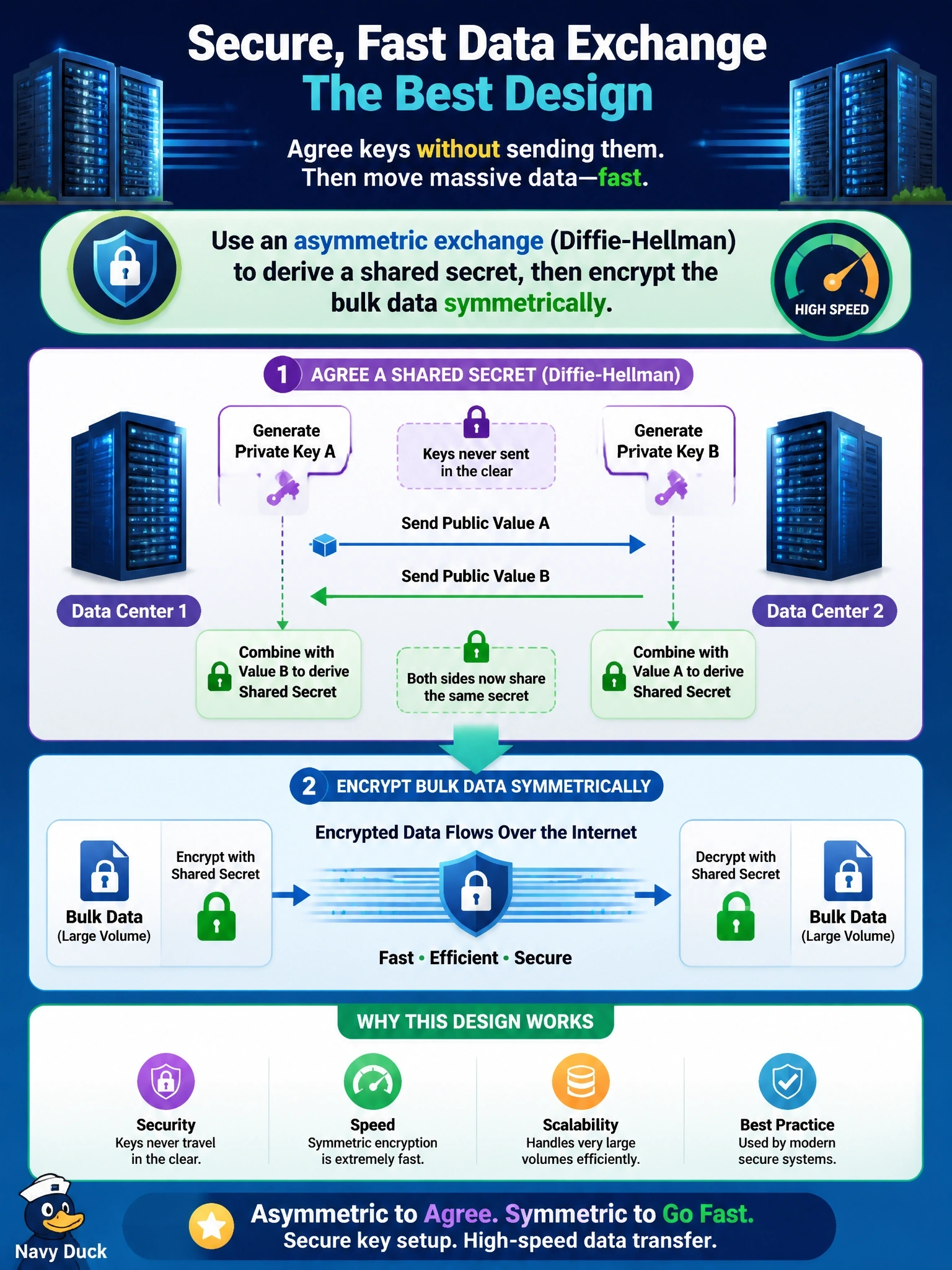
Short Explanation
Think of it as meeting in a locked room to agree on a password, then using that password to move the heavy boxes fast. The asymmetric exchange gets you a shared secret safely, and the symmetric cipher does the bulk work. Don't fall for RSA-for-everything; it's far too slow for big data.
Full Explanation
Practical secure protocols such as IPsec and TLS use hybrid cryptography. An asymmetric mechanism, typically Diffie-Hellman or its elliptic-curve form, lets two parties compute the same shared secret over an untrusted network without ever transmitting it; an eavesdropper who sees the public values cannot feasibly derive the secret. That secret seeds symmetric session keys, and a symmetric cipher such as AES in an authenticated mode then encrypts the bulk traffic at high speed, often with hardware acceleration. Encrypting bulk data directly with RSA fails on both counts: asymmetric operations are orders of magnitude slower than symmetric ones, and RSA can only encrypt small blocks, so it is used to wrap keys or sign data, not to carry files. Emailing an AES key violates the requirement that keys never cross the network in the clear, and it creates a distribution problem every time keys rotate. Hashing provides integrity only; a digest cannot be reversed, so it neither conceals data in a usable way nor lets the receiver recover the contents. Exam caveat: post-quantum planning targets the asymmetric key exchange step, which is why hybrid ML-KEM exchanges are being introduced. Operational check: confirm the VPN or TLS configuration negotiates a Diffie-Hellman group for key exchange and an AES-GCM cipher for data protection.