
A factory IoT network trunks two VSANs across one TE port-channel. The first VSAN merges, and the second stays isolated because the trunk allows only the first VSAN. What lets the second VSAN use that same cable?
Select an answer to reveal the explanation.
Short Explanation
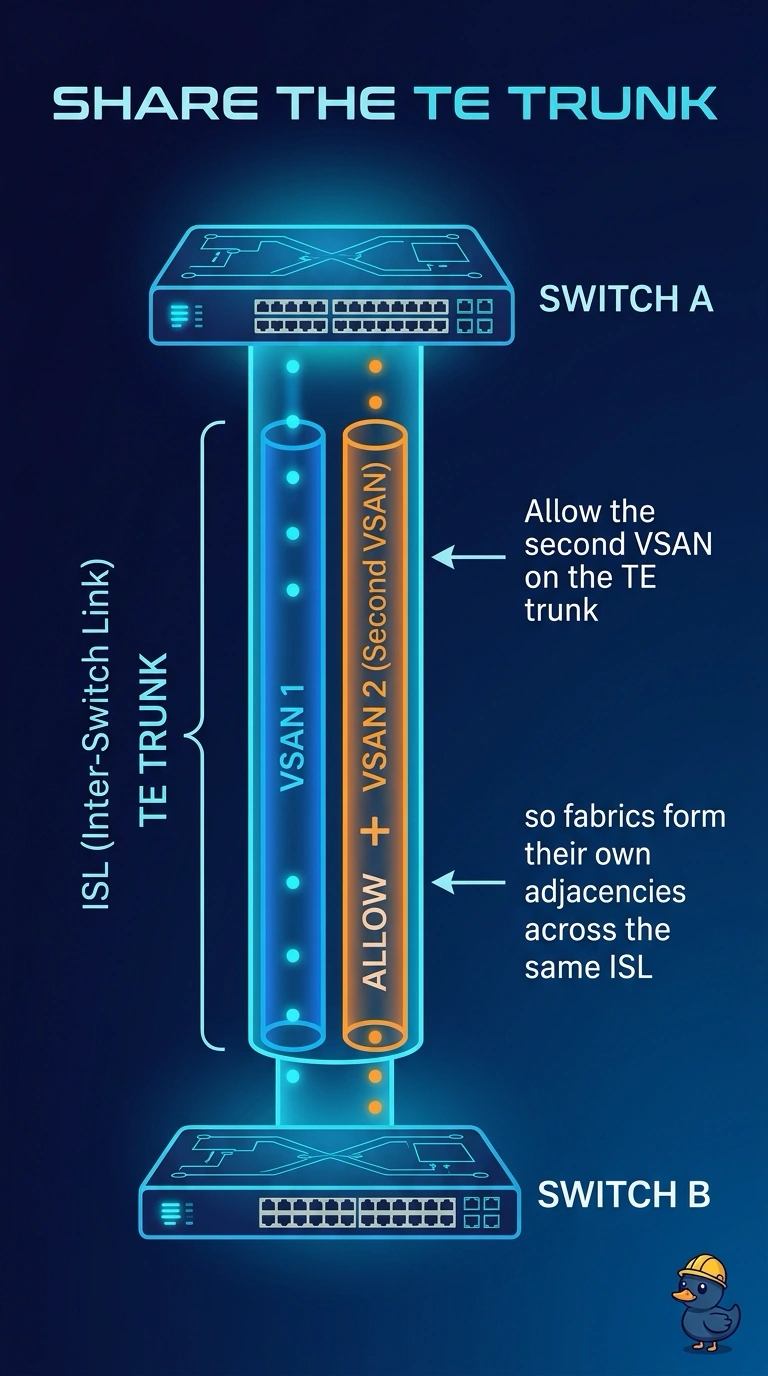
Two companies can share a hallway and still keep separate locks on their own doors. You allow the second VSAN on the TE trunk so that fabric can use the same cable without joining the first VSAN. A zoneset does not merge VSANs, and copying routes from the healthy VSAN will not create a trunk permission that is missing.
Full Explanation
A VSAN is its own Fibre Channel fabric, with its own zoning, name server, and FSPF topology, even when several VSANs ride one physical trunk. A TE port carries only the VSANs in its allowed list. The factory trunk permits the first VSAN, so that fabric merges, and the second VSAN stays isolated until it is allowed on the same TE port-channel. That allowance is what lets the second VSAN use the cable. A zoneset is activated inside one VSAN. It cannot name two VSANs into a single fabric, and activating it does not add a VSAN to a trunk. FSPF routes are computed per VSAN. Copying the working VSAN's routes into the other does not create an ISL, because the second fabric still has no permitted path. Domain IDs are also per VSAN. Making them match is not the key that admits a VSAN onto a TE port, and the isolated VSAN does not need to reuse the other VSAN's domain. Caveat: after the VSAN is allowed, that VSAN still needs a unique domain topology of its own, or the new ISL can isolate for a domain overlap inside the second VSAN. Operational check: add the second VSAN to the allowed list on both ends of the trunk, then confirm that VSAN shows a merged ISL while the first VSAN stays up.