
A state university presents LUNs to hosts with iSCSI. An engineer adds a Fibre Channel zone that names those hosts and the array, and the hosts still cannot see the LUNs. What identifies an iSCSI host to that array?
Select an answer to reveal the explanation.
Short Explanation
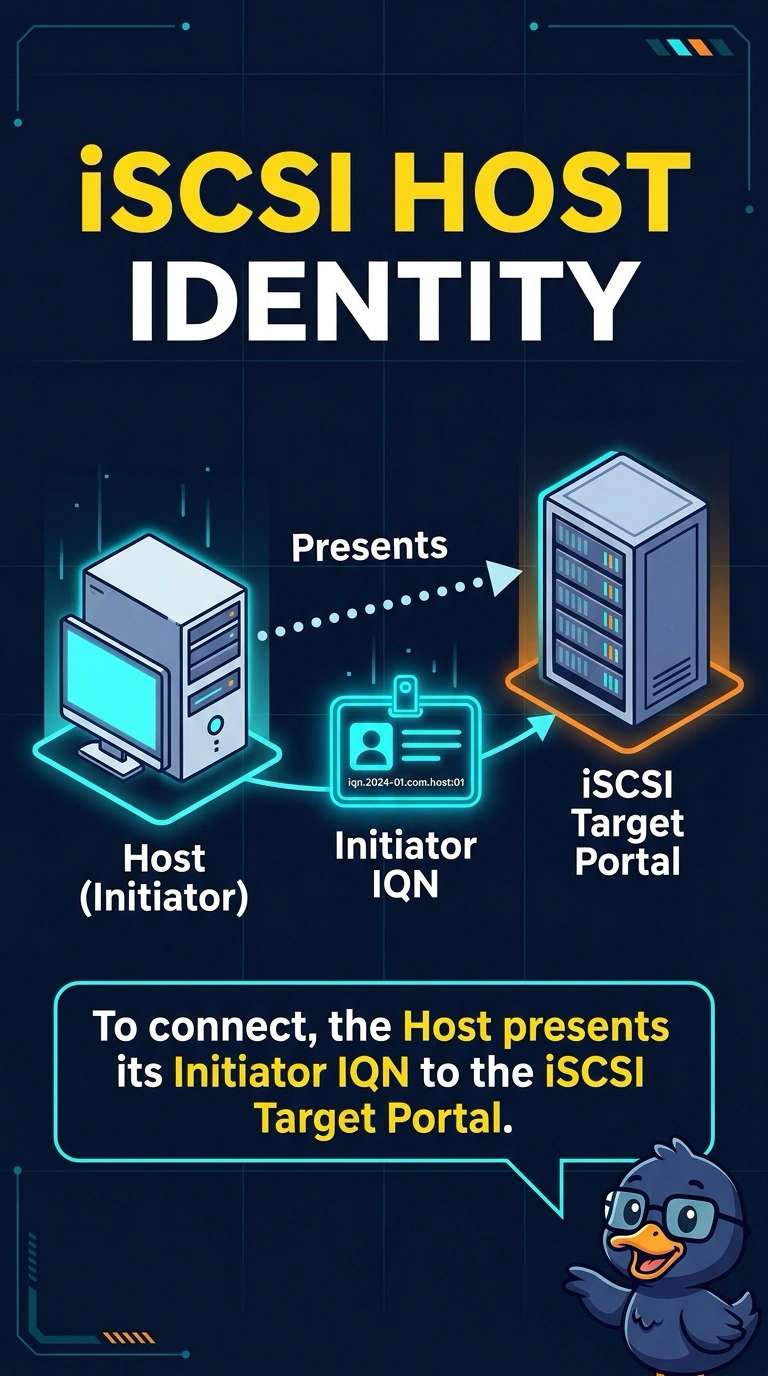
You are holding a building access card up to a website login. You identify this host to the array with the initiator IQN it presents to the iSCSI target portal, which is an IP conversation and not a Fibre Channel zone. Activating a zoneset never introduces that host to the portal.
Full Explanation
iSCSI is SCSI carried over IP. The host logs in to a target portal, and the identity it presents is an initiator IQN. The array uses that IQN, often with the portal and LUN mask, to decide which LUNs the host may see. A Fibre Channel zone is enforced by an MDS inside a VSAN. This university's disks are not being presented over Fibre Channel, so the new zone does not create the iSCSI session and the LUNs stay hidden. NFS is a file protocol, commonly on port 2049, where a client mounts an export path. An iSCSI LUN is a block device, not an NFS mount, and the host does not identify itself with an export path. An FCID is the 24-bit address assigned at FLOGI on a Fibre Channel fabric. An iSCSI host does not receive one, and the array does not use an FCID as the iSCSI initiator name. Caveat: some arrays can also restrict the portal by IP address, so a correct IQN from an unexpected source address can still be refused. Operational check: confirm the host reaches the target portal on TCP port 3260, confirm the initiator IQN matches the array mask, and rescan for the LUN after the Fibre Channel zone is left out of the path.