
A factory IoT network host is already in an active zone with its array, yet it has no Fibre Channel address because it has not completed FLOGI. When does the switch assign that 24-bit FCID?
Select an answer to reveal the explanation.
Short Explanation
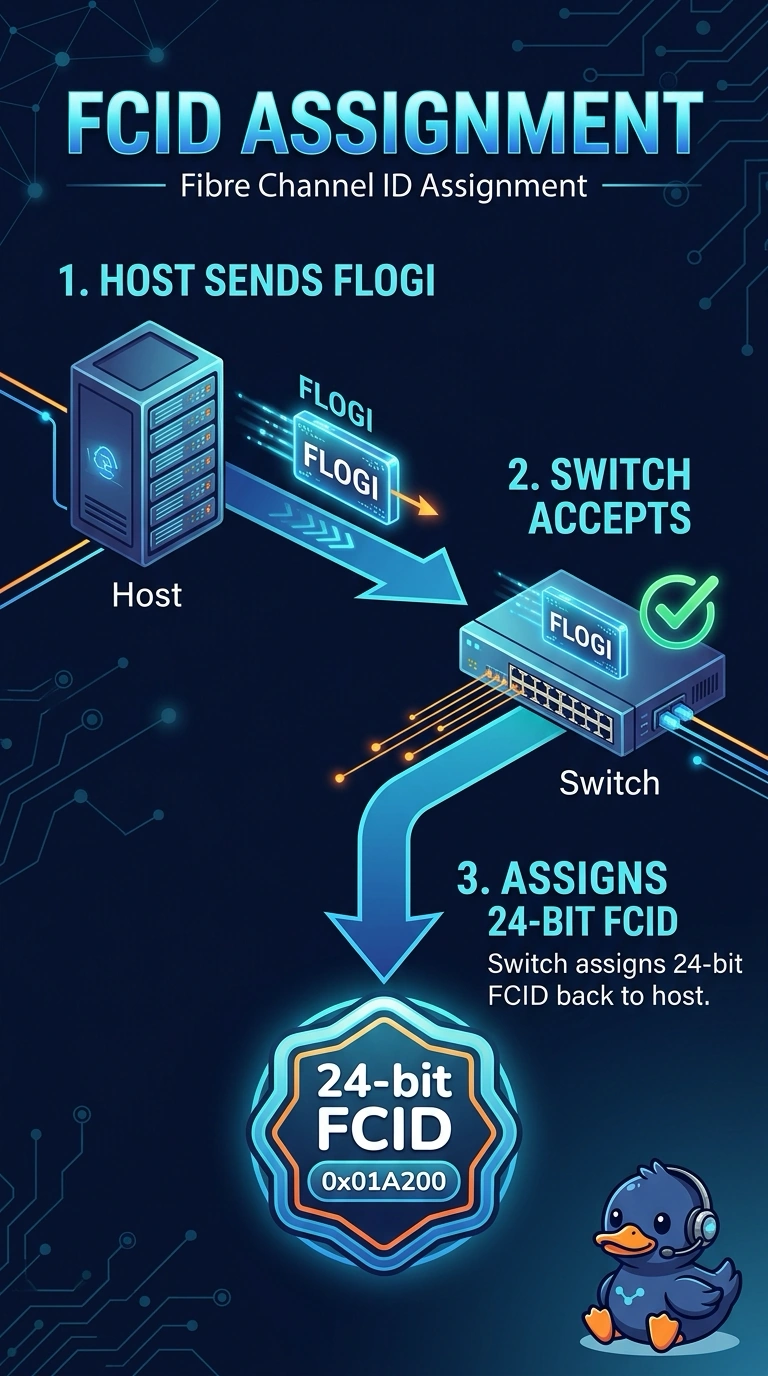
An FCID is a badge issued at the door, not a seat number printed on the invitation. You get the 24-bit address when the switch accepts FLOGI, even though the zone was written earlier. Activating the zoneset decides who may talk, and it does not stamp an address on a host that has not logged in.
Full Explanation
A Fibre Channel ID is a 24-bit address. The switch assigns it when the host completes FLOGI, then registers that address in the name server. Zoning can already name the host and the array, and the host still has no FCID until that login succeeds, which is the factory case. Zoneset activation copies a zoneset into the enforcement database. It does not write an FCID into the zone and it does not invent an address for a device that has not logged in. A CFS commit of a device alias distributes a friendly name. The alias can refer to a port name, and committing it does not allocate the 24-bit address. The host does not choose its FCID the way a server can be given a static IP address. The fabric switch is the authority that assigns it at login. Caveat: if the host later FLOGIs to a different switch, the domain portion of the new FCID can change, so any tool that cached the old address has to be refreshed. Operational check: complete FLOGI, confirm a 24-bit FCID appears for the host, and confirm that address shows up in the name server.