
A state university has a SAN port-channel configured on both MDS switches, yet one member stays out of the bundle while the other member is inside it. That member is hard-set to a different speed. What should change?
Select an answer to reveal the explanation.
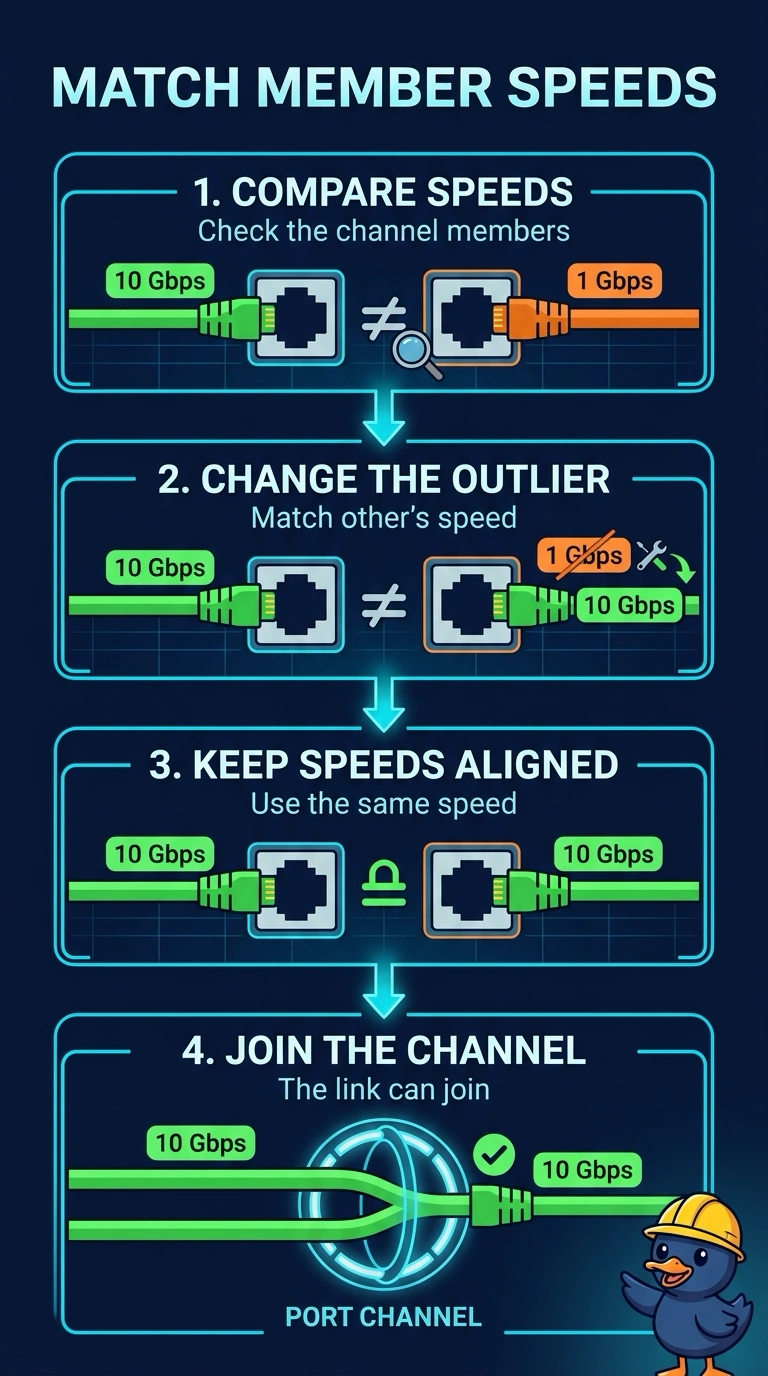
Short Explanation
A port-channel member has to run at the same speed as the lane it wants to join. You hard-set this member to a different speed, so the channel leaves it outside the bundle. Ethernet LACP and a shared domain ID will not bring that Fibre Channel member in.
Full Explanation
A SAN port-channel bundles only members that are compatible with each other. Speed is one of those checks. A member that is hard-set to a different speed from the member already in the channel stays outside the bundle even though both switches have the port-channel configured. Matching the speed lets that link join. Ethernet LACP is how NX-OS negotiates an Ethernet port-channel. An MDS Fibre Channel ISL does not use Ethernet LACP to fix a speed mismatch or to form a SAN port-channel. Identical domain IDs are a fabric-merge failure, not a membership requirement. Each switch still needs its own domain, and sharing one would isolate the ISL rather than add a member. CFS distributes selected configuration databases such as device aliases. It is not a gate that must be turned off before a channel member can join. Caveat: speed is not the only membership check. A different trunk-allowed VSAN list or a different mode can keep the member out after the speed is corrected. Operational check: set the same speed on the member, confirm the port-channel shows that member up, and confirm it is no longer left as an individual E port.