
A factory IoT network director has two supervisors, and both a system-image upgrade and an EPLD update are pending. The impact check reports the system image as nondisruptive. Which upgrade can keep Fibre Channel logins up?
Select an answer to reveal the explanation.
Short Explanation
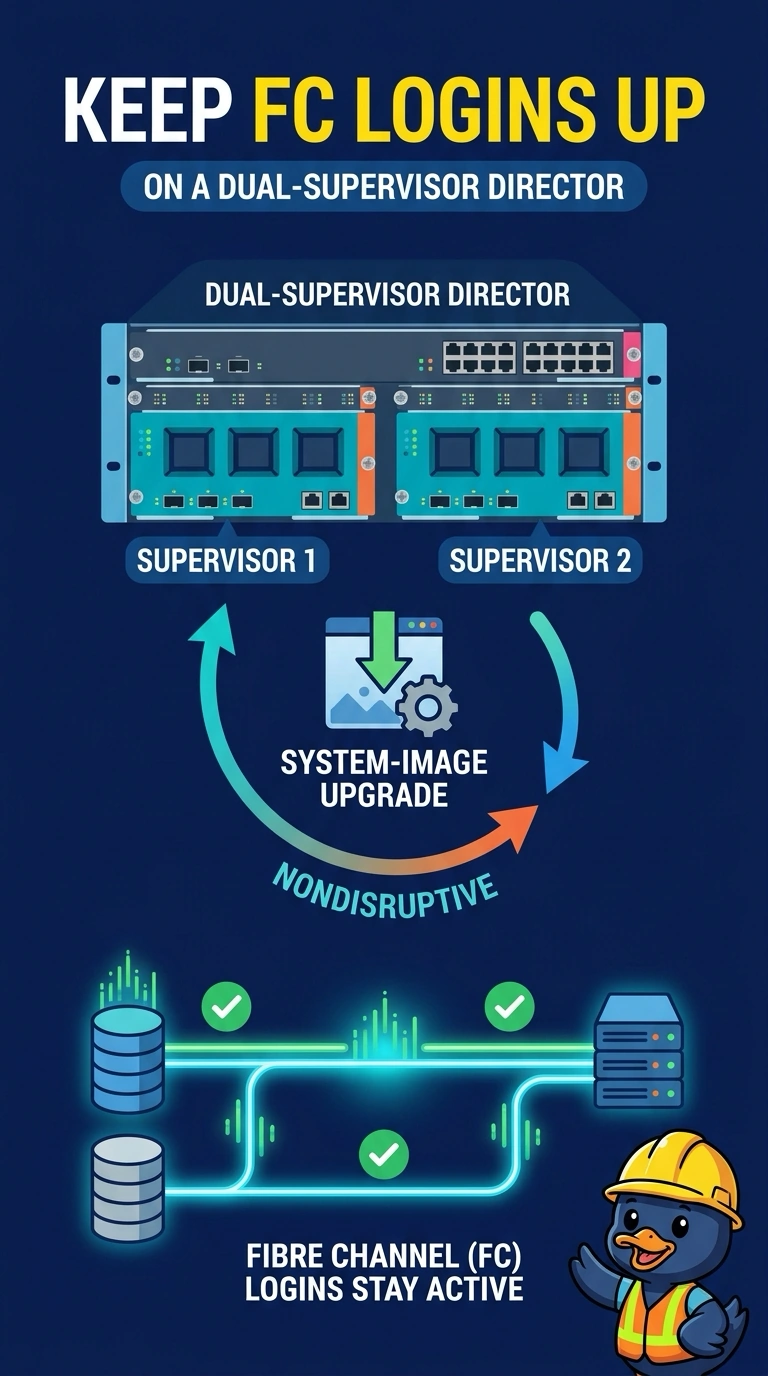
Think of a director with two supervisors as a train with two engines. You can upgrade the system image without dropping fabric logins when the impact check calls that upgrade nondisruptive. An EPLD update rewrites programmable logic on a module and is a different, reload-style change, so it is not the path that keeps those logins up.
Full Explanation
An MDS director with two supervisors can move to a new system image without dropping Fibre Channel logins when the upgrade impact check reports that path as nondisruptive. The standby supervisor takes the new image, the supervisors switch roles, and the forwarding modules stay up through that system-image change. That is the pending upgrade that matches the factory's goal. An EPLD update programs hardware logic on a line card or supervisor. It is a separate image from the system software, and applying it reloads the module whose logic changed, so it is not the hitless system-image window even when both tasks are queued the same night. Erasing the startup configuration and booting a replacement image is a rebuild. It discards the running configuration and drops every login, which is the opposite of staying nondisruptive. Activating a zoneset copies zoning into the enforcement plane for a VSAN. It does not copy a system image or an EPLD onto the director. Caveat: a chassis with one supervisor cannot take this hitless system-image path, and only the impact result for this image pair tells you whether the upgrade will reload the director. Operational check: confirm both supervisors are present and the impact result says nondisruptive, complete the system-image upgrade, and verify existing logins stay up before you schedule the EPLD reload on its own.