
A factory IoT network carries two SAN applications on one MDS pair. A zoneset change for the sensor application must not disturb the controller application. What isolates those two fabrics?
Select an answer to reveal the explanation.
Short Explanation
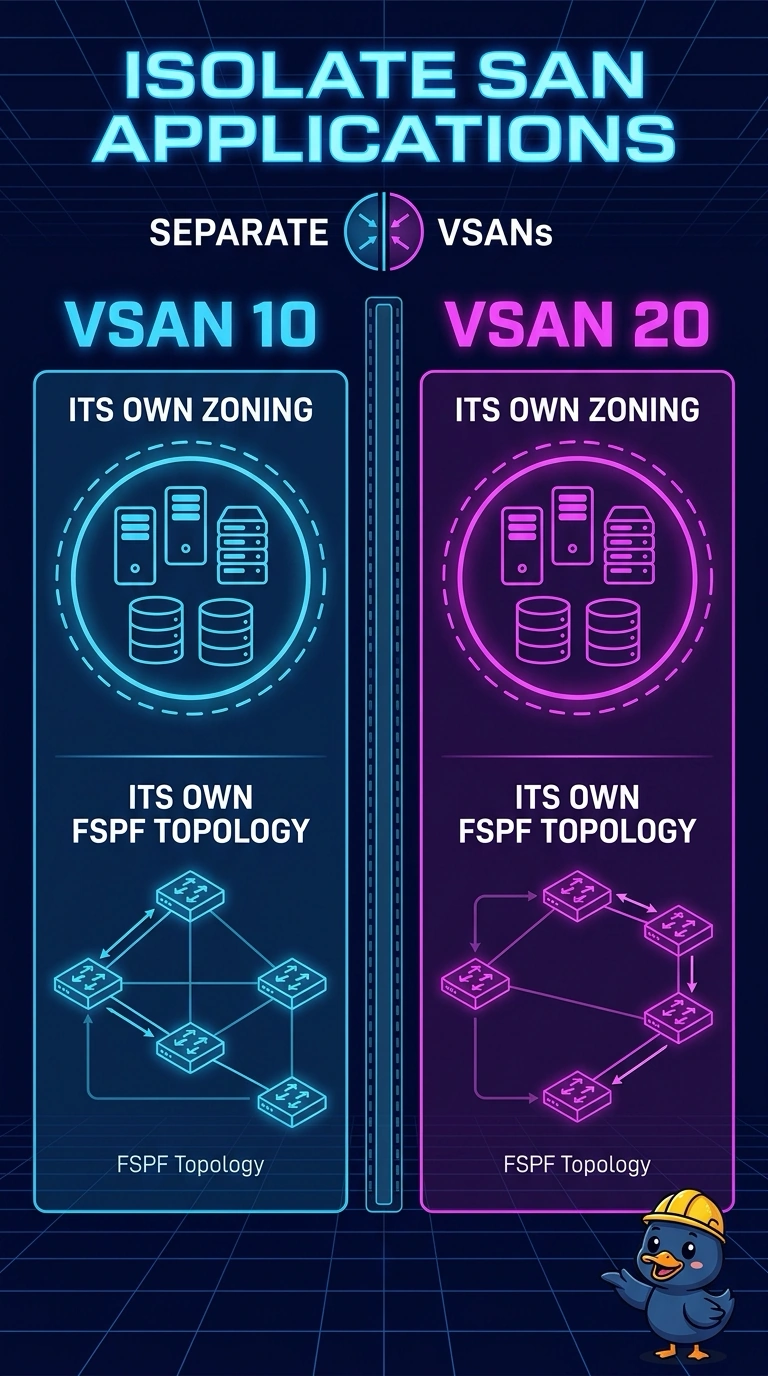
VSANs are separate fabrics that happen to share a chassis. You put the sensor and controller applications in different VSANs so zoning and FSPF in one do not disturb the other. Two active zonesets in a single VSAN are not available to create that split.
Full Explanation
A VSAN is a virtual fabric. Zoning, the name server, and FSPF all run separately inside each VSAN, even when the VSANs share the same MDS hardware. A TE port can carry more than one VSAN, but a zoneset activation in the sensor VSAN does not change the controller VSAN. Separate VSANs are what isolate the two factory applications. OSPF areas segment IP routing. They do not create Fibre Channel services or isolate a zoneset on an MDS. HSRP groups elect a gateway on an Ethernet VLAN. They do not separate zoning databases. A VSAN cannot have two active zonesets at the same time. Activating a second one would replace the first inside that same VSAN, which is the opposite of isolating two applications. Caveat: a trunk that allows both VSANs onto the same ISL still keeps their fabric services separate, but a mis-allowed VSAN on that trunk can extend an application into a place you did not intend. Operational check: confirm each application is in its own VSAN, activate a test zoneset in the sensor VSAN, and confirm the controller VSAN still shows its original active zoneset.