
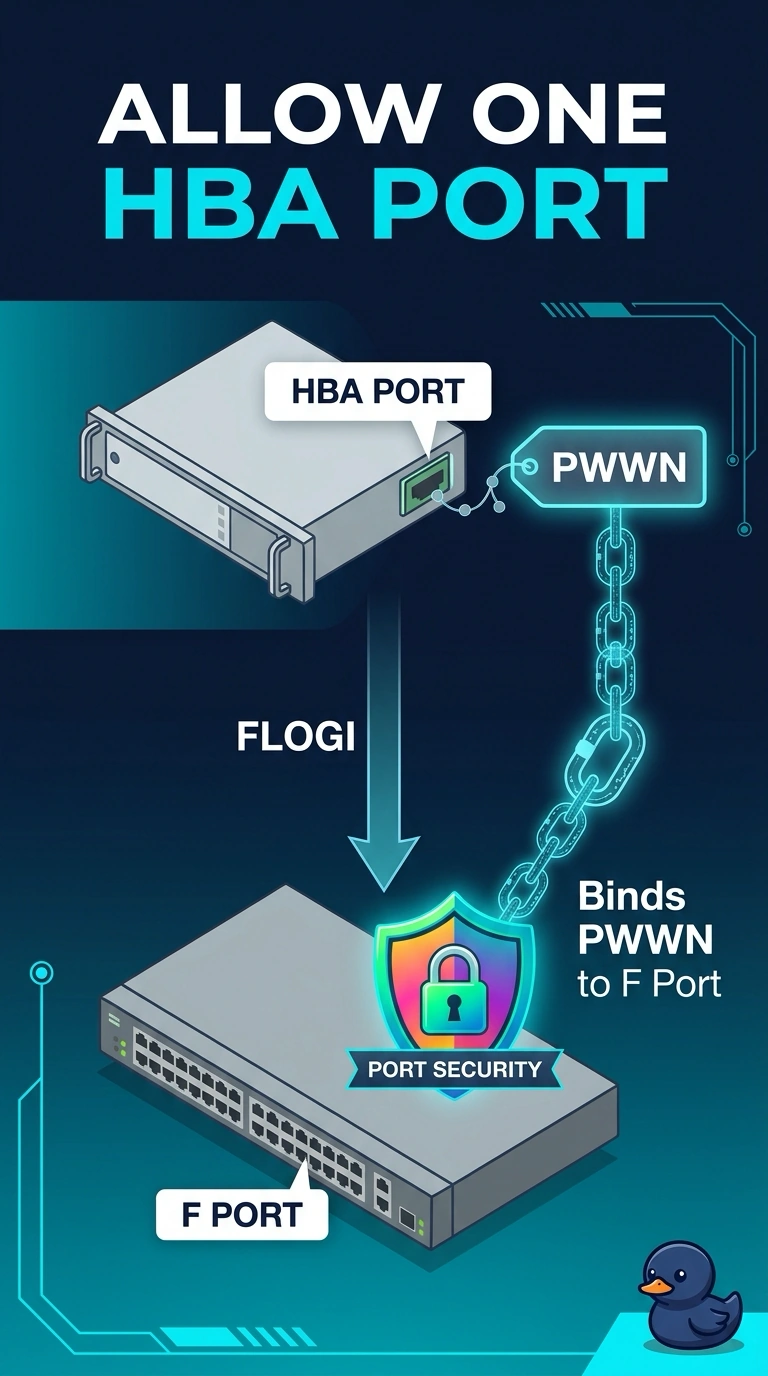
A regional hospital wants only one known HBA port name to complete FLOGI on a specific MDS F port. A different HBA cabled into that port should be rejected. Which feature enforces that?
Select an answer to reveal the explanation.
Short Explanation
Port security is a door that recognizes one key card and ignores the rest. You bind the expected HBA port name to that F port so a different adapter cannot complete FLOGI there. A zone decides who may talk after login, which is a later question than who may log in.
Full Explanation
MDS port security ties an F port to one or more permitted port world wide names. When an HBA FLOGIs, the switch compares the PWWN with that list and rejects a name that is not allowed, which is exactly the hospital rule for this port. Zoning can limit which logged-in devices may exchange traffic. It does not stop a stranger from completing FLOGI on the port, and a zone that names the real HBA still assumes that HBA is the one on the wire. Fabric binding authorizes switch WWNs and domain IDs so an unexpected switch cannot join the fabric. It is not the check on a host HBA at an F port. A device alias is a friendly name for a PWWN, distributed through the fabric. Naming the HBA does not pin it to a port and does not reject a different adapter. Caveat: if you allow more than one PWWN on the port, a spare HBA you listed can still log in, so the list has to be as tight as the policy. Operational check: attempt FLOGI with a test HBA that is not on the allowed list, confirm the port rejects it, and confirm the approved PWWN still logs in cleanly.