
A retail bank's VTEPs deliver known unicast across a VXLAN segment, but ARP broadcasts from a host do not reach the remote VTEPs. The underlay has no multicast routing. Which BUM method fits this underlay?
Select an answer to reveal the explanation.
Short Explanation
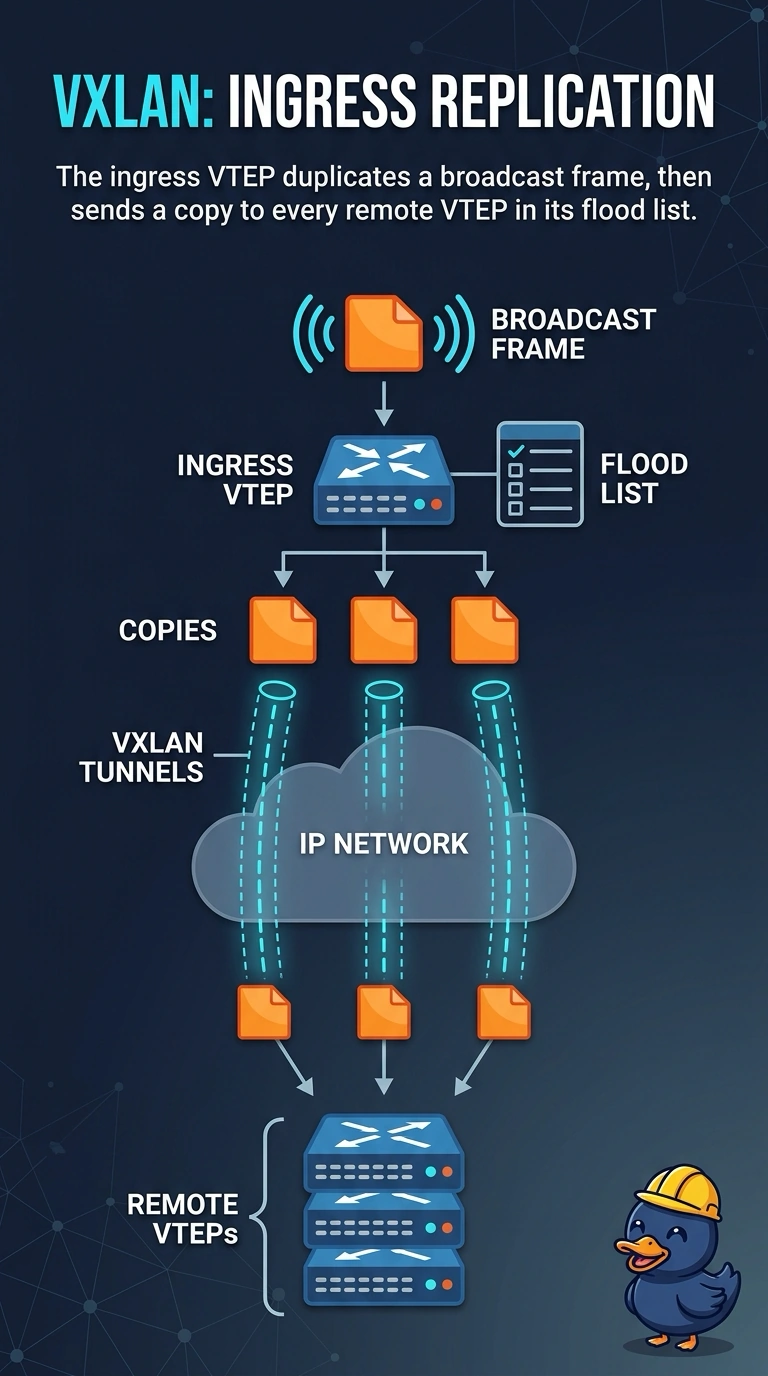
The named letters are arriving, and the flyers never leave the local post office. You use ingress replication so each VTEP copies the ARP broadcast to the remote VTEPs without an underlay multicast tree. A different gateway MAC does not build that flood path, and it is not what this underlay is missing.
Full Explanation
Known unicast in VXLAN is tunneled to the specific remote VTEP that owns the destination MAC, so it can work with ordinary underlay routing. Broadcast, unknown unicast, and multicast need a flood method. With no multicast routing in the underlay, the fitting method is ingress replication: the ingress VTEP makes a copy for each remote VTEP in the flood list. Sparse-mode multicast in the underlay is the other flood method, and it requires multicast routing that this bank does not have. Choosing it does not flood BUM on a network where that routing is absent. A unique anycast gateway MAC on each VTEP would break gateway reachability for a moved host. It does not convert an ARP broadcast into unicast, and it is not a BUM transport. A vPC peer-keepalive is a liveness probe between a vPC pair. It is not the flood tree for a VXLAN segment, and most of these VTEPs are not using it to replicate broadcasts. Caveat: ingress replication still needs the remote VTEP addresses in the flood list, or the local VTEP has nobody to copy the broadcast to. Operational check: enable ingress replication on the segment, confirm the remote VTEPs are in the flood list, and verify an ARP broadcast from one host is received on a remote VTEP.