
A retail bank uses PIM sparse mode for an any-source group. Receivers and the source are up, the unicast route to the source matches the interface where the stream would arrive, and no rendezvous point is configured. Why does the stream fail to start?
Select an answer to reveal the explanation.
Short Explanation
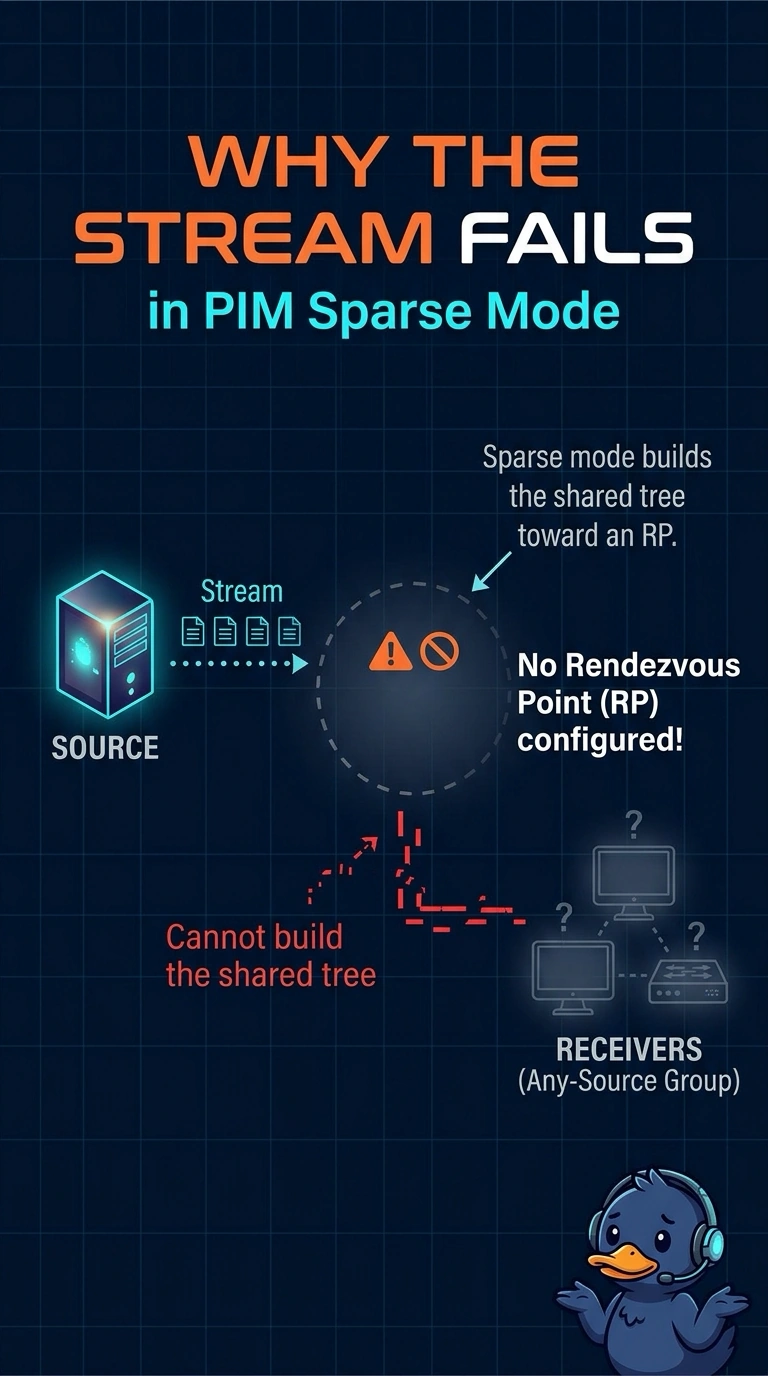
Sparse-mode multicast meets at a landmark before anyone takes the direct path. You never named a rendezvous point, so the routers have nowhere to build the shared tree and the stream does not start. The unicast route already agrees with the door the packets would use, so this is not a reverse-path failure.
Full Explanation
PIM sparse mode for an any-source group builds a shared tree rooted at the rendezvous point. Receivers join toward that point, and the source registers there, before the routers can move traffic onto a source tree. With no rendezvous point configured for the bank's group, that shared tree has nowhere to form and the stream never starts. The unicast route to the source already points out the interface where the packets would arrive, so a reverse-path failure is not the drop in this incident. Reverse-path checks matter once packets are arriving on the wrong interface. HSRP elects a gateway. It does not create a rendezvous point, and leaving preempt off does not stop a multicast tree. A stub OSPF area changes which external routes the area accepts. It does not delete the receiver VLAN from the unicast table, and this bank already has the unicast route it needs. Caveat: source-specific multicast can forward without a rendezvous point, but this group is any-source sparse mode, so the rendezvous point is required. Operational check: configure the same rendezvous point for the group on the routers that must join, then confirm the shared tree appears and the receivers get the stream.