
Two game studio Nexus switches share an area, timers, and MTU, but one OSPF neighbor stays Down and that interface sends no hellos. The interface is passive. What is stopping the adjacency?
Select an answer to reveal the explanation.
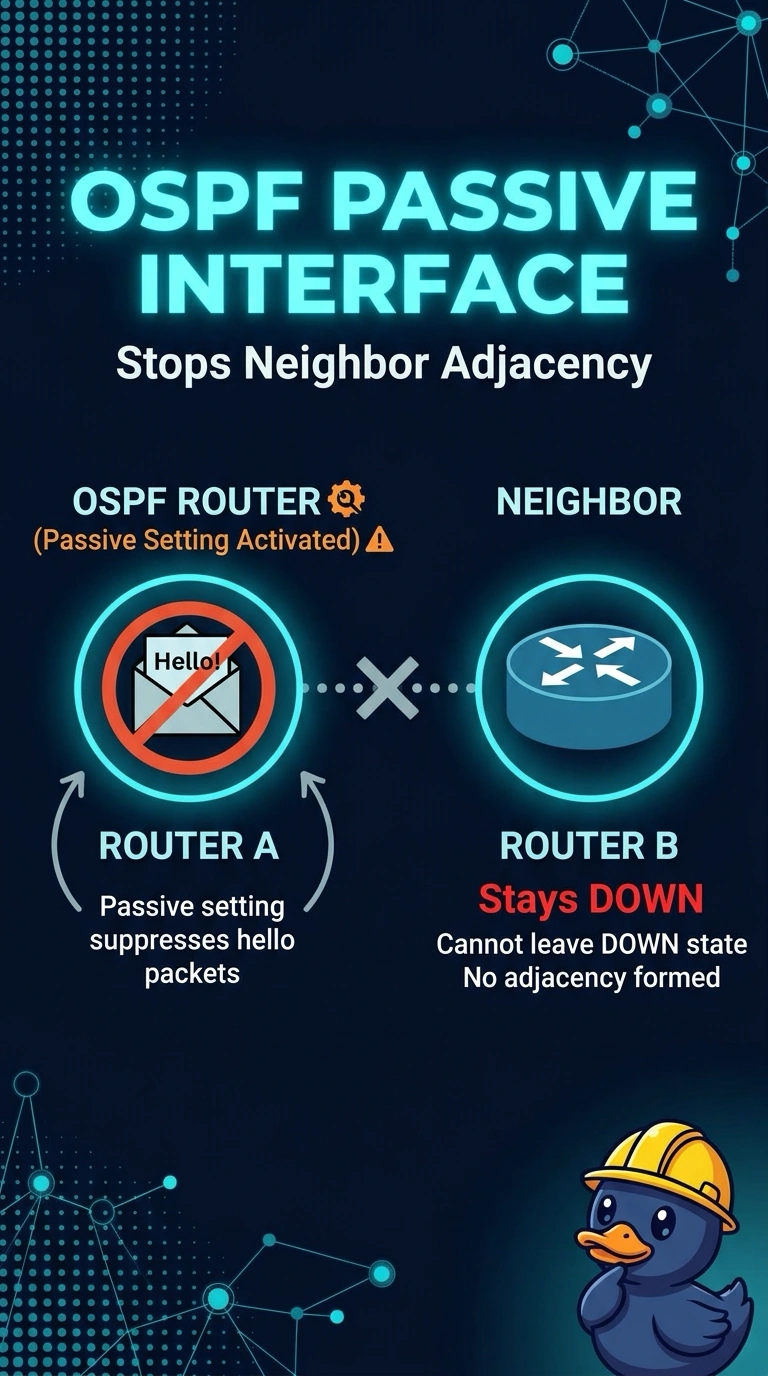
Short Explanation
A passive interface is a doorbell with the wires lifted. You configured the interface passive, so it does not send hellos and the neighbor stays Down no matter how carefully the area and timers match. An authentication problem would still let hellos onto the wire and then reject the neighbor, which is not this silence.
Full Explanation
An OSPF passive interface advertises its network but does not send or accept hellos on that link. With no hellos, the game studio neighbor cannot progress and remains Down, even when area, timers, and MTU already match. Removing the passive setting on the interfaces that should form the adjacency is what lets hellos flow. An authentication mismatch rejects OSPF packets that do not carry the expected key. Those hellos are still transmitted, so a dead silent interface is not the authentication symptom. The OSPF process tag is local to each switch. Neighbors do not compare tags, and a tag difference does not suppress hellos. HSRP preempt controls whether a returning router takes the active gateway role. It has no effect on whether OSPF sends hellos, and leaving preempt off does not pin a neighbor in Down. Caveat: a passive interface is useful on links with no OSPF neighbor, such as a pure host VLAN, so remove it only on the link where this adjacency is required. Operational check: clear the passive setting on both ends of the link, confirm hellos are leaving, and confirm the neighbor reaches the full state.