
A national retailer's vPC pair loses the peer-keepalive, and the peer-link stays up. What happens to the vPC member ports?
Select an answer to reveal the explanation.
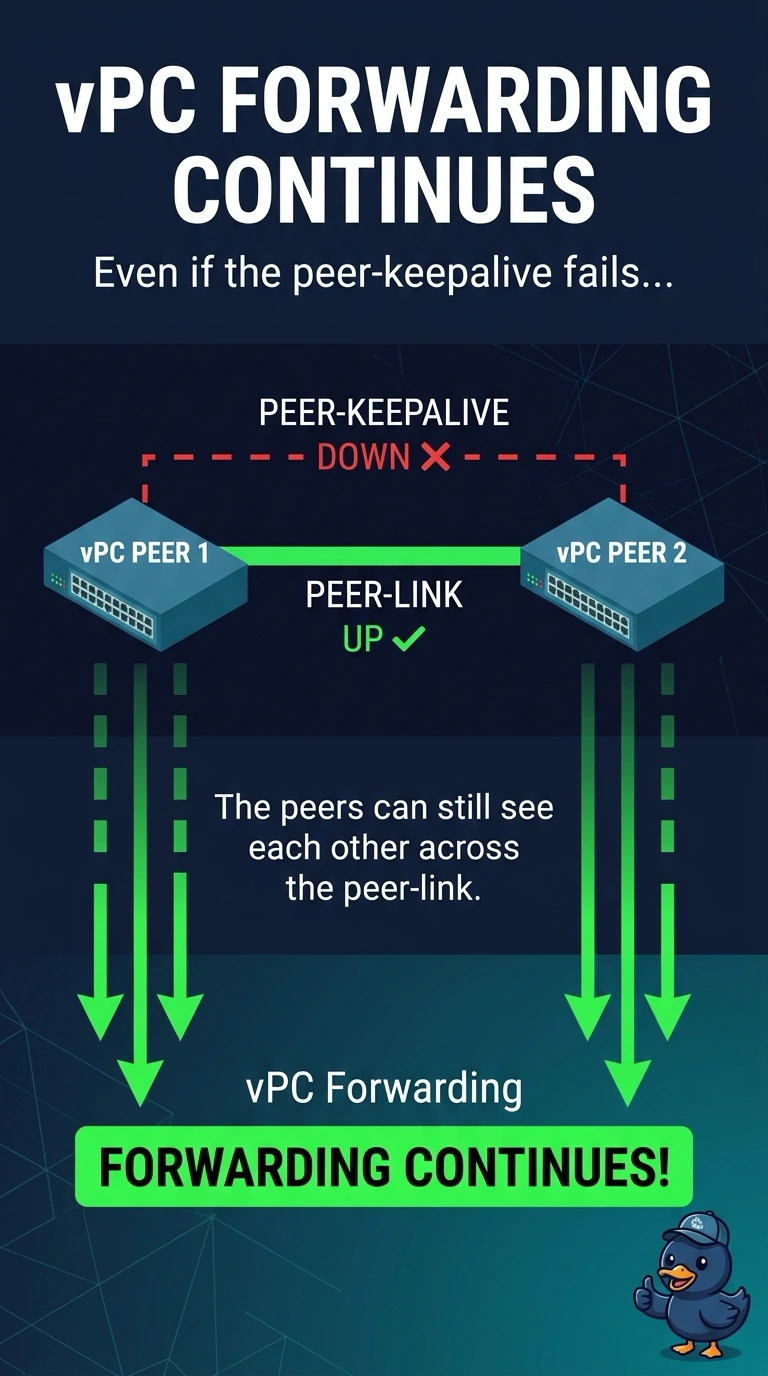
Short Explanation
The peer-link is the pair still standing in the same room and talking. You lost only the keepalive, so the member ports keep forwarding, because each switch can still see the other across the peer-link. Suspending those ports is the reaction to a dead peer-link while keepalive is alive, which is the opposite of this failure.
Full Explanation
vPC uses the peer-link to synchronize state and to carry the traffic that must cross between the peers, and it uses the keepalive to detect a peer when the peer-link is gone. If the keepalive fails while the peer-link stays up, both switches can still see each other, so they keep the vPC member ports forwarding. The retailer loses dual-active detection until the keepalive is repaired, and the data plane does not suspend. The suspension rule is the other failure: peer-link down and keepalive up, where the secondary suspends member ports so both peers do not forward the same vPCs. Treating every keepalive loss as that case is backwards. Orphan ports are hosts attached to only one peer. A keepalive failure does not relabel member ports as orphans or tell them to flood BPDUs on every VLAN. HSRP preempt is a gateway behavior. Member ports do not wait on an HSRP election on the keepalive VLAN, and the keepalive VLAN is not the peer-link. Caveat: while the keepalive is down, a later peer-link failure can split the pair without a clean suspension, so the keepalive should be restored before that risk is ignored. Operational check: shut only the keepalive path, confirm member ports stay up and a warning reports the keepalive, then restore it and confirm the warning clears.