
A national retailer uses the same anycast gateway IP on every VTEP for one VXLAN segment, but two leaves were built with different anycast gateway MAC addresses. Hosts that move between those leaves cannot use the gateway until ARP times out. What must match on the VTEPs?
Select an answer to reveal the explanation.
Short Explanation
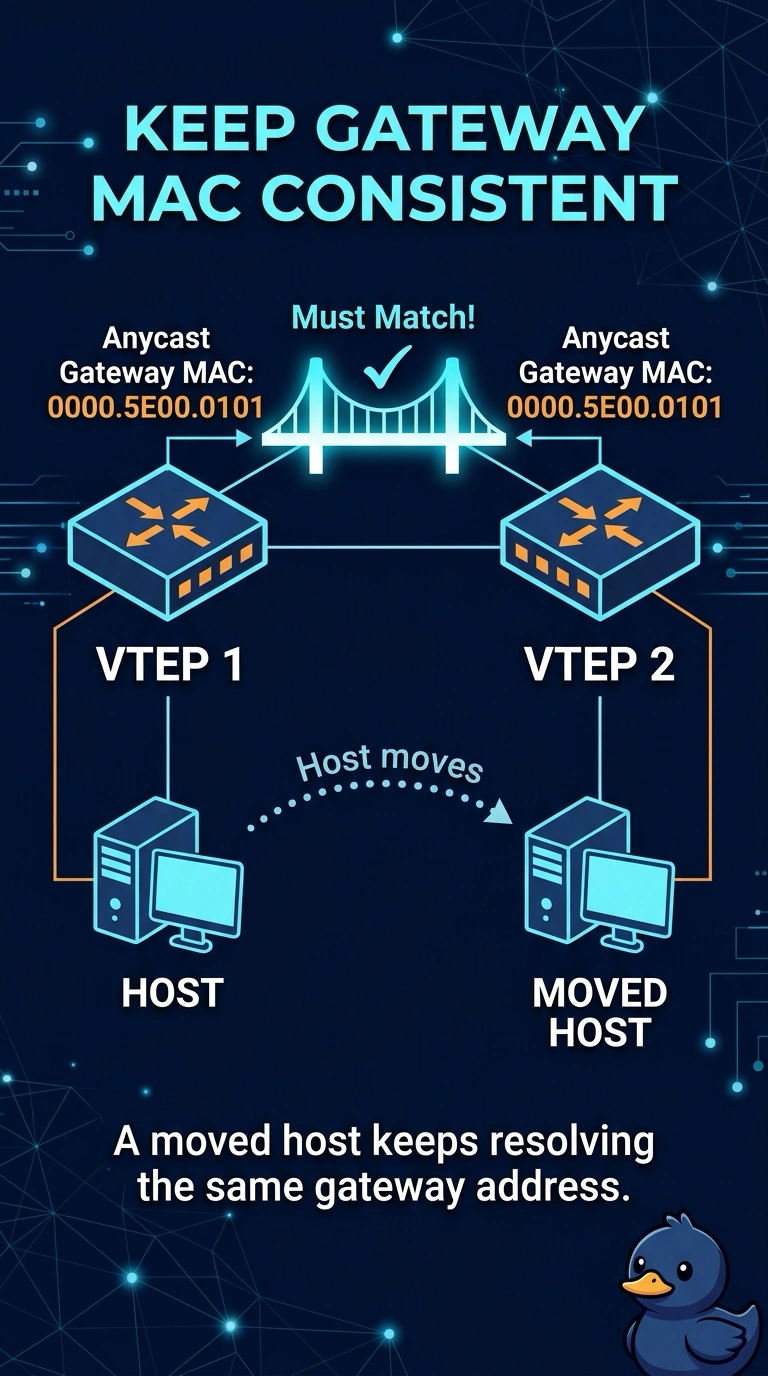
The anycast gateway is a shared storefront, and every VTEP has to hang the same sign on it. You keep both the IP and the MAC identical so a host that moves still recognizes its gateway. A different MAC makes the host wait on an ARP entry that now points at the wrong place.
Full Explanation
Distributed anycast gateway lets every VTEP own the same gateway IP for a segment, and the gateway MAC has to be that same anycast MAC on every VTEP. A moved host keeps its ARP entry for the gateway. If the new leaf uses a different MAC, the host keeps sending frames to a MAC that leaf is not answering, until ARP times out and the host learns the new one. Matching the anycast gateway MAC is the fix. The OSPF process tag is local. VTEPs do not need identical tags to form underlay adjacencies or to share an anycast gateway. Duplicating a BGP router ID on purpose makes BGP unstable and does nothing useful for the gateway MAC. The vPC peer-keepalive decides whether a vPC peer is alive. Anycast gateway forwarding is not elected by that keepalive address, and many VTEPs in this design are not even a single vPC pair. Caveat: the anycast gateway IP and the VNI mapping still have to match as well, or fixing only the MAC leaves the host on the wrong subnet. Operational check: set one fabric-wide anycast gateway MAC, confirm each leaf shows that MAC on the segment, and move a test host to see that the existing ARP entry still reaches the gateway.