
A national retailer has VXLAN tunnel endpoints up and OSPF adjacencies in the underlay, but no host MAC routes appear in BGP. The EVPN address family is not activated for the fabric neighbors. Which advertisement stays missing until that address family is turned on?
Select an answer to reveal the explanation.
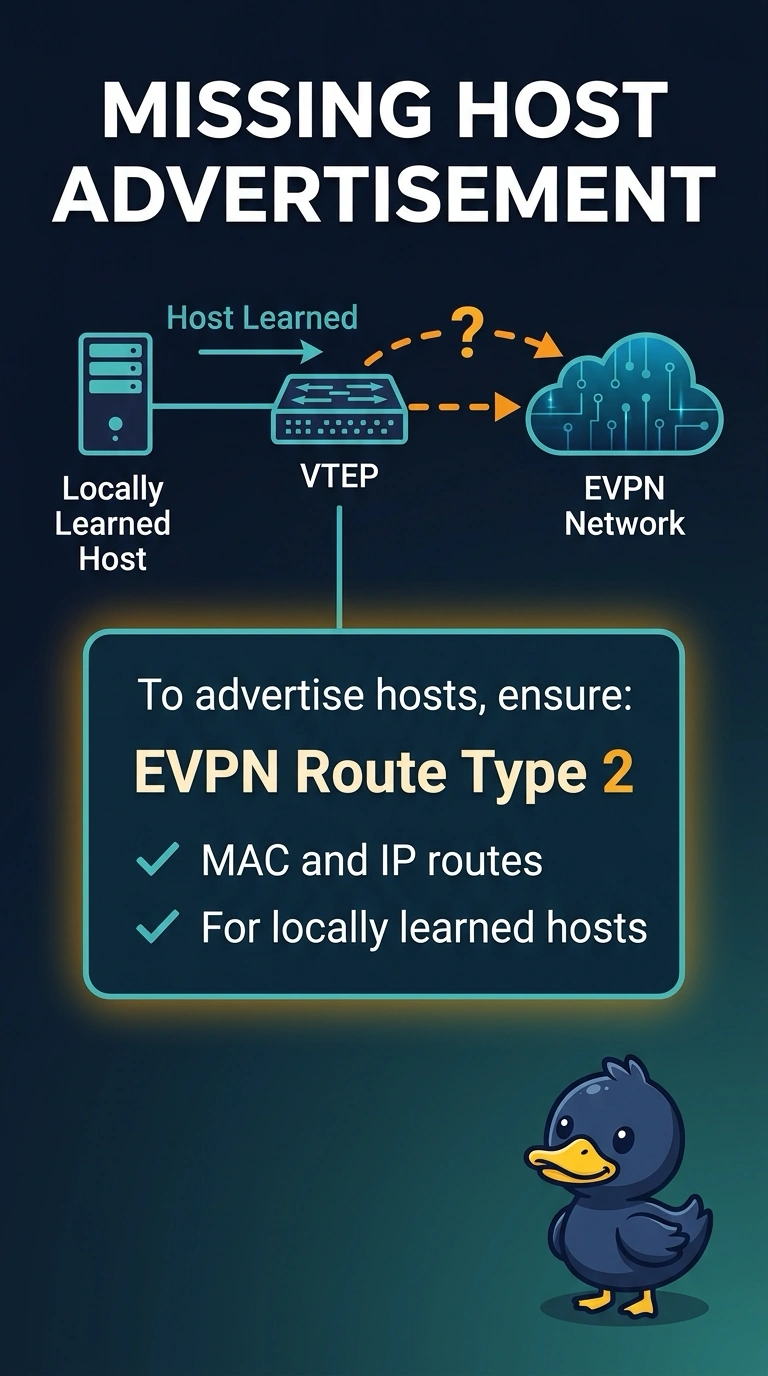
Short Explanation
Think of the underlay as the road and EVPN as the shipping manifest for hosts. Even with OSPF neighbors up, you won’t learn host MAC addresses until the BGP session activates the EVPN address family. Underlay loopback routes remain in IPv4 unicast, so that family does not create them.
Full Explanation
MP-BGP carries EVPN information only in the L2VPN EVPN address family. Route type 2 advertises a host: a VTEP places a locally learned MAC address, and optionally its IP address, in that family so other VTEPs can build remote MAC and ARP tables. Until the family is activated for the fabric neighbors, type 2 routes are not negotiated, matching a fabric with a healthy underlay but no host MAC routes in BGP. IPv4 unicast is a separate family: underlay loopback addresses can be advertised there, or learned through OSPF, without EVPN configuration. VPNv4 prefixes belong to an MPLS Layer 3 VPN, not VXLAN host MAC advertisement. BGP link-state reports underlay topology to a controller; it does not carry endpoint MAC routes. Exam caveat: type 5 prefix routes also use the EVPN family, but missing host MAC routes point to type 2. Practical check: confirm the neighbor has the L2VPN EVPN family established, then look for type 2 routes from the local VTEP after a host sends an ARP.