
A media company uploaded new images and created a new host firmware package. Associated blades still run the previous BIOS. The maintenance policy is immediate. Why has no blade rebooted into the new package?
Select an answer to reveal the explanation.
Short Explanation
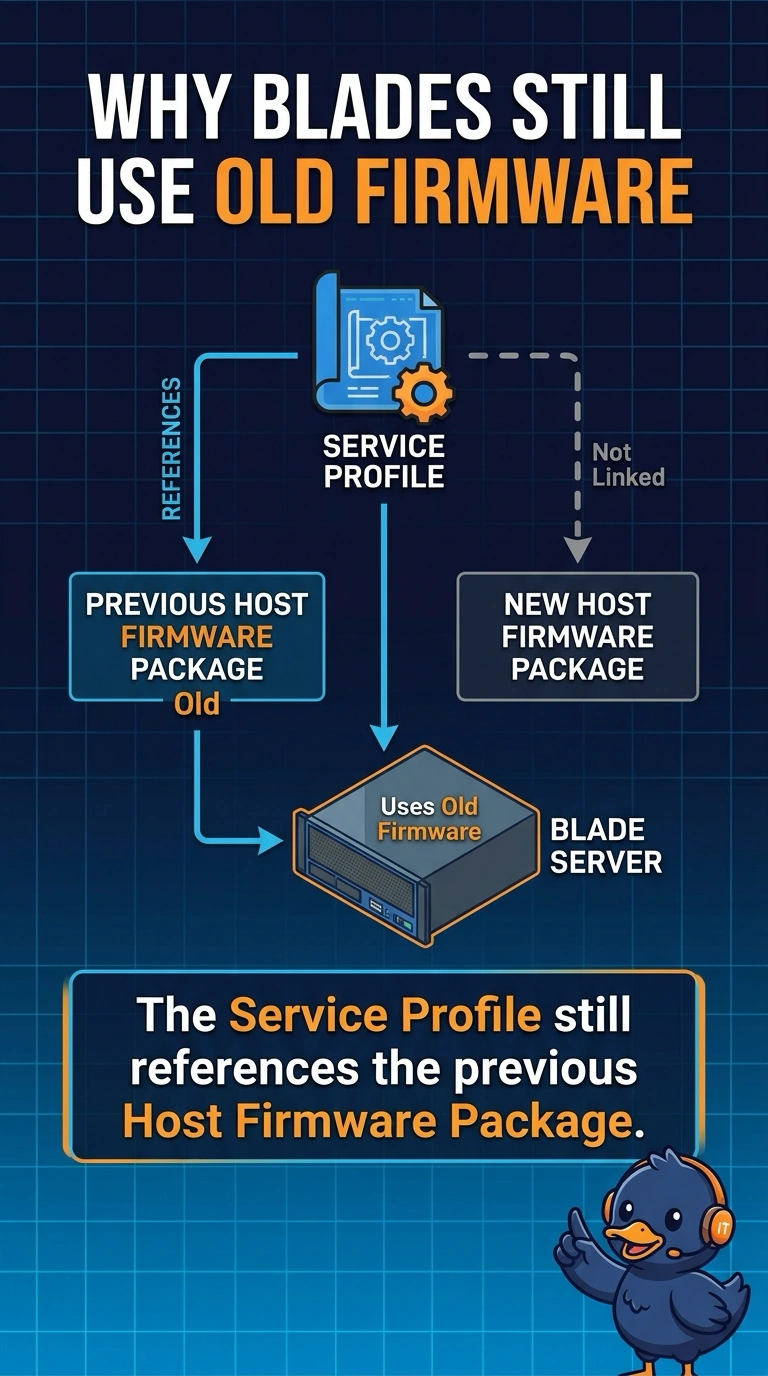
You printed a new menu and left the old one clipped to every table. The blades boot the host firmware package their service profiles name. A new package that nothing references never stages, so an immediate maintenance policy has no reboot to perform.
Full Explanation
The host firmware package on the service profile, or on the updating template that profile follows, is what selects BIOS, CIMC, and adapter code for that server. Creating another package in the library does not retarget existing profiles. Until the profile references the new package, the blade stays on the old one and the maintenance policy is never asked to reboot it. An immediate maintenance policy applies the change without waiting for acknowledgment. User-ack is the policy that waits, and it is not the policy in use here. A host firmware package is server firmware. Fabric interconnect and IOM code belong to the infrastructure firmware, so this package was never the fabric interconnect image. The chassis discovery link count decides whether a chassis is discovered. It does not freeze BIOS upgrades on blades that are already associated. Caveat: after you point the profiles at the new package, immediate maintenance will reboot them. If you need a window, change the maintenance policy before you retarget the package. Operational check: open one service profile, confirm the host firmware package name, and only then expect a reboot.