
A media company cabled two links from a new blade chassis to each fabric interconnect and configured those ports as server ports, but the chassis is not discovered. The chassis discovery policy requires four links. Which change matches the cabling?
Select an answer to reveal the explanation.
Short Explanation
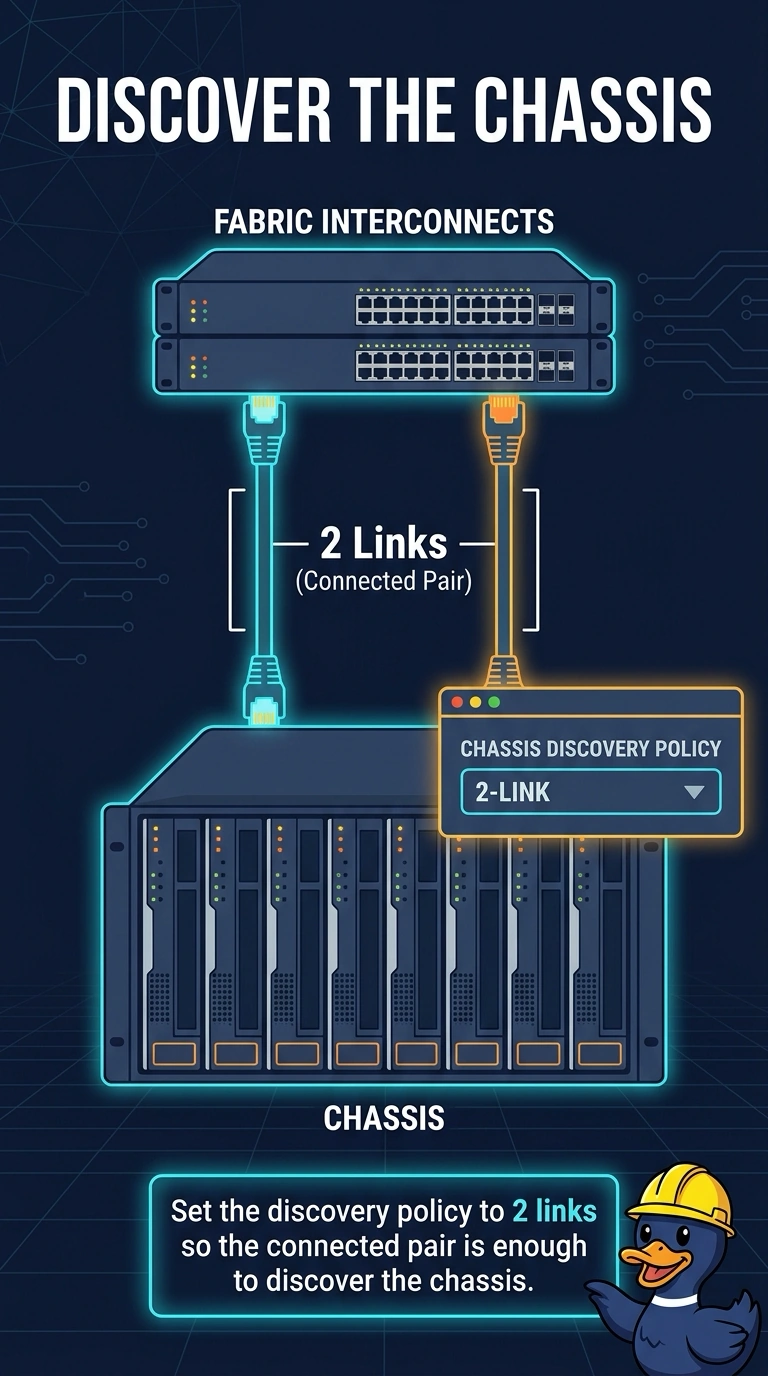
The loading dock was told to expect four trucks, and only two arrived, so the door never opened. You set the chassis discovery policy to two links so the cabling you actually installed is enough. Turning those server ports into LAN uplinks points them at the wrong role and still does not discover the chassis.
Full Explanation
The UCS chassis discovery policy states how many links must be up before a chassis is discovered. This media company configured the ports as server ports and cabled two of them to each fabric interconnect, but the policy still requires four, so discovery does not start. Lowering the policy to two links matches the cabling and lets the chassis appear. LAN uplinks face the upstream network. Changing the IOM-facing server ports into uplinks removes the chassis path rather than starting a two-link discovery. A host firmware package applies to a server after hardware exists in inventory. It is not a prerequisite image for discovering an empty chassis, and there is no server yet to update. A service profile template associates a configuration to a server that has already been discovered. Binding one to a pool does not count links or discover a chassis. Caveat: the links have to be up on both fabrics if the design expects both sides, or a policy of two links can discover a chassis that is still missing a fabric. Operational check: set the discovery policy to two links, confirm the server ports are up, and acknowledge the chassis when it appears.