
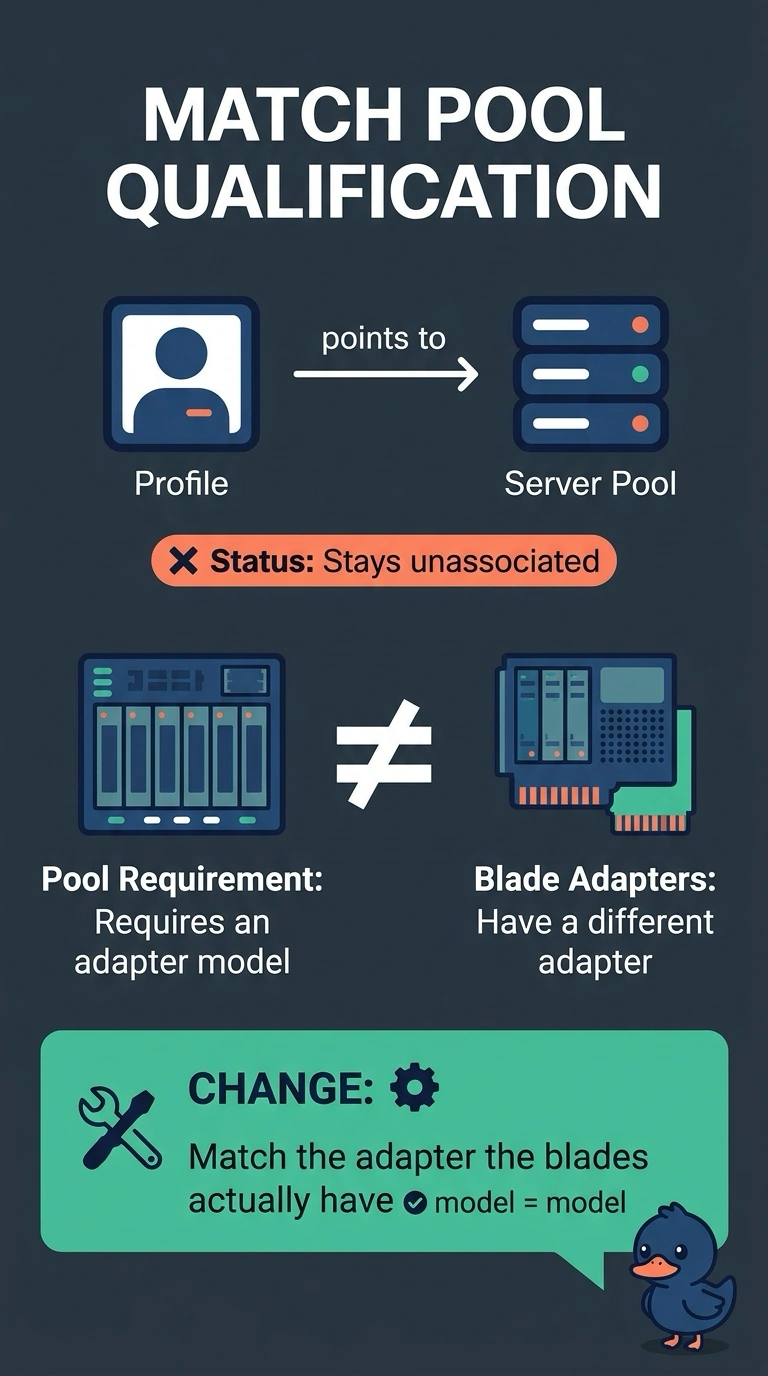
A SaaS platform service profile points at a server pool and stays unassociated. The pool qualification requires an adapter model that none of the blades have. What change allows a blade to be selected?
Select an answer to reveal the explanation.
Short Explanation
The hiring form demands a license none of the candidates hold, so the chair stays empty. You change the server-pool qualification to the adapter these blades actually have, and a blade can be selected. Adding a UUID does not make a blade match, because a UUID is an identity and not a hardware qualifier.
Full Explanation
A server-pool qualification is the hardware filter UCS uses before it will place this service profile. The qualification demands an adapter model none of the SaaS blades have, so the pool has no legal target and the profile stays unassociated. Changing that qualification so it names the adapter these blades actually have removes the mismatch and lets a blade be selected. Adding another address to the UUID pool only creates another identity string. The UUID pool does not qualify a blade, and an extra identity does not make the installed adapter match the rule. Setting the maintenance policy to immediate tells UCS when a server that already has a profile may reboot. Immediate mode does not ignore an adapter qualifier, and it cannot associate a profile to hardware the qualification rejects. Moving the boot policy so SAN is first only changes the boot order after a profile is already associated. An unassociated profile is not waiting on a boot target. Caveat: the same qualification can also require memory or CPU counts, so the adapter line can be right and another line can still exclude these blades. Operational check: compare the qualification with the adapter reported on one blade, align that requirement, and confirm the profile reaches the associated state.