
A media company vNIC is pinned to one uplink. That uplink fails, and the vNIC goes down even though other uplinks on the same fabric interconnect are up. Why did the vNIC stay down?
Select an answer to reveal the explanation.
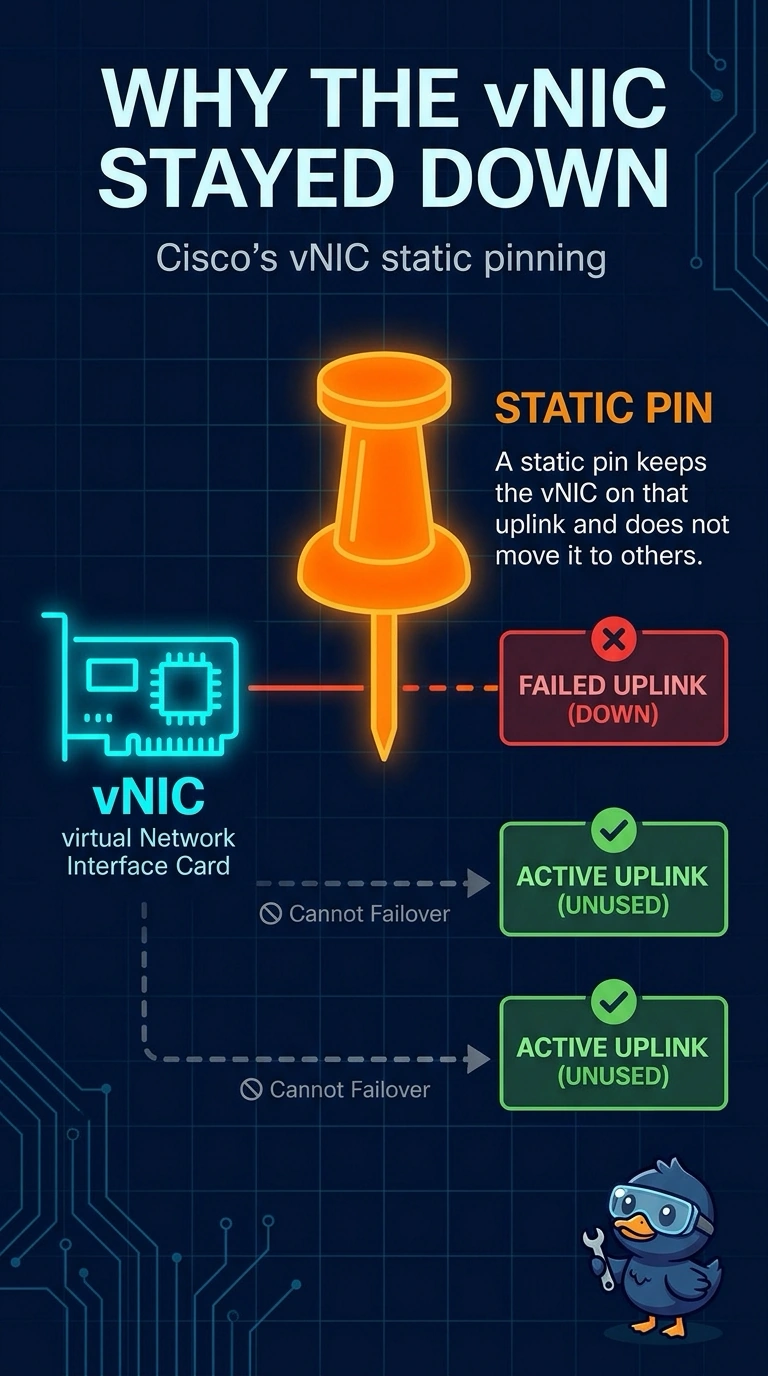
Short Explanation
You can think of a static pin as a fixed destination: you tied this vNIC to one uplink, so it does not move to the other uplinks when that one fails. A missing VLAN would leave the vNIC up but unable to reach that network, which is different from this outage.
Full Explanation
The vNIC is statically pinned to one uplink, so its connection remains tied to that uplink when it fails; it does not move to other uplinks on the fabric interconnect. The vNIC therefore goes down even though those other uplinks are up. A missing VLAN in the vNIC template would prevent network access on that VLAN, but it would not explain the vNIC going down specifically when its pinned uplink fails. A WWNN pool allocates Fibre Channel node names; Ethernet pin groups do not draw names from it, so an empty pool cannot keep this vNIC on a failed uplink. An unacknowledged chassis is a chassis discovery or management issue, not a setting that forces every uplink to share one vNIC pin. Caveat: alternate uplinks must be on the same fabric interconnect to be relevant; the other fabric is a separate path and does not inherit this static pin. Practical check: clear the static pin or restore the failed uplink, then confirm that the vNIC comes back on an uplink that is up.