
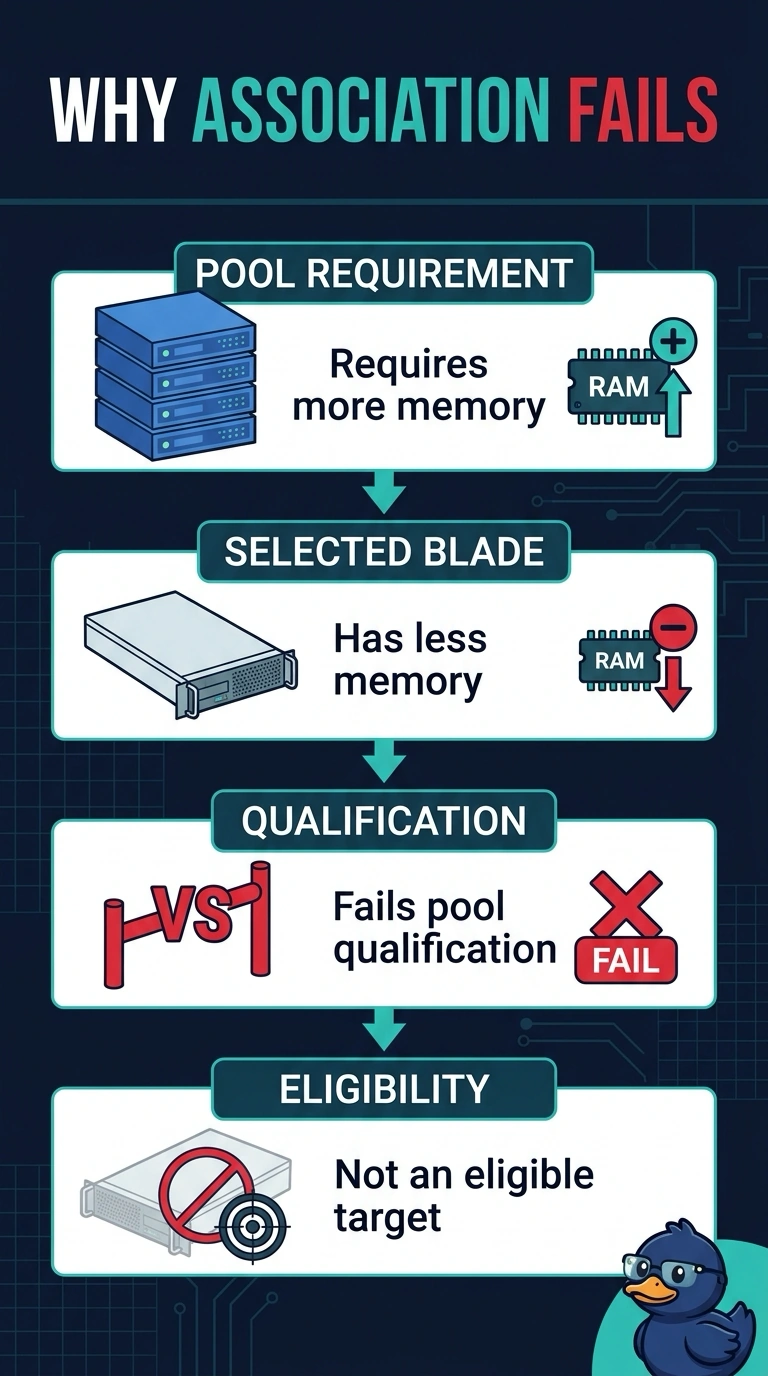
A media company service profile stays unassociated. The server pool qualification requires more memory than the selected blade has. Why does association fail?
Select an answer to reveal the explanation.
Short Explanation
The server pool is a velvet rope with a height mark on it. You asked for more memory than this blade has, so the profile is not allowed to associate to it. Boot order matters after a blade is chosen, and it is not the gate that rejected this assignment.
Full Explanation
A server pool qualification describes which blades are eligible, using hardware attributes such as the amount of memory. When the only blade in front of the profile does not meet that qualification, UCS will not associate the profile to it, which is the media company's failure. The boot policy chooses the device order used at power-on. It is applied to a profile that already has a server, and a disk-versus-SAN order does not make a blade ineligible. A UUID pool supplies an identity string for the profile. It is not where memory size is checked, and an empty UUID pool would be a different shortage than a memory qualification. Grid is a chassis power policy for two independent feeds. It does not read blade memory and does not refuse a service profile because a qualification failed. Caveat: a pool that also demands a specific adapter or CPU can fail the same way, so read the qualification that is actually bound to the pool. Operational check: compare the blade inventory memory with the qualification, then either pick a blade that qualifies or relax the rule and confirm the profile associates.