
A SaaS platform can open each fabric interconnect on its own address, but the cluster virtual IP does not answer. The L1 and L2 cluster ports between the pair are not cabled. What is missing?
Select an answer to reveal the explanation.
Short Explanation
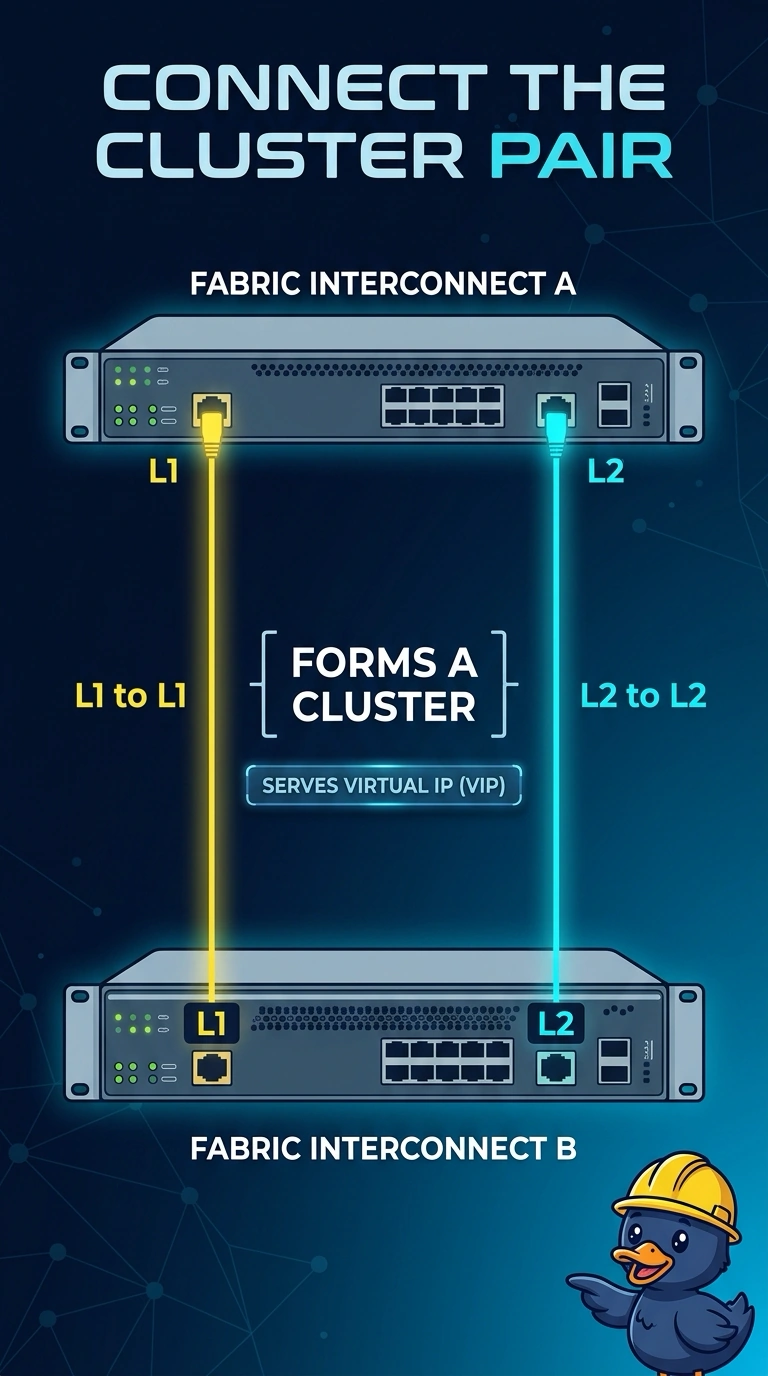
The virtual IP is the front desk, and it opens only after the two interconnects can see each other. You cable L1 to L1 and L2 to L2 so the cluster can form and own that address. Acknowledging a chassis does not elect the cluster address.
Full Explanation
Fabric interconnect high availability uses the L1 and L2 cluster ports, cabled L1 to L1 and L2 to L2, so the pair can see each other and elect a primary. The cluster virtual IP is served by that primary. Each interconnect can still answer on its own management address when the cluster links are missing, which is the SaaS symptom. Cabling L1 and L2 is what lets the cluster form and the virtual IP answer. Those ports are not LAN uplinks. Configuring them toward the data center switches does not create the cluster heartbeat. Acknowledging a chassis brings discovered blade hardware into inventory. It does not create the cluster virtual IP. NPV is a Fibre Channel edge mode used so a switch does not take a domain ID. It is not a fabric interconnect clustering mode, and it does not replace the L1 and L2 cables. Caveat: the virtual IP still has to be configured in the cluster addressing, so cables alone do not help if no cluster address was ever set. Operational check: cable L1 and L2, confirm the pair shows a healthy cluster, and confirm the virtual IP answers on the primary.