
A game studio GPU cluster uses RoCEv2. Jumbo frames already pass end to end, and the GPUs still drop when the fabric is busy. The traffic class has no flow control. What supplies lossless behavior for that class?
Select an answer to reveal the explanation.
Short Explanation
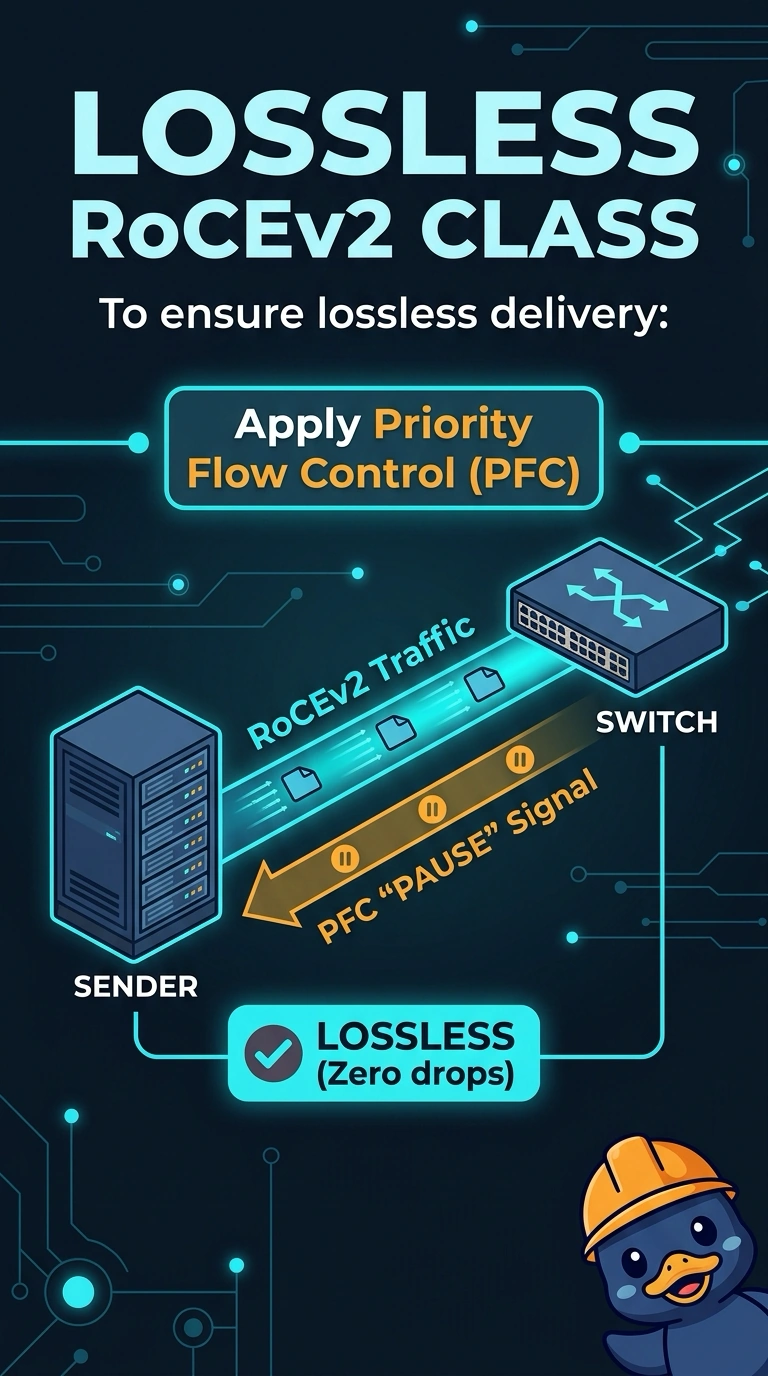
A bigger box does not keep your fruit from bruising when the conveyor stops hard. Jumbo frames only change how many bytes fit, while Priority Flow Control pauses the RoCEv2 class when a queue fills.
Full Explanation
RoCEv2 rides Ethernet and needs a lossless class. Priority Flow Control, the IEEE pause for one priority, tells the previous hop to stop sending that class before the buffer overflows. That is the flow control this cluster does not have. Raising the MTU again changes frame size. It does not generate pause, so a congested best-effort queue still drops. Explicit congestion notification marks traffic so the endpoints can slow down. Those marks are useful congestion signaling, and they do not by themselves pause the switch queue. A class with only ECN is not lossless. A SPAN session copies frames for an analyzer. It does not change how the queue behaves under load. Caveat: the pause has to be on the priority the GPUs use, on each hop, or traffic that falls into best effort still drops. Operational check: confirm the RoCEv2 class shows pause activity when you load it, and confirm the NICs are mapped to that class. Map the GPUs and the switch ports to the same priority before you call the test done. Pause on an unused priority leaves RoCEv2 in a class that still drops.