
A logistics company wants VLAN changes pushed to dozens of Nexus switches from one control host, with no agent installed on the switches, and a second run should change nothing if the VLANs already match. Which tool fits?
Select an answer to reveal the explanation.
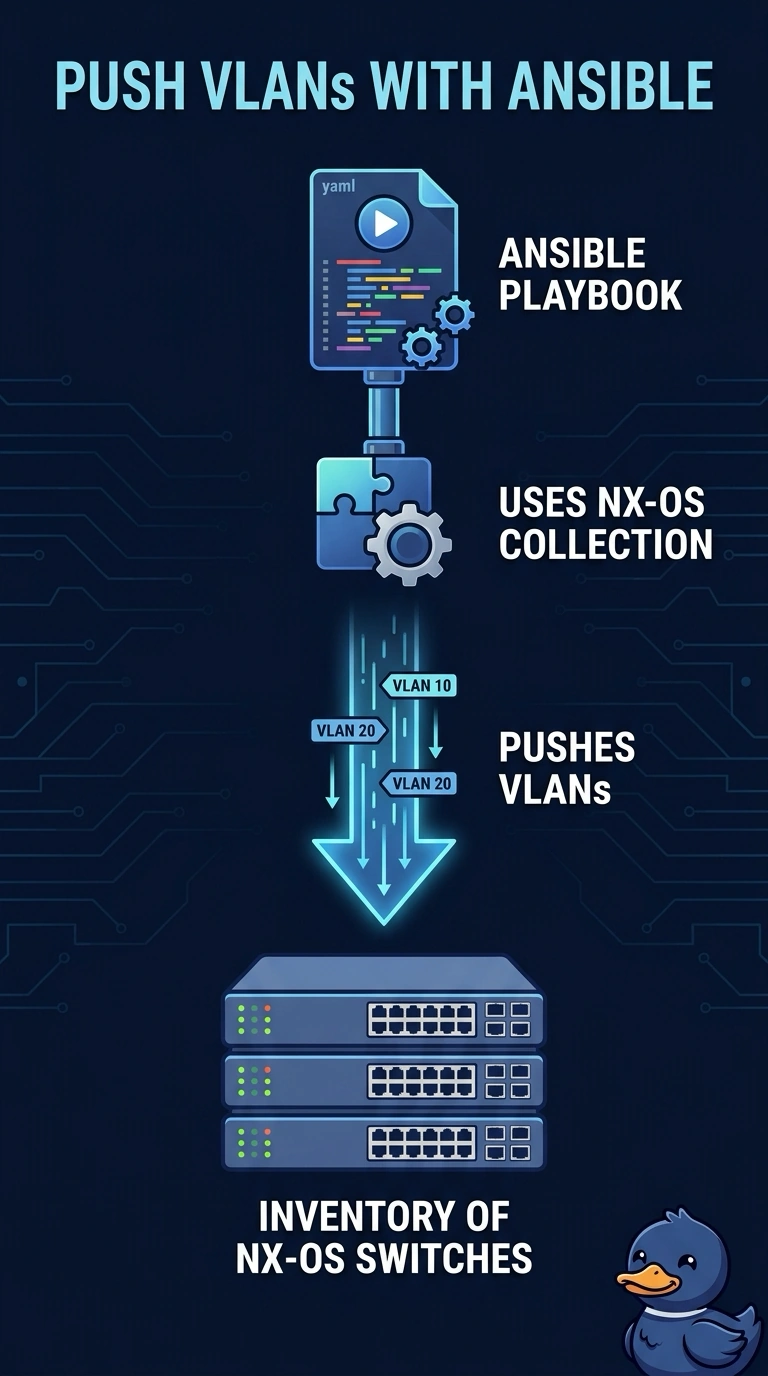
Short Explanation
You want a crew that visits every loading dock with the same checklist and leaves quietly if the work is already done. Ansible does that over the network, with no agent on the switch. A boot script or a syslog applet is a different job.
Full Explanation
Ansible talks to Nexus switches over SSH or NX-API, uses an inventory, and applies playbook tasks that describe the desired VLANs. A second run against switches that already match the playbook reports little or no change, which is the idempotent behavior the logistics team asked for, and nothing has to be installed on the switches. POAP is a day-0 process that runs when a switch boots without a startup configuration. It is not a daytime tool for ongoing VLAN edits on switches that are already in service. An EEM applet reacts to an event such as a syslog line. Firing it on every syslog message would churn configuration, and it is not how you roll a reviewed VLAN change across dozens of switches. The scheduler runs a timed job on the switch where it is configured. Spanning tree does not distribute scheduler jobs or VLAN configuration to peers. Caveat: the playbook is only as idempotent as the modules you choose. A raw CLI task that always adds a VLAN can error on the second run if you do not guard it. Operational check: run the playbook twice against a lab switch and confirm the second run does not keep changing the VLAN list.