
A logistics company stores the desired Nexus configuration in files and wants a preview of what will change, based on a stored state file, before any switch is touched. Which tool matches that workflow?
Select an answer to reveal the explanation.
Short Explanation
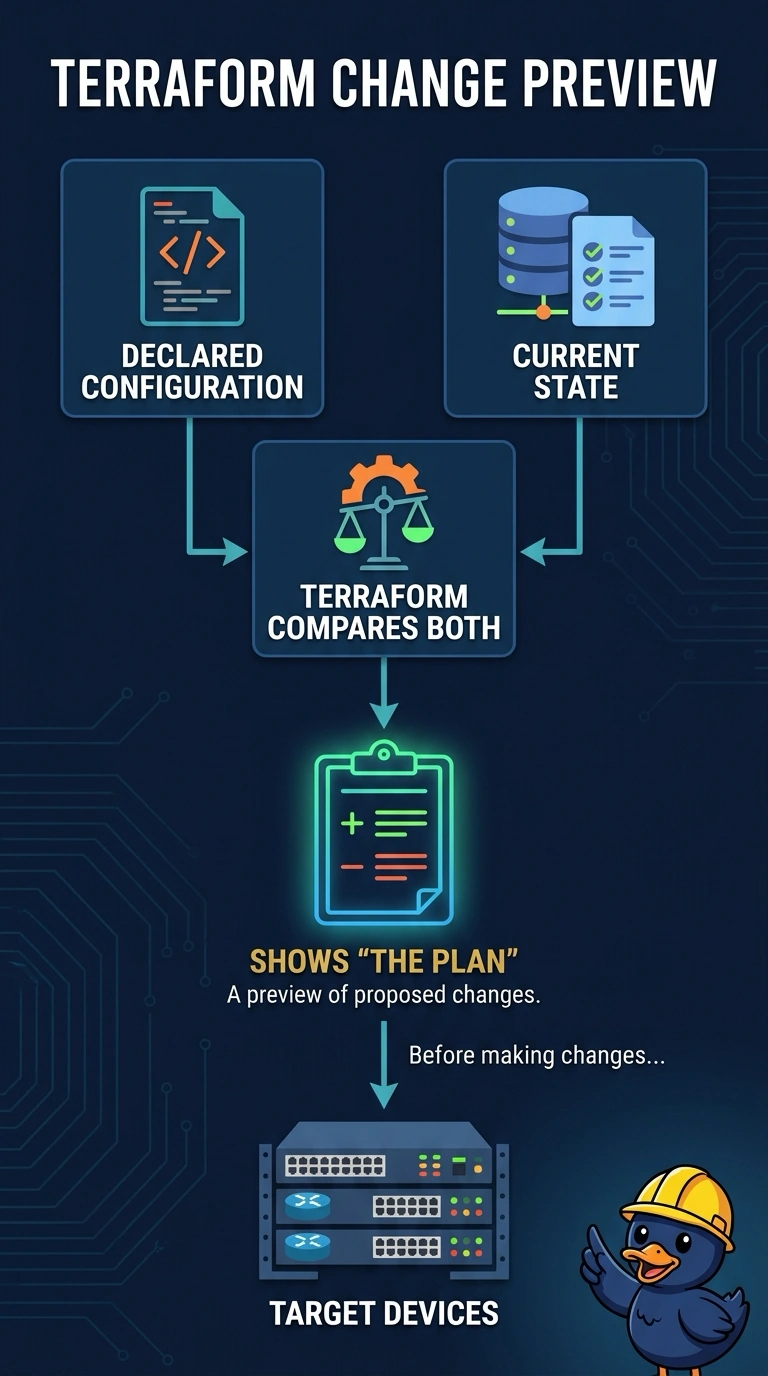
Think of a blueprint and a marked-up drawing of the building you already have. You want the tool that diffs those two and shows the work list before anyone picks up a hammer, which is what Terraform does with a plan and a state file. A playbook that simply walks a task list is a different habit, and it is not that preview.
Full Explanation
Terraform is declarative. You describe the intended configuration, Terraform stores what it last applied in a state file, and a plan shows the gap between the files and that state before any device call is made. That is the preview this logistics company asked for. Ansible is agentless and procedural. Its playbooks can be written carefully so they converge, but the workflow in the stem is a state comparison and a plan, not an ordered task list with no state file as the source of truth. An EEM applet lives on one switch and reacts to an event such as a syslog line. It does not open a state file for a fleet and preview a change. The onboard scheduler runs a command because the clock said so. It can copy a file, and it does not compute a declarative plan against stored state. Caveat: a Terraform plan is only as honest as the state and the provider credentials, so a stale state file can propose a change the network does not actually need. Operational check: run a plan against a nonproduction switch, confirm the preview lists only the intended VLAN difference, and apply only after that preview matches the change window.