
A government agency wants a Nexus switch to shut an uplink when that port's input-error counter crosses a threshold the operator sets. The reaction must follow the counter, not a clock. Which tool matches?
Select an answer to reveal the explanation.
Short Explanation
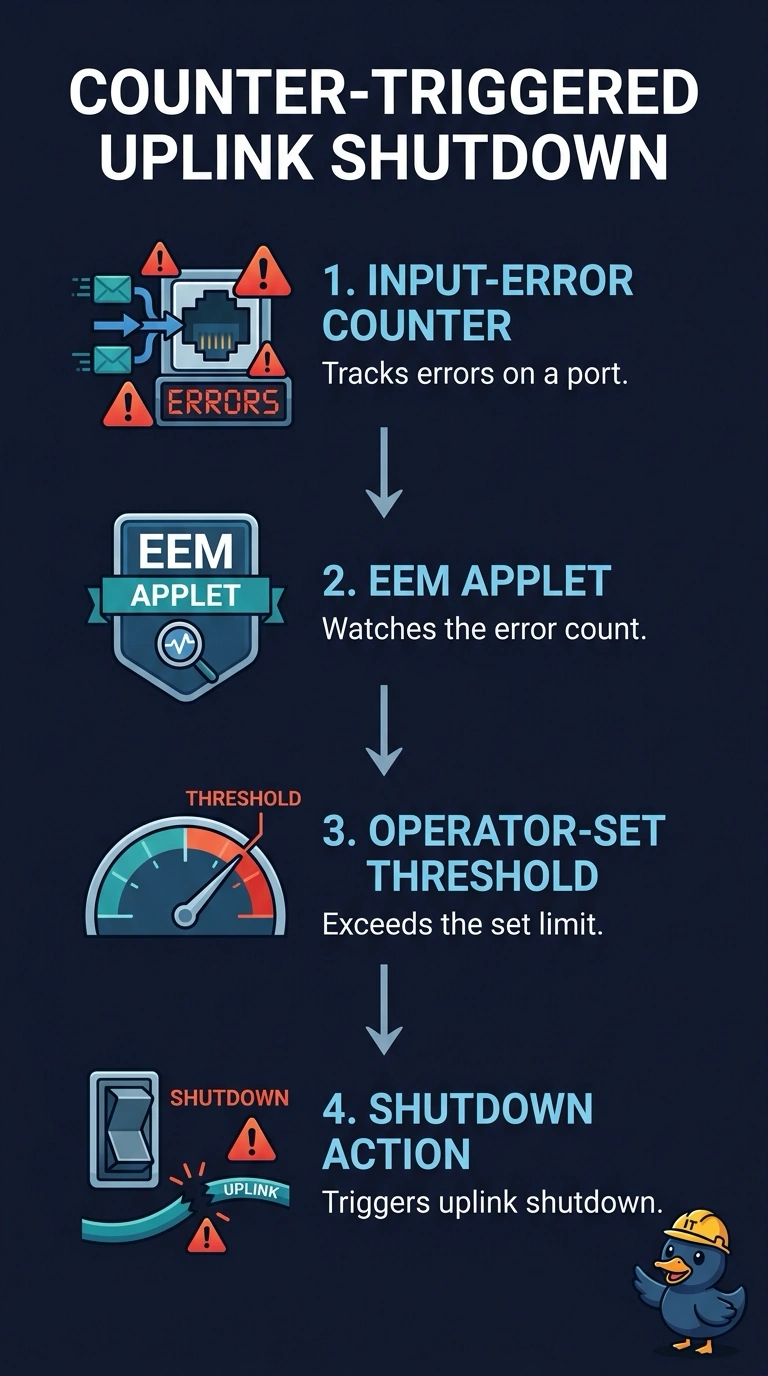
This is a tripwire on a counter, not an alarm clock. You want the uplink shut when its input-error counter crosses the threshold, so an EEM applet watches that counter and runs the shutdown. A scheduled job cannot see the counter cross, because it only wakes up when the clock says so.
Full Explanation
Embedded Event Manager binds an event on the switch to an action. A counter event can watch the input-error counter on the uplink and, when the operator's threshold is crossed, run a CLI action that shuts the port. That is a reaction to the counter itself, which is what the agency asked for. The scheduler runs a job on a timetable. It can read counters when the clock fires, and it does not sit on the counter and fire at the moment the threshold is crossed. POAP is a day-0 process that looks for an image and a configuration when the switch has no startup configuration. It is not a production threshold monitor, and thresholds are not limited to first boot. NetFlow exports flow records to a collector. The collector learns about conversations. It does not shut an uplink on the switch when a flow record arrives, and flow records are not the input-error counter. Caveat: the applet has to be registered, and the shutdown action should be one you can reverse, or a brief error burst takes the uplink down until someone brings it back. Operational check: register the applet, raise the counter on a lab port past the threshold, and confirm the port shuts once because of the applet rather than because a clock expired.