
A logistics company wants a repeatable NTP configuration pushed to many Nexus switches, with nothing installed on the switches, and a second run must not stack a duplicate NTP server. Which tool fits?
Select an answer to reveal the explanation.
Short Explanation
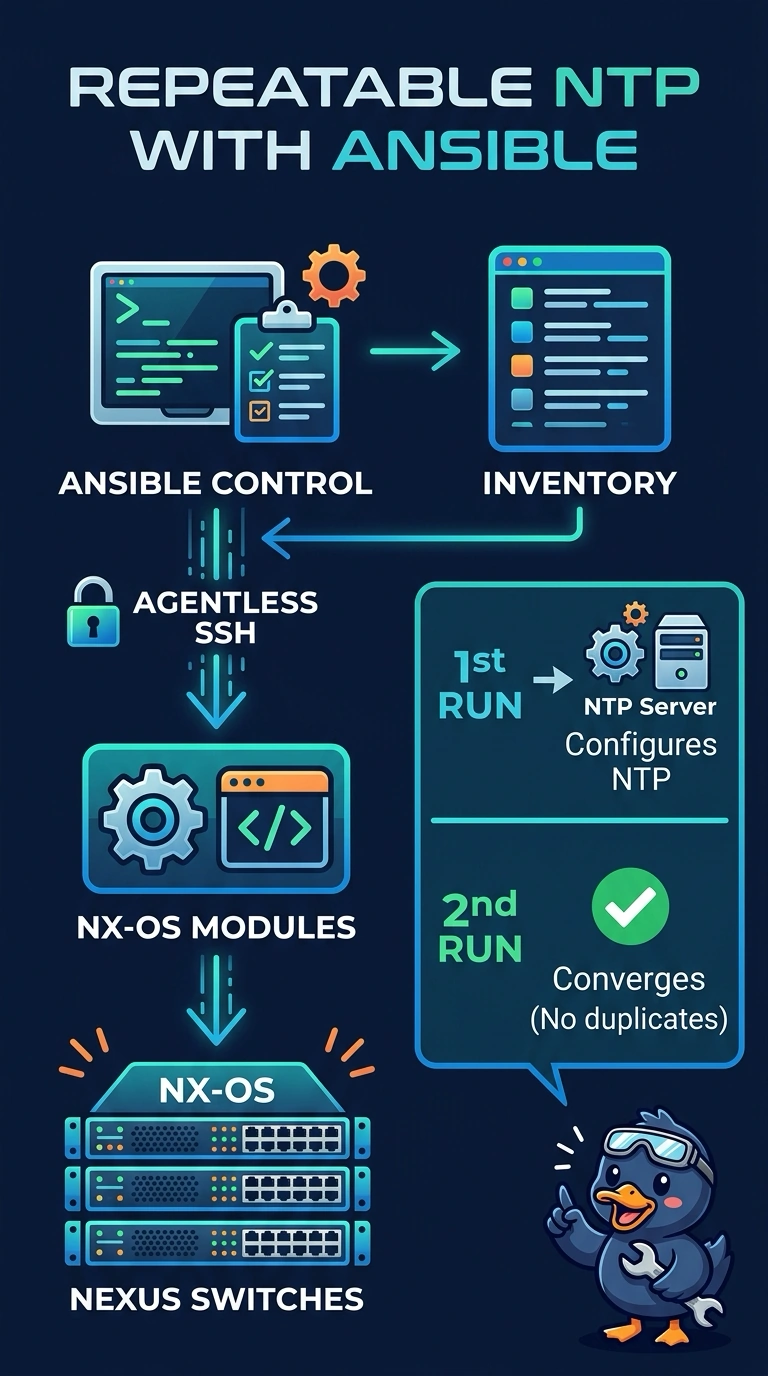
Ansible is a chef who cooks in the kitchen without moving in. You run a playbook over SSH, with no agent on the switches, and an idempotent module so a second run does not stack another NTP server. POAP is a first-boot ritual, not a daily config push.
Full Explanation
Ansible talks to NX-OS from a control host over SSH and does not install an agent on the switch. The inventory lists the logistics switches, and the NX-OS modules are written to be idempotent: if the NTP server is already present, a second run reports success and does not add it again. That matches a repeatable push with nothing installed on the switches. POAP applies an image and a configuration when a switch boots with no startup configuration. Deleting the startup configuration every night to force POAP would wipe the switch. It is not how you refresh NTP. Terraform is a declarative tool with its own state and providers. It is not required for this push, and Ansible does have NX-OS modules, so the claim that Ansible cannot push NTP is false. A SPAN session copies frames. It does not parse a playbook or edit the NTP configuration. Caveat: idempotence depends on using the module the way it was designed. A raw command that always appends a line can still duplicate configuration even inside an Ansible playbook. Operational check: run the playbook twice and confirm the second run does not add a second copy of the NTP server.