
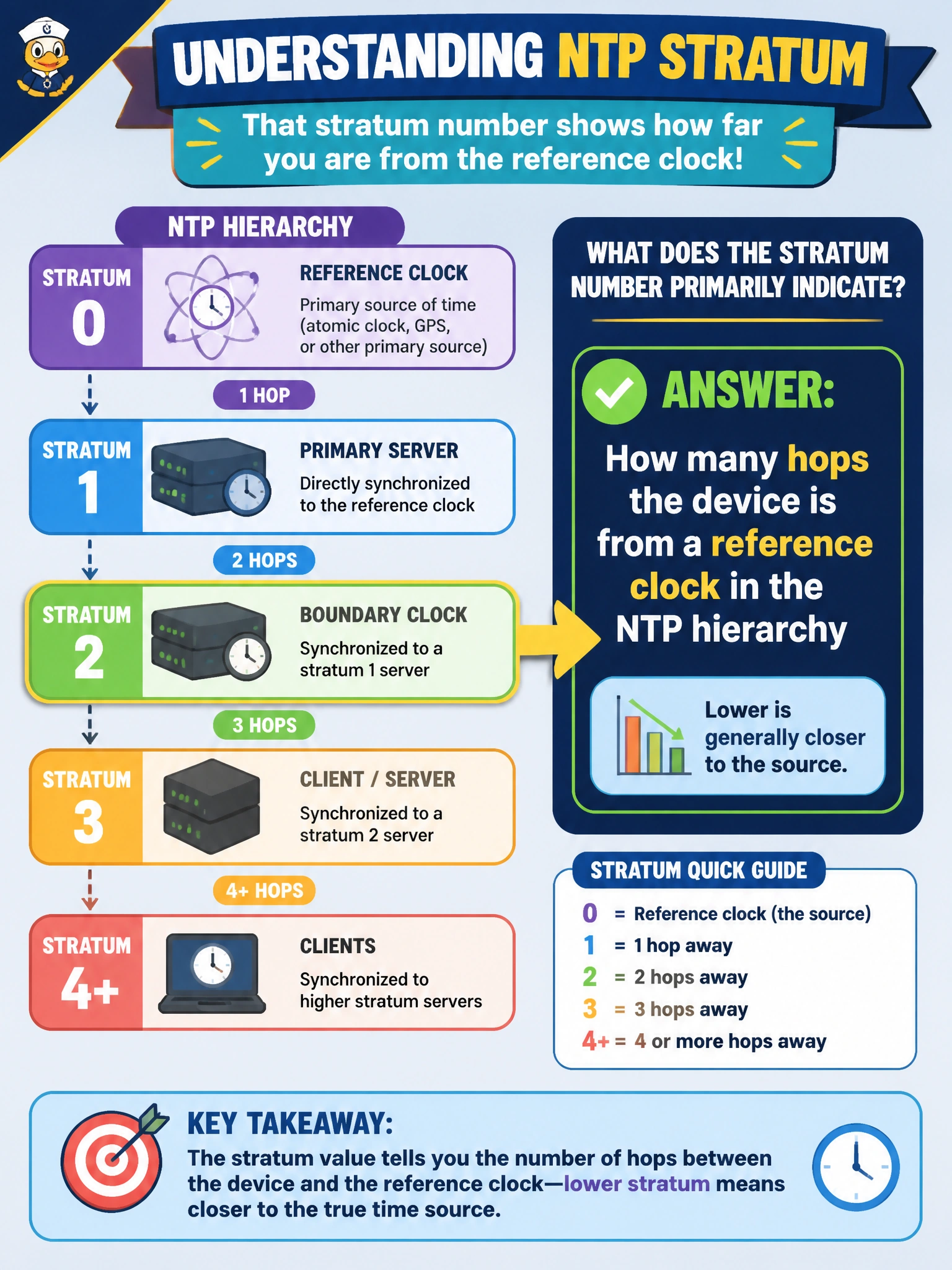
Convention-center engineers interpret NTP status and see a stratum value on a boundary clock. What does that stratum number primarily indicate?
Select an answer to reveal the explanation.
Short Explanation
Think of stratum as how many desks away from the reference clock you are. Stratum 1 sits next to the reference, while stratum 3 is a couple of handoffs downstream; lower generally means closer to the trusted source when you read NTP status.
Full Explanation
For convention-center engineers interpreting NTP status on a boundary clock, the stratum number primarily indicates how many hops the device is from a reference clock in the NTP hierarchy. Lower values are generally closer to the authoritative source. A boundary clock’s stratum positions it in that hierarchy so downstream cameras, POS systems, and operations systems can share a coherent time domain for logs and scheduling. The count of HSRP groups configured on the distribution layer is unrelated: stratum is not an FHRP group counter. The maximum IGMP version negotiated on connected access switches describes multicast membership signaling, not distance in the NTP hierarchy. The number of PAT translations active on the edge firewall describes NAT activity and has no bearing on NTP stratum semantics. Exam caveat: stratum conveys hierarchy distance and quality context, not security authentication by itself. Lower is generally closer, but reachability, authentication, and sound peer selection still matter; a low-stratum untrusted source remains a poor choice for municipal logging. Practical check: inspect NTP status and associations on the boundary clock and key clients, confirm expected stratum steps from the reference through the boundary clock to access devices, and verify that offsets remain small during an event-load window.