
City hall applies a multicast boundary that unexpectedly stops needed PIM traffic toward a civic venue. What is the most accurate impact of that boundary?
Select an answer to reveal the explanation.
Short Explanation
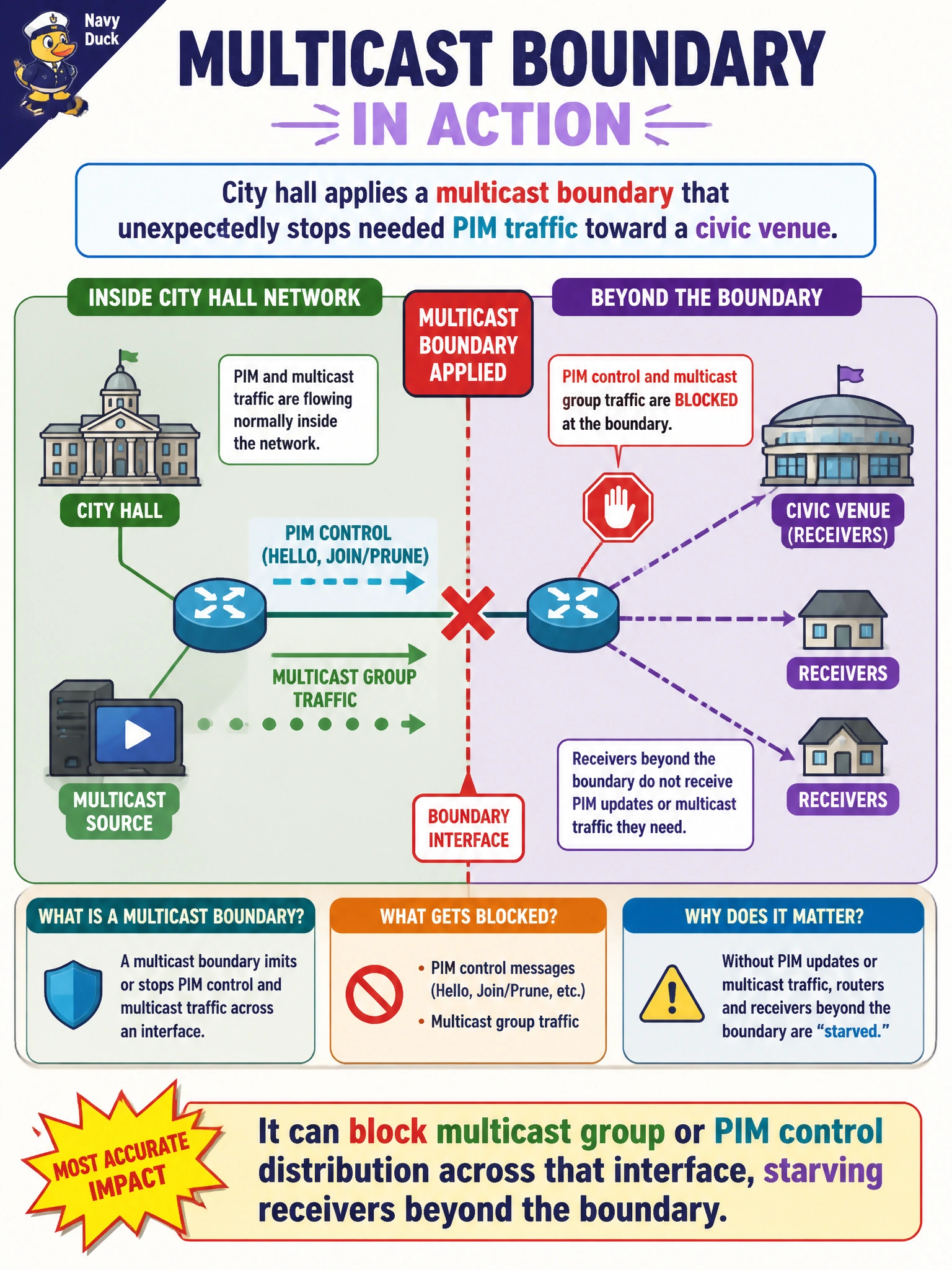
A multicast boundary is a locked fire door between buildings. Great when you want the concert stream to stay in the arena—bad when you accidentally locked the door the venue cameras still need. PIM and groups stop at that line.
Full Explanation
City hall applying a multicast boundary that unexpectedly stops needed PIM traffic toward a civic venue illustrates the real impact of that control. A multicast boundary can block multicast group or PIM control distribution across that interface, starving receivers beyond the boundary of the groups or signaling they need. In a municipal design, boundaries are intentional filters—useful for containing unwanted groups, dangerous when they accidentally filter the venue’s required ranges or PIM messages toward the RP/source path.
Forcing all unicast OSPF routes to become Type-1 external before venue admission fails because a multicast boundary is not an OSPF LSA-type conversion tool. Converting HSRP into VRRP automatically on the venue distribution pair fails because multicast boundaries do not transmute FHRP protocols. Enabling ERSPAN encapsulation so mirrored frames bypass the PIM RP fails because SPAN/ERSPAN mirroring is unrelated to multicast boundary filtering of PIM/group traffic.
Exam caveat: treat multicast boundaries as scope/filter controls on groups and related multicast control plane behavior—not as unicast routing or FHRP changers. When a venue suddenly loses multicast after a boundary change, inspect the filtered group ranges and PIM messaging before chasing unrelated OSPF or HSRP theories.
Operational check: review the boundary ACL/group list on the affected interface, compare permitted ranges to the civic venue’s required groups, use mroute/PIM neighbor checks beyond the boundary, and temporarily relax or correct the filter while validating receiver joins recover.