
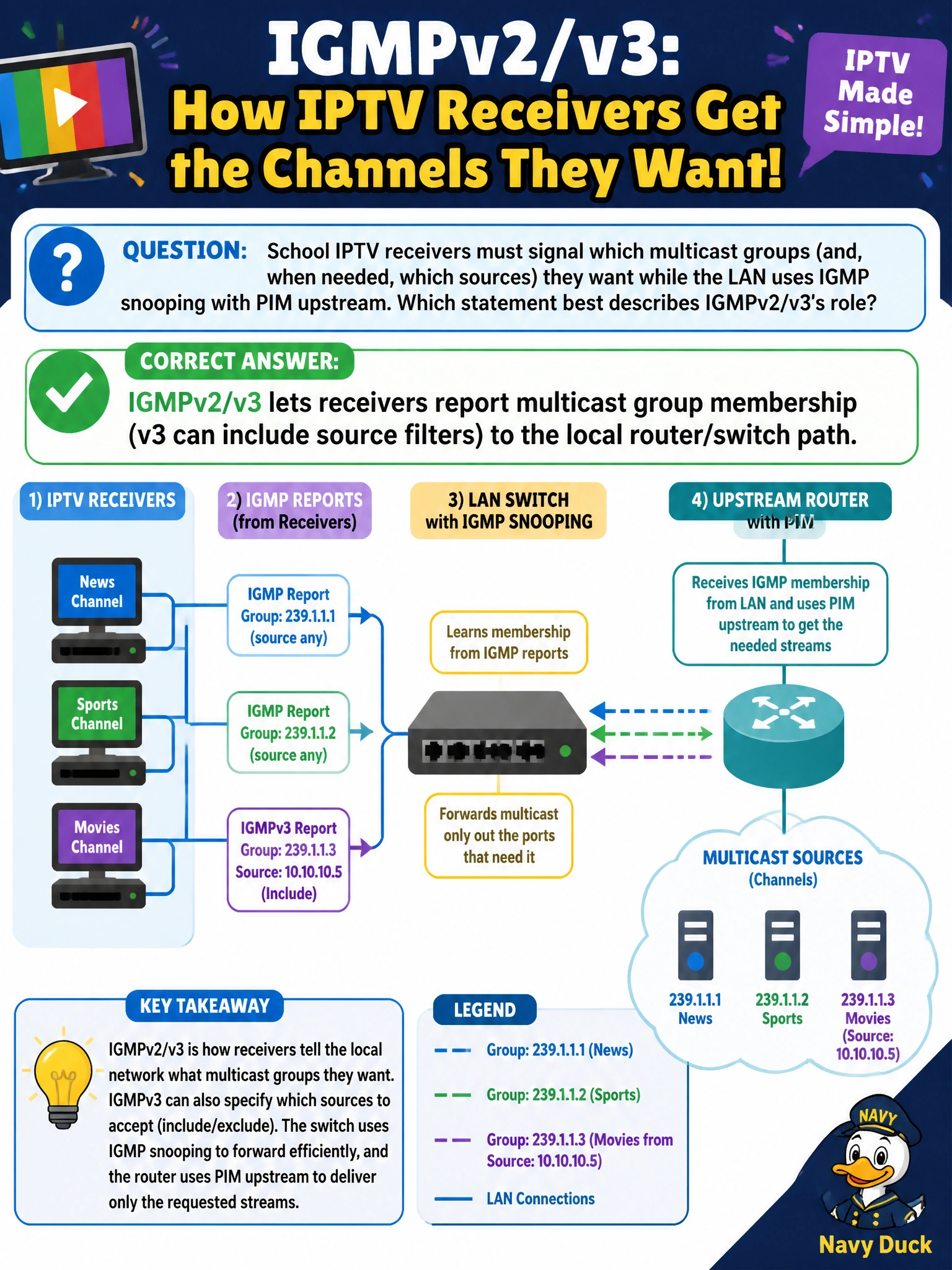
School IPTV receivers must signal which multicast groups (and, when needed, which sources) they want while the LAN uses IGMP snooping with PIM upstream. Which statement best describes IGMPv2/v3’s role?
Select an answer to reveal the explanation.
Short Explanation
IGMP is the classroom hand-raise: “Teacher, I want channel 5—and maybe only from that one studio.” PIM is the hallway routing that actually carries the show. Without the hand-raise, the switch and router don’t know who subscribed.
Full Explanation
School IPTV receivers must signal which multicast groups—and, when needed, which sources—they want while the LAN uses IGMP snooping with PIM upstream. IGMPv2/v3’s role is to let receivers report multicast group membership to the local router/switch path; IGMPv3 can include source include/exclude filters so classrooms pull only the intended studio feeds. IGMP snooping switches then constrain flooding based on those reports, while PIM still builds the routed multicast trees beyond the local segment. That division of labor is how a school district keeps channel joins efficient without turning every VLAN into a multicast flood domain.
Claiming IGMP replaces PIM entirely fails because IGMP is receiver membership signaling, not inter-router multicast tree construction; routers still need PIM (or equivalent) for shared and source trees. Saying IGMPv2/v3 only authenticates wireless clients before unicast DNS fails because IGMP is not a wireless AAA or DNS gatekeeper. NTP stratum negotiation using IGMP payloads fails because time synchronization is NTP’s job; IGMP does not carry stratum negotiation for IPTV head-ends.
Exam caveat: map IGMP to host-to-router membership and PIM to router-to-router multicast routing. IGMPv2 equals group membership; IGMPv3 equals groups plus optional source filters—do not invent authentication or timing roles for IGMP on the exam. Snooping is a switch optimization that listens to IGMP; it does not replace PIM upstream.
Operational check: verify receivers send joins with show ip igmp groups and snooping membership tables, confirm the querier and PIM upstream are present, and validate that only subscribed classroom ports see the IPTV group while non-subscribers stay quiet.