
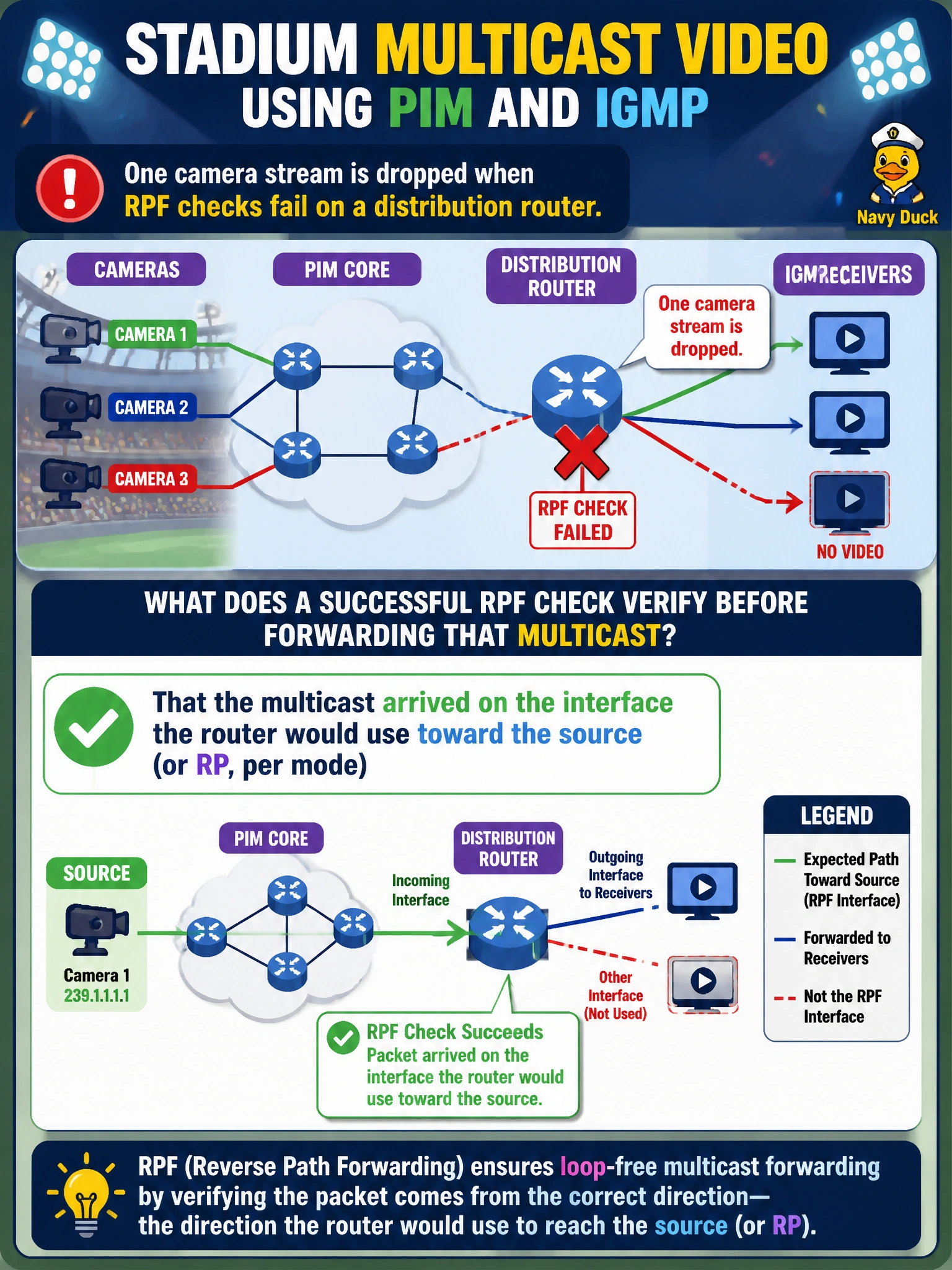
Stadium multicast video uses PIM and IGMP, but one camera stream is dropped when RPF checks fail on a distribution router. What does a successful RPF check verify before forwarding that multicast?
Select an answer to reveal the explanation.
Short Explanation
Multicast is picky about the door it came in. RPF is the bouncer asking, “Would I reach that camera source out this same interface?” If the answer is no, the frame gets tossed—keeps loops and wrong-path floods from ruining game-day video.
Full Explanation
Stadium multicast video using PIM and IGMP can drop a camera stream when RPF checks fail on a distribution router. A successful Reverse Path Forwarding (RPF) check verifies that the multicast packet arrived on the interface the router would use toward the source (or toward the RP, depending on PIM mode and tree state) before the router forwards that multicast further. In practice, the distribution router looks up the source or RP in its unicast routing / PIM context and accepts the packet only if the incoming interface matches that reverse path. That check is what keeps stadium camera groups from looping or entering on the wrong uplink during game-day multicast distribution.
Claiming IGMP snooping has disabled every unused access port fails the concept—RPF is a multicast forwarding sanity check on routers/PIM paths, not a blanket access-port disablement rule from IGMP snooping. Rewriting the destination group address to a unicast stadium VIP fails because RPF does not convert multicast groups into unicast VIPs as its acceptance criterion. HSRP preempt forcing standby active before joining the group fails because first-hop gateway preempt is unrelated to whether a multicast packet passes RPF on a distribution router.
Exam caveat: RPF failure is a classic reason multicast “almost works” until asymmetric routing or a bad unicast route toward the source/RP appears. Do not blame IGMP snooping or HSRP first when the symptom is RPF drop on a Layer-3 multicast hop. Also distinguish sparse-mode shared-tree RPF toward the RP from source-tree RPF toward the source after SPT switchover.
Operational check: on the dropping router, use show ip mroute and show ip rpf <source> (platform equivalents) for the camera source, compare the RPF interface to the actual incoming interface of the stream, and correct unicast routing or PIM neighbors so the reverse path matches the arrival interface.