
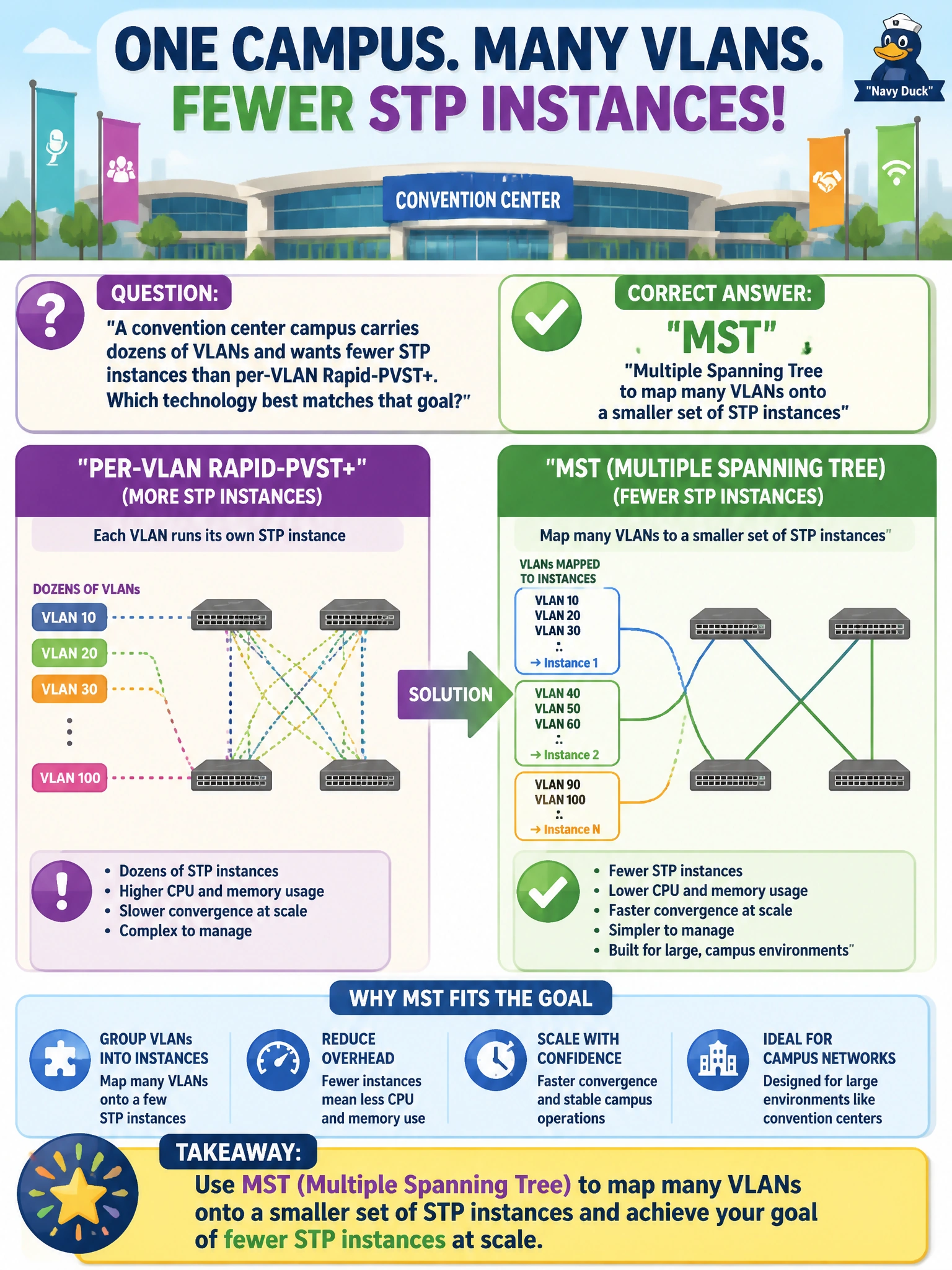
A convention center campus carries dozens of VLANs and wants fewer STP instances than per-VLAN Rapid-PVST+. Which technology best matches that goal?
Select an answer to reveal the explanation.
Short Explanation
Per-VLAN STP is like hiring a separate traffic cop for every hallway. MST lets you group hallways under a few cops—same safety, less overhead when you have a forest of VLANs.
Full Explanation
Multiple Spanning Tree (MST) maps many VLANs onto a smaller set of STP instances. On a convention center campus with dozens of VLANs, per-VLAN Rapid-PVST+ creates one spanning-tree instance per VLAN, which increases CPU and control-plane overhead. MST lets designers group VLANs into a few instances that share topology calculations, preserving loop-free Layer-2 behavior while reducing instance sprawl—the exact goal stated in the stem.
Disabling spanning tree and relying only on EtherChannel is unsafe: EtherChannel collapses some parallel links into one logical link but does not replace campus-wide loop prevention everywhere redundant L2 paths exist. Configuring every VLAN as the native VLAN on all trunks is invalid and destructive; a trunk has one native VLAN, and stuffing every VLAN into native breaks 802.1Q semantics. Running a separate OSPF process per VLAN instead of Layer-2 redundancy abandons the L2 design problem; OSPF does not substitute for MST’s VLAN-to-instance mapping inside switched VLANs.
Exam caveat: MST only works as intended when region name, revision, and VLAN-to-instance maps match across the region. A partial rollout that drifts the map can place switches in different regions and produce unexpected CIST behavior. MST does not remove the need for edge protections such as BPDU Guard on host ports.
Operational check: define the convention-center VLAN-to-instance map, push identical region name/revision/map to all MST switches, verify show spanning-tree mst configuration consistency, and confirm voice/data/event VLANs follow the designed instances before cutting over from Rapid-PVST+.