
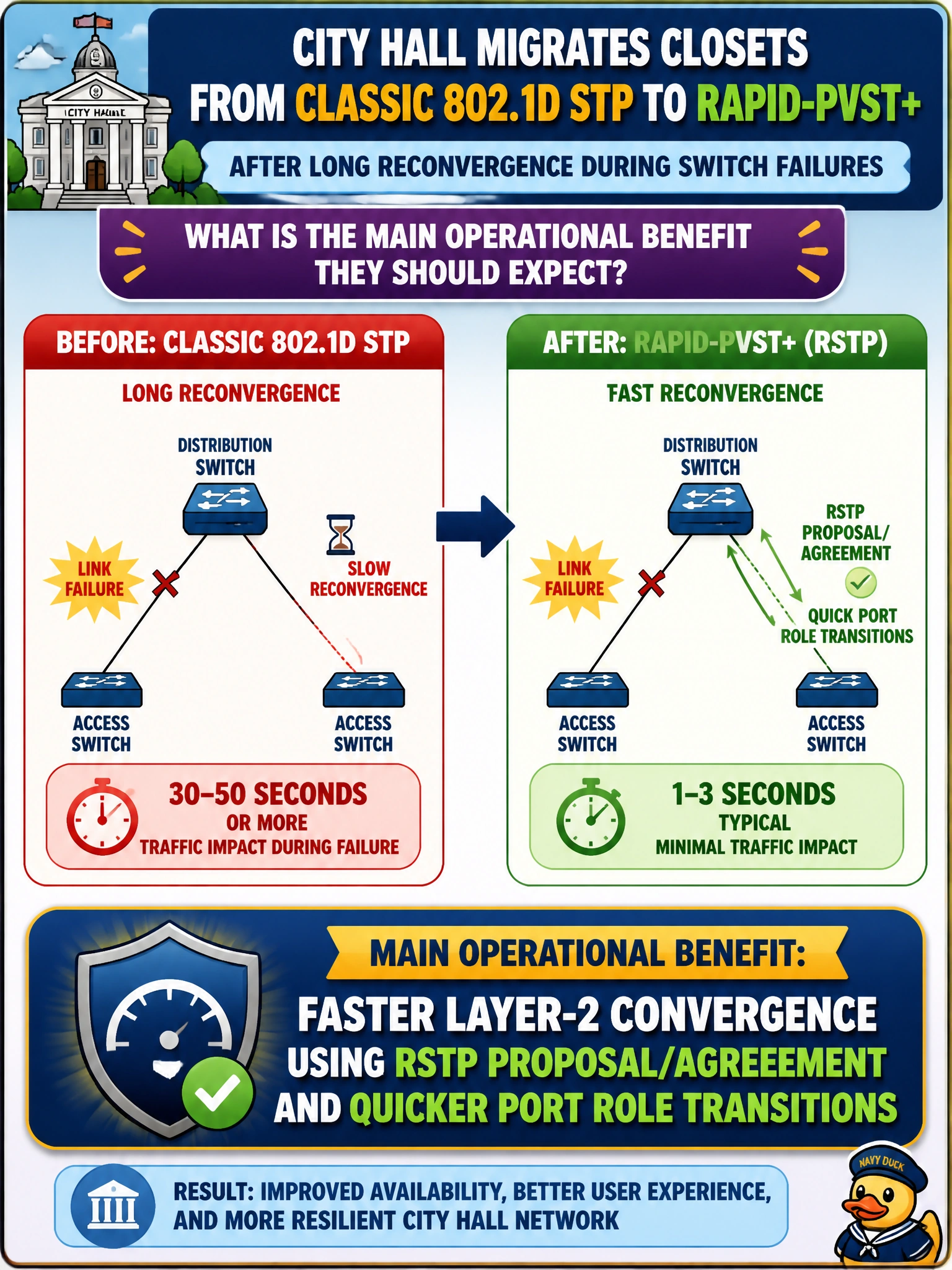
City Hall migrates closets from classic 802.1D STP to Rapid-PVST+ after long reconvergence during switch failures. What is the main operational benefit they should expect?
Select an answer to reveal the explanation.
Short Explanation
Classic STP felt like waiting for the elevator through every floor. Rapid STP shortcuts the handshake so the campus gets back to forwarding a lot faster after a closet hiccup.
Full Explanation
Migrating City Hall closets from classic 802.1D STP to Rapid-PVST+ primarily buys faster Layer-2 convergence. RSTP uses proposal/agreement handshakes on point-to-point links and supports rapid transitions for edge ports, so after a switch or link failure the campus returns to a stable forwarding topology much sooner than 802.1D’s longer listening/learning timers. Municipal services that were stalled by multi-tens-of-seconds reconvergence see shorter outage windows while still retaining loop-free blocking of redundant paths.
Elimination of all blocked ports so every redundant link forwards forever is incorrect: Rapid STP still blocks alternate paths; otherwise Layer-2 loops would form. Replacing VLANs with VRF-lite as the only loop-prevention method confuses Layer-2 STP with Layer-3 virtual routing; VRF-lite does not replace spanning tree inside a VLAN. Automatic conversion of all access ports into LACP Port-Channels is unrelated to the STP mode migration—EtherChannel is a separate aggregation feature.
Exam caveat: Rapid-PVST+ still runs an instance per VLAN, which can be heavy at large scale; MST may be preferred when instance count hurts. Also, benefits assume correct edge/PortFast on hosts and accurate point-to-point link recognition; misclassified shared segments reduce rapid behavior.
Operational check: after enabling Rapid-PVST+, verify spanning-tree mode, confirm root placement unchanged, fail a closet uplink in a maintenance window, measure reconvergence for a City Hall VLAN, and compare against the prior 802.1D baseline while ensuring alternate ports still discard when redundant.