
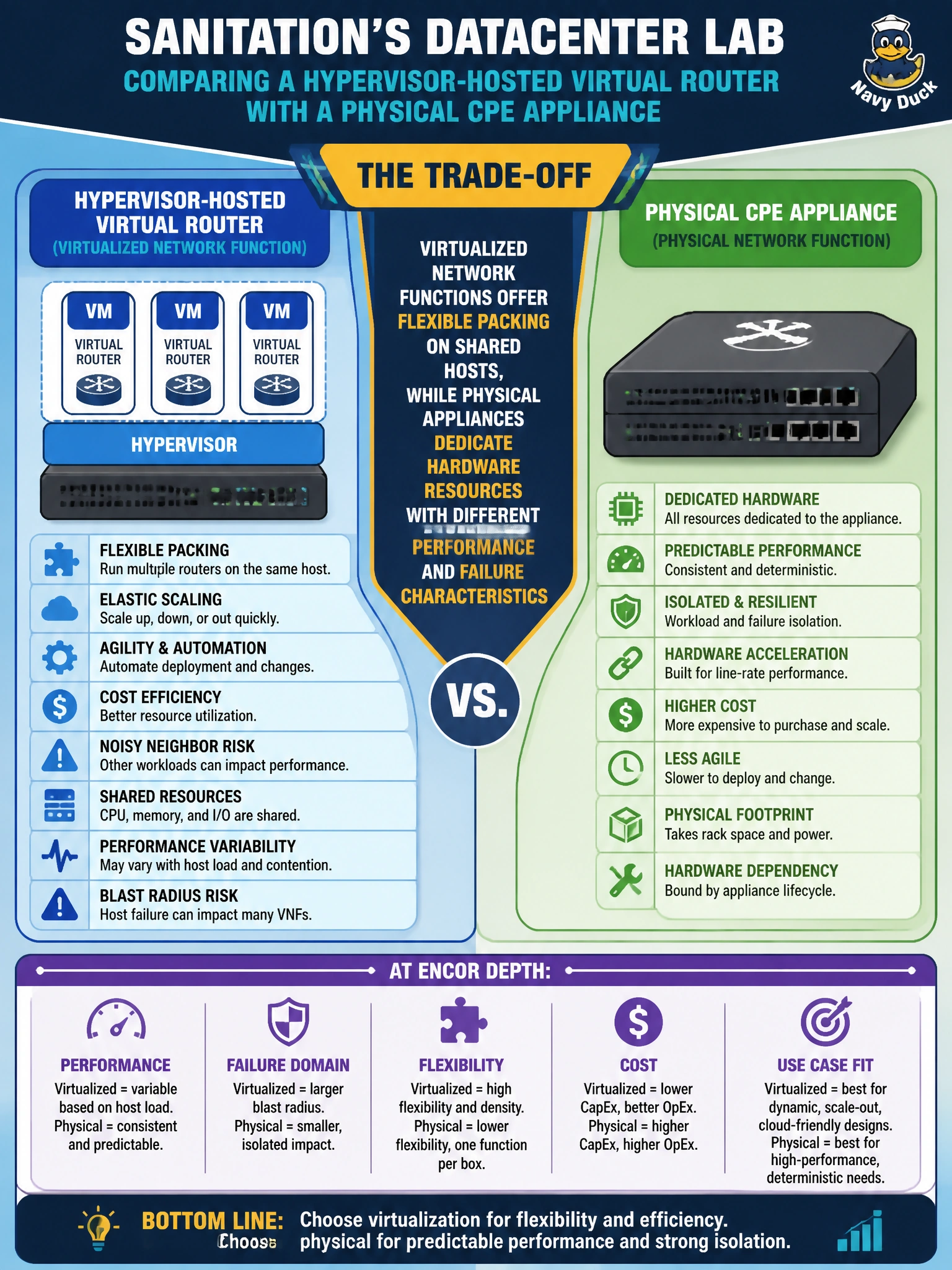
Sanitation's datacenter lab is comparing a hypervisor-hosted virtual router with a physical CPE appliance. What trade-off best reflects device virtualization at ENCOR depth?
Select an answer to reveal the explanation.
Short Explanation
A virtual router is like a food-truck kitchen sharing the parking lot—flexible and quick to roll out, but you share power and space with neighbors. A physical CPE is a brick-and-mortar kitchen with its own utilities. Labs love the food truck; production still weighs the trade-offs.
Full Explanation
Device virtualization trade-offs matter when sanitation labs compare a hypervisor-hosted virtual router with a physical CPE appliance. Virtualized network functions pack flexibly onto shared hosts, which helps labs and agile deployments, but they share CPU, memory, storage, and scheduling with neighbors and therefore exhibit different performance and failure characteristics than dedicated boxes. Physical appliances dedicate hardware resources with their own performance and failure profile. ENCOR depth is the balanced trade-off statement, not a claim that one side always wins on every metric.
Asserting virtual routers always outperform purpose-built hardware and never share host resources denies the shared-host reality of hypervisor packing and oversells virtualization. Saying physical CPE cannot forward IP so labs must virtualize every function is false—physical CPE forwards IP routinely and remains a valid lab or production choice. Claiming hypervisor-hosted routers eliminate the need for any underlay switching or routing ignores that virtual routers still depend on host networking and campus or datacenter underlays to move packets.
Exam caveat: prefer the trade-off language—flexibility on shared hosts versus dedicated appliance characteristics—over absolute performance claims or 'no underlay needed' fantasies.
Operational check: size host resources for the virtual router lab, measure forwarding under load against a physical CPE baseline where relevant, document shared versus dedicated failure domains, and decide promotion beyond the lab only after sanitation operators accept the performance and blast-radius differences.