
A library stack switch ages out CAM entries and unknown unicasts begin flooding, which staff mistakenly blame on the Layer 3 FIB. What distinction should they apply?
Select an answer to reveal the explanation.
Short Explanation
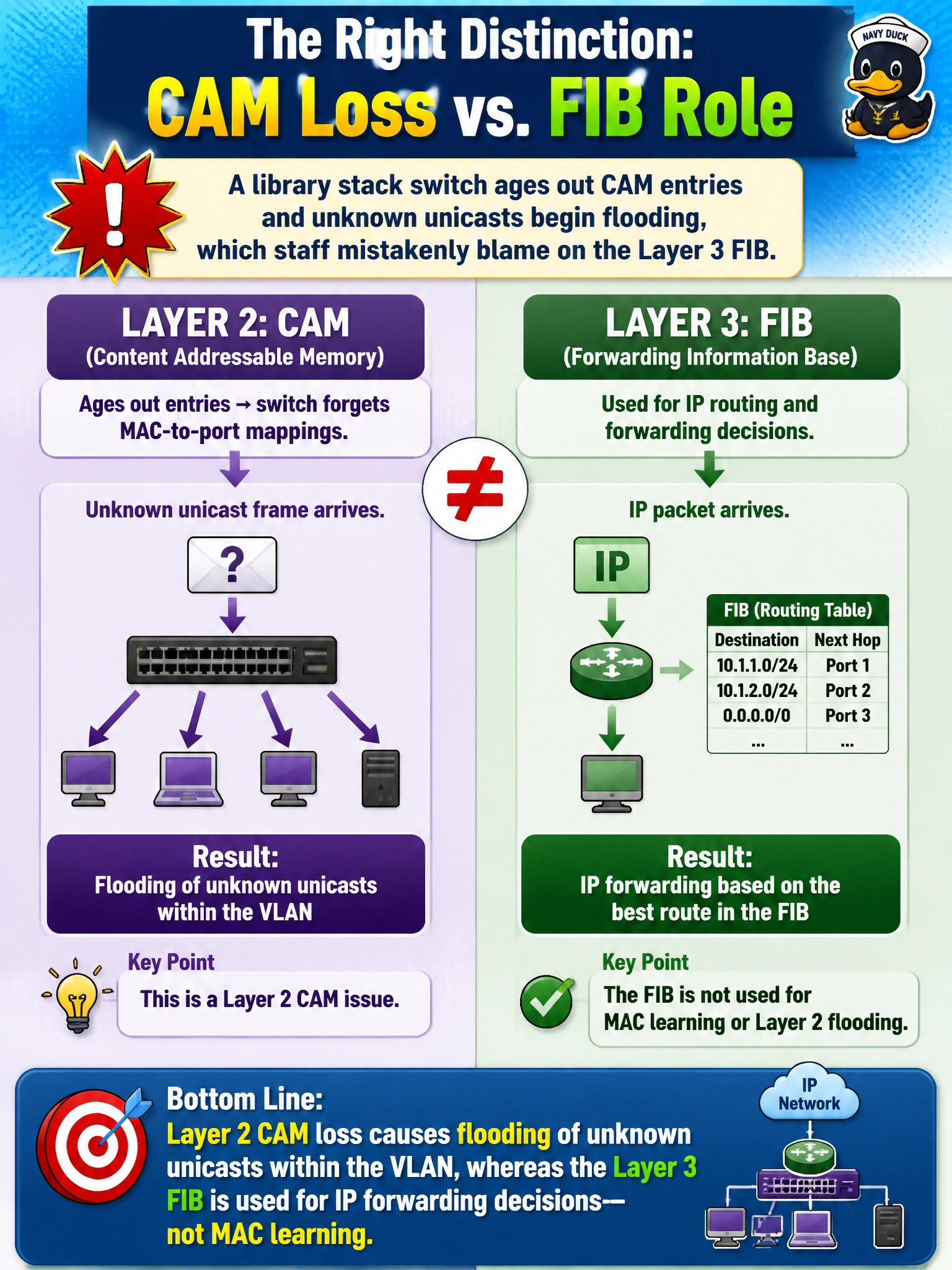
When the switch forgets a MAC, it yells 'anyone know this address?' and floods the VLAN—that is CAM behavior. The FIB is a different book used for IP next-hop forwarding. Blaming the FIB for MAC floods is mixing up the Layer 2 guestbook with the Layer 3 map.
Full Explanation
Layer 2 CAM and Layer 3 FIB answer different questions. When a library stack switch ages out CAM entries, it may flood unknown unicasts within the VLAN while it relearns MACs. That flooding is a Layer 2 learning symptom. The Layer 3 FIB is used for IP forwarding decisions and is not the MAC learning table staff should blame for CAM-aging floods. Separating those planes prevents mis-troubleshooting FIB routes when the real issue is MAC aging and unknown-unicast behavior inside a VLAN.
Saying CAM aging only affects OSPF areas while FIB aging only affects SSIDs assigns both tables to the wrong problem domains. Claiming the FIB stores MAC addresses exclusively while CAM stores only /32 host routes reverses and garbles their roles. Treating CAM and FIB as alternate names for the same adjacency table on all platforms collapses three distinct structures into one incorrect synonym.
Exam caveat: unknown-unicast flooding after MAC age-out points to CAM/L2 learning, not FIB/IP route lookup.
Operational check: correlate flooding with CAM age timers and MAC table misses on the stack switch, verify the VLAN's unknown-unicast behavior, and only inspect the FIB if IP forwarding to routed prefixes is independently failing.